The Complete Guide to Spring AI: A Full Learning Path for Java Engineers Building AI Applications
The Complete Guide to Spring AI: A Ful…
Spring AI stable release enables Java developers to efficiently build enterprise-grade AI applications.
With the stable release of the Spring AI framework, Java developers now have a low-barrier path to AI application development. This article introduces a comprehensive course covering LLM integration, prompt engineering, conversation management, Tools/MCP, RAG, and five AI Agent patterns. Three hands-on projects — a multi-model switching system, an intelligent customer service assistant, and an enterprise-grade knowledge base — run throughout the curriculum, with solutions for enterprise pain points including multi-layer memory architecture, Tools selection optimization, MCP authorization, and RAG retrieval accuracy.
Why Java Engineers Need to Embrace AI Development
Spring AI has released its stable version, which means Java developers can finally build AI applications using a familiar tech stack. Spring AI is the official framework in the Spring ecosystem for AI application development, led by the VMware/Broadcom team. It draws inspiration from LangChain in the Python ecosystem but deeply integrates Spring Boot's core mechanisms like dependency injection and auto-configuration, allowing Java developers to build AI applications without learning an entirely new paradigm. The stable release means the API is no longer subject to frequent breaking changes, giving enterprises the confidence to use it in production environments. With the rising performance and falling costs of open-source large language models, the barrier to local AI deployment has dropped significantly — a new technology wave is forming.
From an industry perspective, AI application development is becoming the most certain growth area in the IT industry. Whether it's rebuilding traditional applications with AI or injecting AI capabilities into existing systems, there's a massive demand for developers with AI engineering skills. For Java programmers, Spring AI offers a low-barrier, high-efficiency path to this transition.
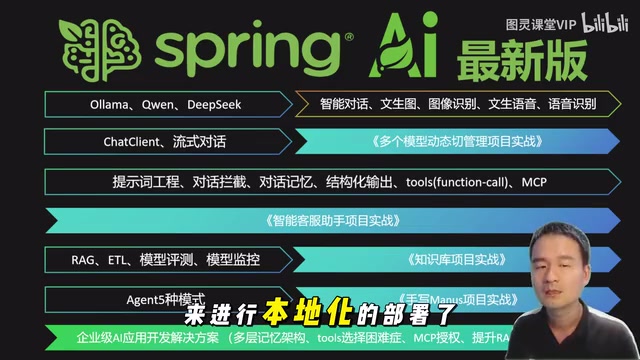
Course Structure: From Beginner to Enterprise-Level Practice
This Spring AI course series, crafted by instructor Xu Shu over nearly two months, follows a three-tier progressive structure of "theory + hands-on projects + deep-dive principles," covering the complete AI application development pipeline.
LLM Integration and Intelligent Scenarios
The course starts with model selection and systematically covers different approaches to integrating large language models:
- Local LLMs: Ideal for data-sensitive scenarios, supporting private deployment
- Cloud-based LLMs: API integration with mainstream models including Qwen, DeepSeek, and more
- Intelligent scenario coverage: Multi-modal capabilities including text-to-image, image recognition, text-to-speech, and speech recognition
- Streaming conversations: Real-time streaming responses using Chat Client
The rise of local LLMs is driven by the maturity of local inference frameworks like Ollama, along with the technical breakthrough of open-source models such as Llama, Qwen, and Mistral achieving usable inference performance on consumer-grade GPUs. For industries with strict data compliance requirements — such as finance, healthcare, and government — local deployment has become the preferred path for AI adoption.
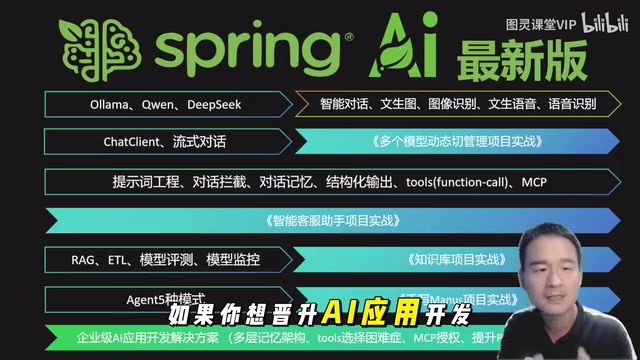
Deep Dive into Core Technical Modules
After mastering the basics of model integration, the course dives deep into Spring AI's core technology stack:
Prompt Engineering: This is the critical factor that determines the output quality of AI applications. Prompt engineering isn't simply about "writing questions" — it's a systematic methodology covering role setting (System Prompt), few-shot examples, Chain-of-Thought guidance, output format constraints, and more. Research shows that the same model can produce output quality that varies by orders of magnitude depending on prompt design. Well-crafted prompts lead to more precise, business-aligned outputs, and the course systematically covers prompt design methodologies and common patterns.
Conversation Management: This includes conversation interception and memory mechanisms — the foundation for building stateful AI applications. Large language models are inherently stateless: each API call is independent, and the model doesn't naturally "remember" what was said before. Conversation memory mechanisms simulate "memory" by concatenating historical messages into the context window, but this consumes significant tokens. This requires carefully designed memory management strategies such as sliding windows and summary compression. Without proper context management, every conversation round starts from a "blank slate."
Structured Output: Getting LLMs to return structured JSON data instead of free-form text is crucial for seamlessly integrating AI capabilities into business systems. Spring AI uses components like BeanOutputConverter, combined with the model's Function Calling capability or prompt constraints, to directly map model outputs to Java POJO objects — dramatically reducing the integration cost between AI and business systems.
Tools and MCP: The Tools mechanism enables LLMs to call external tools and APIs. MCP (Model Context Protocol) is a standardized protocol proposed and open-sourced by Anthropic in late 2024, designed to solve the fragmentation problem of integrating AI models with external tools and data sources. Similar to how USB unified hardware connection standards, MCP aims to establish a universal "tool slot" specification for the AI application ecosystem. It has already gained support from major vendors including OpenAI and Google, and is becoming the de facto standard for AI tool invocation. Together, Tools and MCP dramatically expand the capability boundaries of AI applications.
Three Hands-On Projects Throughout the Course
The course features three progressively challenging projects to ensure students are ready for enterprise-level development upon completion.
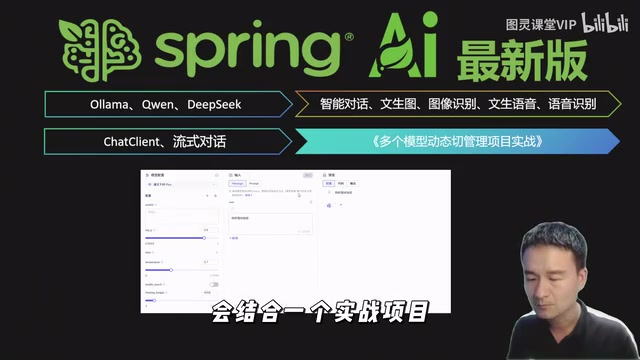
Project 1: Multi-Model Dynamic Switching Management System
In real business scenarios, enterprises often need to integrate multiple LLMs simultaneously — using different models for different scenarios to balance cost and performance. For example, simple FAQ responses can use cost-effective smaller models, while complex code generation or long document analysis calls for more powerful flagship models. This "model routing" strategy reduces inference costs while maintaining output quality for critical scenarios. This project teaches you how to build a flexible model management layer with runtime dynamic switching — a quintessential example of Spring AI engineering practice.
Project 2: Intelligent Customer Service Assistant
Intelligent customer service is one of the most typical and widely deployed AI application scenarios today. Unlike traditional chatbots based on rules or intent recognition, LLM-powered intelligent customer service can understand complex semantics, handle multi-turn follow-up questions, dynamically retrieve answers from knowledge bases, and invoke backend services like order systems and CRMs through Tools to complete actual business operations. This project combines prompt engineering, conversation memory, and Tools invocation — making it the ultimate test of your Spring AI learning outcomes.
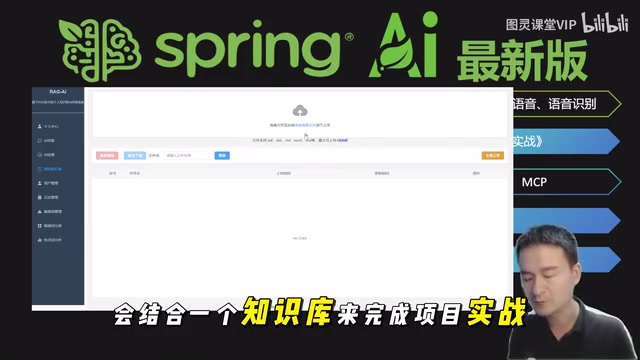
Project 3: Enterprise-Grade RAG Knowledge Base System
RAG (Retrieval-Augmented Generation) is the core architectural pattern for solving LLM "hallucination" and knowledge freshness issues. The basic principle works as follows: private documents are chunked and converted into high-dimensional vectors via an Embedding model, then stored in a vector database (such as Milvus, Chroma, or PGVector). When a user asks a question, the query is similarly vectorized, and document chunks with the highest cosine similarity are retrieved. These chunks are then injected into the prompt as context, guiding the model to answer based on real source material rather than generating content from thin air. The course covers everything from RAG fundamentals to ETL data processing, vector retrieval, model evaluation and monitoring, ultimately building a complete enterprise-grade knowledge base system.
AI Agent: Understanding Five Intelligent Agent Patterns in Depth
The advanced section of the course focuses on AI Agents — one of the hottest directions in the AI field today. The core idea behind AI Agents is enabling models to not only "answer questions" but also "autonomously plan and execute multi-step tasks." The widely recognized Agent architecture patterns include: ReAct (alternating reasoning and action cycles, where the model thinks and calls tools simultaneously), Plan-and-Execute (planning the overall task decomposition first, then executing step by step), Multi-Agent (multiple specialized agents collaborating and dividing work), Reflexion (iteratively optimizing output through self-reflection and error correction), and the basic Tool-Use pattern. Different patterns involve trade-offs in task complexity, execution efficiency, and reliability — understanding these differences is a prerequisite for building reliable Agent systems. The course systematically covers all five agent patterns, helping developers build a structured understanding of Agents rather than staying at the conceptual level.
After learning the five patterns, the course also guides students through building a ManagedAgent project from scratch, providing a ground-up understanding of how agents work. This "know the why, not just the what" approach is especially valuable for handling complex scenarios in real-world development.
Enterprise-Level Problem Solutions
Real enterprise AI application development goes far beyond simple API calls. The final section of the course specifically addresses common pain points in production environments:
- Multi-layer memory architecture: Solves context management challenges in long conversation scenarios, preventing token waste and information loss. A typical multi-layer memory design includes three tiers: short-term memory (complete conversation within the current session window), long-term memory (cross-session persistent user preferences and key information stored in databases), and summary memory (compressed summaries of historical conversations to save token consumption).
- Tools selection overload: When a large number of Tools are registered, how do you ensure the model accurately selects the right one? This problem becomes particularly acute when the tool count exceeds 20. Solutions include optimizing tool descriptions, dynamic tool filtering (pre-filtering candidate tool sets based on user intent), and tool group routing strategies.
- MCP authorization mechanisms: In enterprise environments, MCP security authorization is a critical concern. Tools exposed by MCP servers may involve sensitive data read/write operations, requiring fine-grained permission control and operation auditing through standard authorization protocols like OAuth 2.0.
- RAG retrieval accuracy improvement: The core competitive advantage of a knowledge base lies in retrieval accuracy. The course shares multiple optimization strategies, including document chunking strategy optimization, hybrid retrieval (combining vector search with keyword-based BM25 retrieval), introducing Reranker models, and advanced techniques like query rewriting.
Summary and Learning Recommendations
The stable release of Spring AI marks Java's official entry into the AI application development arena. For developers with a Java background, this is a rare window of opportunity — demand for AI application development is exploding, while talent with production-grade engineering capabilities remains scarce.
The value of this course lies in the fact that it's not just a simple API tutorial — it's a complete closed loop from technology selection, development, and hands-on practice to solving production-level problems. Learners are advised to follow the course's designed progression, with special focus on hands-on practice with the projects, because the core competency of AI application development is ultimately forged through real project experience.
Key Takeaways
- Spring AI stable version has been released, enabling Java developers to build AI applications with their familiar tech stack — the highest-certainty growth direction in the IT industry
- The course covers the complete technology stack: LLM integration, prompt engineering, conversation management, Tools/MCP, RAG, and five AI Agent patterns
- Three hands-on projects (multi-model switching system, intelligent customer service assistant, enterprise-grade knowledge base) run throughout the course, ensuring practical readiness upon completion
- Enterprise-level pain point solutions are provided: multi-layer memory architecture, Tools selection optimization, MCP authorization, and RAG retrieval accuracy improvement
- Systematic coverage of five AI Agent patterns plus a hands-on project helps developers understand agent runtime mechanisms from the ground up
Related articles
 Tutorials
Cursor + Codex Dual-IDE Collaboration: A Practical Methodology for Open-Source Project Customization
A complete methodology for open-source project customization based on real-world experience, detailing the Cursor+Codex dual-IDE workflow, seven-stage process, MVP validation, and AI source code reading techniques.
 Tutorials
Cursor Multi-Agent in Practice: Building a Full-Stack Next.js Blog in 50 Minutes
Build a full-stack blog in 50 minutes using Cursor IDE's multi-Agent mode with Next.js, Clerk auth, and Supabase. Learn the 4-phase AI Agent workflow and key integration pitfalls.
 Tutorials
Building an AI Software Factory from Scratch: A Cursor Engineer's Hands-On Experience with Multi-Agent Collaboration
Cursor engineer Eric shares practical insights on building an AI software factory: automation levels, guardrail design, parallel Agent management, and scaling to 1000+ Agents for 24/7 development.