Universal AI Prompts for Mathematical Modeling: A Zero-to-Hero Four-Stage Practical Guide
Universal AI Prompts for Mathematical …
A four-stage AI prompt system enables beginners to complete the full mathematical modeling workflow
This article presents a four-stage mathematical modeling prompt system covering problem analysis, innovative model construction, data acquisition and preprocessing, and model solving, capable of handling over 90% of competition problem types. The system enhances paper innovation by prescribing three innovation directions: algorithm improvement, cross-disciplinary fusion, and multi-model fusion. No local programming environment is required — beginners can complete the entire closed loop from analysis to visualization using AI tools like Doubao or DeepSeek.
Introduction
Mathematical modeling competitions (such as CUMCM and MCM/ICM) have long been major events for STEM students, requiring participants to complete the entire process from problem analysis to paper writing within 72 to 96 hours, covering various problem types including optimization, prediction, evaluation, and simulation. The traditional approach requires contestants to have a solid foundation in calculus, linear algebra, and probability & statistics, while also being proficient in programming tools like MATLAB, Python, or R — an extremely high barrier to entry. For students with weak programming skills or insufficient modeling experience, the full workflow from problem analysis to final solution can seem overwhelming.
With the maturation of AI tools, Prompt Engineering — the core skill for interacting with large language models — can guide AI to produce output that meets specific format, logic, and depth requirements through carefully designed instruction structures. It essentially transforms domain experts' tacit knowledge into reusable instruction templates. A well-designed prompt system can now cover over 90% of mathematical modeling problem types, achieving a complete closed loop from problem analysis, model construction, and code solving to result visualization.
This article breaks down a "Four-Stage Universal Mathematical Modeling Prompt" methodology, helping students with zero programming or modeling experience efficiently complete the entire mathematical modeling workflow with AI assistance.
Overview of the Four-Stage Prompt System
This prompt system divides the complete mathematical modeling workflow into four stages, each corresponding to a set of structured prompts that are sent to the AI sequentially to progressively advance the solution.
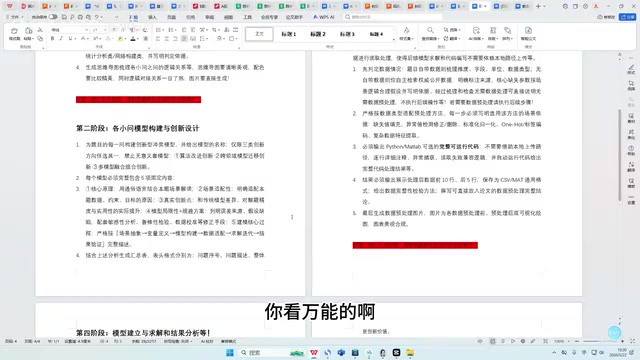
Stage 1: In-Depth Problem Analysis
The core task of Stage 1 is to understand the problem. The prompts guide the AI to complete the following:
- Problem decomposition: Break the competition problem into multiple sub-problems, clarifying the direct and implicit objectives of each
- Background knowledge annotation: Identify the domain knowledge, key parameters, and constraints involved
- Logical relationship mapping: Outline the logical progression between sub-problems and generate a mind map
The value of this step lies in the fact that many students lose points not because their models are poor, but because they deviate from the core requirements of the problem. Through AI's structured analysis, you can quickly identify the output requirements and key points of each sub-problem, avoiding misdirection.
Stage 2: Innovative Model Construction
Stage 2 is the highlight of the entire system — the AI doesn't provide basic models but instead constructs models along three prescribed innovation directions:
- Algorithm improvement innovation: Introducing adaptive parameters, hybrid strategies, and other improvements to classic algorithms such as genetic algorithms, particle swarm optimization, and simulated annealing, forming targeted optimization solutions
- Cross-disciplinary fusion: Drawing on methodologies from field theory in physics, population dynamics in biology, or game theory in economics, integrating approaches from different disciplines to address the current problem
- Multi-model fusion innovation: Referencing mature Ensemble methods from machine learning (such as Stacking, Bagging, and Boosting frameworks), combining multiple models to form new problem-solving frameworks that significantly improve model robustness
For each sub-problem, the AI provides the model name, principle explanation, applicable scenarios, innovation analysis, and comparative advantages over traditional models. It also generates a summary table clearly listing the corresponding model, solution approach, and model selection rationale for each sub-problem, accompanied by a modeling flowchart.
This design directly addresses the pain point of "insufficient model innovation" in mathematical modeling competitions. In competition scoring criteria, model innovation typically carries significant weight. When judges review papers, an innovative model with a clear name and theoretical basis often scores higher than simply applying textbook formulas. This prompt system guides the AI toward innovative thinking from the very beginning.
Stage 3: Fully Automated Data Acquisition and Preprocessing
Stage 3 handles data issues, covering two common scenarios:
- When data is provided in the problem: Automatically performs data cleaning, handling missing values (mean/median imputation, KNN interpolation, multiple imputation, etc.), outliers (IQR method, Z-score, or Isolation Forest detection), and inconsistent scales (Min-Max normalization or Z-score standardization)
- When no data is provided: Automatically searches for suitable data sources from authoritative public datasets such as the National Bureau of Statistics, World Bank Open Data, UCI Machine Learning Repository, and Kaggle, with clear source attribution
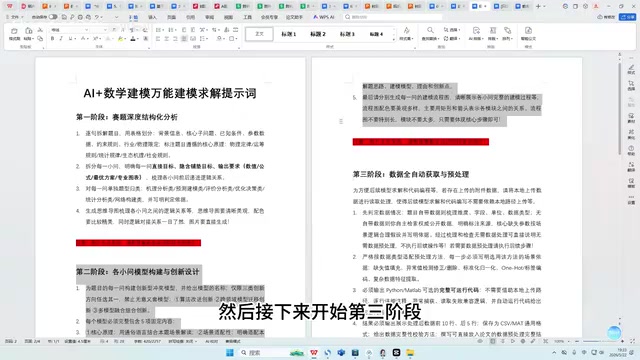
A key feature is that it does not rely on local data uploads or third-party tools. Many students get stuck on technical details like local path configuration and Python environment setup when using AI for modeling. This prompt system completely bypasses these obstacles. The AI directly generates complete, runnable data processing code (based on mainstream libraries like pandas and scikit-learn) and outputs before-and-after comparison charts.
If image generation fails (which occasionally happens with AI tools), simply copy the preset prompt "Image generation failed, please regenerate" and send it to the AI to obtain the result chart again.
Stage 4: Model Solving and Result Analysis
Stage 4 is the final solving phase, with each sub-problem's solution containing four modules:
Module 1: Model Establishment and Formula Derivation
- Variable definitions and assumption statements
- Detailed formula derivation process (step-by-step expansion)
- Modeling flowchart
Module 2: Model Solving
- Complete solution steps
- Runnable source code
- Competition-grade result charts (line charts, bar charts, heatmaps, etc., using a dopamine color scheme)
Module 3: Model Validation
Model validation is an often-overlooked but critically important component of mathematical modeling papers. In recent years, scoring rubrics for both CUMCM and MCM/ICM have explicitly required discussion of model limitations and applicability boundaries. A comprehensive validation system is a necessary condition for achieving high scores:
- Validity testing: Using cross-validation, holdout methods, or goodness-of-fit comparisons with historical data (R², RMSE, MAE)
- Sensitivity analysis: Systematically varying model parameters to observe the magnitude of output changes, assessing model robustness to parameter uncertainty, commonly using one-factor-at-a-time analysis, Morris screening, and Sobol global sensitivity analysis
- Comparative testing: Horizontally comparing the constructed model with baseline models to demonstrate the superiority of the innovative approach
Module 4: Result Analysis
- Data analysis based on problem requirements
- In-depth analysis and extensions
- Conclusions that directly answer the questions
During use, simply change the sub-problem number in the prompt to the current problem being solved (e.g., change "Problem 1" to "Problem 2") to progress through each one.
Practical Demonstration: Test Results Across Different Problem Types
In actual testing, this prompt system was validated on both a CUMCM C-type problem and an Electrical Engineering Cup B-type problem, covering different problem types including optimization, prediction, and evaluation.
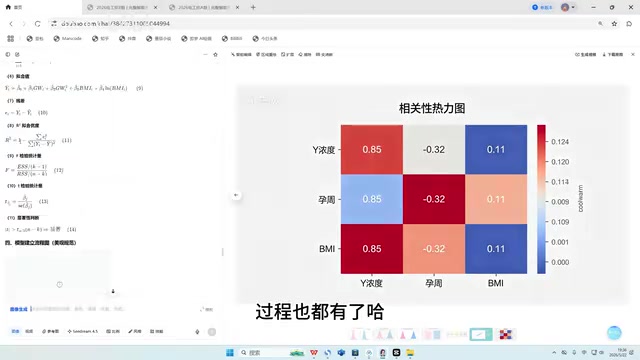
Taking the CUMCM C problem as an example, in Stage 2, the AI constructed a "BMR Luck Dual-Factor Weighted Nonlinear Correlation Model (W2RN2)" for the first sub-problem — the model name itself demonstrates strong innovation. The entire process generated complete formula derivations, runnable code, heatmaps, and correlation analysis charts with aesthetically pleasing color schemes that meet competition paper formatting requirements.
The Electrical Engineering Cup B problem test was equally smooth. The AI automatically constructed a multi-model fusion solution for the demand forecasting problem, with data preprocessing, visualization analysis, and model validation completed seamlessly.
Usage Recommendations and Notes
Recommended Tools
The entire process can be completed using domestic AI tools such as Doubao (based on the Skylark large model) or DeepSeek (based on MoE architecture). Both tools have achieved high standards in code generation and mathematical reasoning, capable of supporting the complete output chain from formula derivation to visualization code. No local MATLAB or Python environment or any third-party platform is needed, greatly lowering the barrier to entry.
Practical Tips
- Send prompts strictly by stage: Send the four stages' prompts sequentially; don't skip steps
- Don't panic when image generation fails: Simply ask the AI to regenerate
- Progress through sub-problems one at a time: In Stage 4, handle only one sub-problem at a time; change the number and continue after completion
- Color schemes are customizable: The default uses a dopamine color scheme, but you can specify other color schemes in the prompts
Limitations
Although this prompt system has broad coverage, please note:
- AI-generated code requires manual verification of logical correctness
- The theoretical rigor of innovative models needs to be vetted personally
- Competition paper writing and polishing still requires human intervention
- For extremely complex or cutting-edge problems, additional manual adjustments may be needed
Conclusion
This four-stage mathematical modeling prompt system essentially encodes expert mathematical modeling experience into structured AI instructions — this is precisely a comprehensive application of Chain-of-Thought (CoT) prompting and Role Prompting techniques in prompt engineering. By guiding the AI to reason step by step through stages while assigning it the role of a "mathematical modeling expert," the output better conforms to competition standards. Its core value lies not in replacing thinking, but in providing beginners with a complete problem-solving framework that enables AI to produce high-quality intermediate results at every stage. For experienced contestants, it can equally serve as a rapid prototyping tool that significantly improves modeling efficiency.
As AI tools become increasingly prevalent, mastering high-quality prompt engineering is becoming a new core competency in mathematical modeling competitions — its importance now rivals traditional programming skills and mathematical modeling theory knowledge.
Key Takeaways
- The four-stage prompt system covers problem analysis, model construction, data processing, and model solving, capable of handling over 90% of mathematical modeling problem types
- The model construction stage prescribes three innovation directions (algorithm improvement, cross-disciplinary fusion, multi-model fusion), directly boosting paper innovation scores
- No local programming environment or third-party tools are needed throughout; beginners can complete full modeling using AI tools like Doubao
- Stage 4 includes model validation (sensitivity analysis, comparative testing, etc.), meeting current competition requirements for rigorous model verification
- When image generation fails, preset prompts can be used to regenerate; output results use a dopamine color scheme achieving competition-grade visualization standards
Related articles
 Tutorials
Cursor + Codex Dual-IDE Collaboration: A Practical Methodology for Open-Source Project Customization
A complete methodology for open-source project customization based on real-world experience, detailing the Cursor+Codex dual-IDE workflow, seven-stage process, MVP validation, and AI source code reading techniques.
 Tutorials
Cursor Multi-Agent in Practice: Building a Full-Stack Next.js Blog in 50 Minutes
Build a full-stack blog in 50 minutes using Cursor IDE's multi-Agent mode with Next.js, Clerk auth, and Supabase. Learn the 4-phase AI Agent workflow and key integration pitfalls.
 Tutorials
Building an AI Software Factory from Scratch: A Cursor Engineer's Hands-On Experience with Multi-Agent Collaboration
Cursor engineer Eric shares practical insights on building an AI software factory: automation levels, guardrail design, parallel Agent management, and scaling to 1000+ Agents for 24/7 development.