v0 Snowflake Integration Enters Public Preview: Generate Data Dashboards with Natural Language
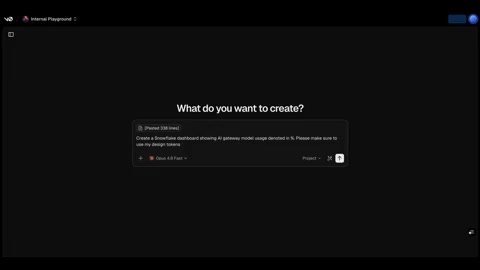
v0's Snowflake integration lets users generate data dashboards from natural language prompts.
Vercel's AI code generation tool v0 has launched a public preview of its Snowflake integration, allowing users to connect their Snowflake accounts and automatically generate professional data dashboards through natural language prompts. This integration bridges frontend UI generation with enterprise data platforms, compressing what traditionally required weeks of cross-team development into minutes of natural language conversation.
Overview
Vercel's AI code generation tool v0 recently announced that its integration with Snowflake has officially entered the Public Preview stage. Users simply need to prompt v0 in natural language to use Snowflake, connect their account, and automatically generate polished data dashboards. The launch of this feature marks a significant step for AI-assisted development tools—moving beyond code generation toward building complete data applications.



What Is the v0 and Snowflake Integration?
v0's Positioning and Core Capabilities
v0 is Vercel's AI-powered frontend code generation tool that allows users to describe requirements in natural language, after which v0 automatically generates usable UI components and complete pages. Vercel itself is one of the world's most influential frontend cloud platforms and the creator and maintainer of the open-source framework Next.js. v0 is deeply rooted in the React and Next.js ecosystem, with generated code defaulting to the shadcn/ui component library and Tailwind CSS styling—meaning the output is not only visually appealing but also follows modern frontend engineering best practices and can be directly integrated into production-grade projects.
In the AI code generation space, v0 has carved out a differentiated competitive position alongside GitHub Copilot, Cursor, Bolt.new, and similar tools. Unlike Copilot, which focuses on general-purpose code completion, v0 specializes in end-to-end generation from natural language to fully runnable UI applications. Its core advantage lies in deep understanding of frontend design patterns and high-quality visual output. Previously, v0 primarily focused on frontend interface generation, but this Snowflake integration extends its capabilities to the data layer, evolving it from a "UI generator" into a complete tool capable of building data-driven applications.
Snowflake's Role in the Integration
Snowflake is an industry-leading cloud data platform widely used in enterprise data warehousing, data lakes, and data analytics scenarios. Snowflake's widespread enterprise adoption stems from its pioneering Separation of Storage and Compute architecture—the storage layer and compute layer can scale independently, with multiple compute clusters accessing the same data simultaneously without interference. This architecture solves the resource contention and scaling bottlenecks inherent in traditional data warehouses (such as Teradata and Oracle Exadata), enabling enterprises to elastically allocate compute resources on demand while achieving cross-departmental data sharing.
As of now, Snowflake serves thousands of enterprise customers globally, managing exabyte-scale data assets. Through the integration with v0, the massive volumes of business data stored in Snowflake—whether sales records, user behavior logs, or financial data—can be directly accessed without manually writing complex SQL queries or frontend visualization code. This "data platform + AI frontend" combination effectively bridges the long-standing technical gap between data storage and data consumption.
How v0 Connects to Snowflake: The Workflow
The entire workflow is remarkably streamlined:
- Natural Language Prompt: Users specify Snowflake as the data source through a prompt in v0
- Account Connection: Authorize the connection to their Snowflake account
- Automatic Dashboard Generation: v0 automatically generates a complete dashboard with data visualizations based on user requirements
Behind this seemingly simple workflow lies the automation of multiple critical technical steps. During the account connection phase, the system likely employs the OAuth 2.0 authorization protocol—users don't need to expose their Snowflake credentials to v0, instead completing secure authorization through a token mechanism. Once the connection is established, v0's AI engine first reads the database schema in Snowflake (i.e., table structures, field names, data types, and other metadata) to understand how the data is organized and its business meaning.
Next, the AI uses Text-to-SQL technology to automatically generate appropriate SQL query statements based on the user's natural language description, extracting the required data from Snowflake. Finally, the AI intelligently selects suitable visualization chart types based on data characteristics—for example, line charts for time series data, bar charts for categorical comparisons, and pie charts for proportion analysis—and generates complete frontend rendering code. The entire process compresses work that traditionally requires collaboration between data engineers, frontend developers, and designers into a single natural language conversation.
This means that even without deep frontend development or data engineering backgrounds, business analysts and product managers can quickly build professional-grade data dashboard applications.
Industry Significance and Trend Analysis
AI Development Tools Evolving Toward End-to-End Application Building
The v0 and Snowflake integration reflects an important trend in AI development tools: evolving from generating isolated code snippets to end-to-end application building. When AI tools can simultaneously handle frontend presentation and backend data connections, traditional full-stack development workflows will be dramatically compressed. In the past, building a data dashboard application typically required backend engineers to write API endpoints, data engineers to optimize query performance, and frontend engineers to implement interactive interfaces—a cycle that could take weeks or even months. Under the new AI-driven paradigm, this process could be shortened to minutes.
Data Visualization Enters a New Era of Natural Language-Driven Interaction
Traditional BI tools (such as Tableau and Power BI) also provide visualization capabilities, but they typically require specific learning investments and operational workflows. Tableau is renowned for its powerful drag-and-drop interactions and rich chart types, but users still need to understand data modeling concepts and master its proprietary VizQL language logic. Power BI is deeply tied to the Microsoft ecosystem and uses the DAX formula language for advanced calculations, with an equally steep learning curve. These tools are fundamentally "tool-driven"—users must adapt to the tool's operational logic.
v0's approach represents a fundamental paradigm shift—from "tool-driven" to "intent-driven." Users describe the desired dashboard style and data dimensions in natural language, and the AI handles everything from data querying to frontend rendering. One of the core technologies behind this is Text-to-SQL—automatically converting natural language into structured query language. In recent years, as large language model capabilities have advanced rapidly, Text-to-SQL accuracy on standard benchmarks (such as Spider and BIRD) has seen significant improvements. However, when facing complex enterprise-grade data models (involving multi-table joins, nested subqueries, window functions, etc.), challenges in accuracy and robustness remain. How v0 balances generation quality with user experience in real enterprise scenarios will be key to whether it can truly replace traditional BI tools.
This may represent the form of next-generation data analytics tools—no longer requiring users to learn specific tools, but instead having tools understand user intent.
Practical Value for Snowflake Enterprise Users
For enterprises already using Snowflake, this integration lowers the barrier to realizing data value. In many organizations, data teams invest significant effort in cleaning, integrating, and loading data into Snowflake, but the "last mile" of data consumption and visualization often becomes a bottleneck—dashboard requests from business departments must queue up waiting for development resources. v0's integration enables team members to quickly transform data insights into shareable, interactive dashboards, achieving "self-service" data analytics and accelerating data-driven decision-making.
Current Limitations and Future Outlook
As a public preview release, this feature likely still has room for optimization across multiple dimensions. Regarding data security, enterprise users typically require fine-grained access controls (such as row-level security policies and column-level data masking), comprehensive audit logs, and data processing workflows compliant with frameworks like SOC 2 and GDPR—these may not be fully covered during the preview stage. In terms of query capabilities, for advanced analytics scenarios involving multi-table JOINs, complex aggregations, and semi-structured data parsing (such as JSON and Parquet), the accuracy and execution efficiency of AI-generated SQL still need validation. Regarding dashboard customization depth, auto-generated interfaces may still require manual intervention when meeting personalized brand styling or complex interaction logic requirements.
However, from a product direction standpoint, deep integration between AI tools and enterprise data platforms will become an inevitable trend. Looking ahead, we can expect v0 to support additional data sources, such as Google Cloud's BigQuery (known for its serverless architecture and efficient analysis of massive datasets) and Databricks (built on Apache Spark, with unique advantages in unified data engineering and machine learning). Furthermore, v0 may expand into more complex data application scenarios, such as real-time data stream monitoring, anomaly detection alert systems, and embedded analytics (embedding data visualizations directly into business applications)—gradually evolving from a "dashboard generator" into an "AI data application platform."
Key Takeaways
Related articles
Getting Started with Claude Code: 5 Key Differences from Traditional AI Chatbots
Explore 5 key differences between Claude Code and traditional AI chatbots like ChatGPT, covering interaction, context, execution, memory, and tool integration.

Your Pension Forced to Buy AI Bubble Stocks: The Truth Behind Nasdaq's Rule Changes
Nasdaq's fast-track rule changes may force your 401K and pension funds to buy SpaceX, OpenAI, and Anthropic stock. Analysis of the $4T valuation bubble and what investors can do.
GPT 5.6 Internal Testing Codename Revealed, Google Pays SpaceX $920M Monthly for Computing Power
OpenAI begins GPT 5.6 Kindle Alpha internal testing with stronger base reasoning. Google partners with SpaceX at $920M/month for computing power. Gemma 4 QAT enables edge deployment, Claude Cowork doubles credits.