Vercel v0 Football App Challenge Explained: Rules, How to Participate, and Creative Directions
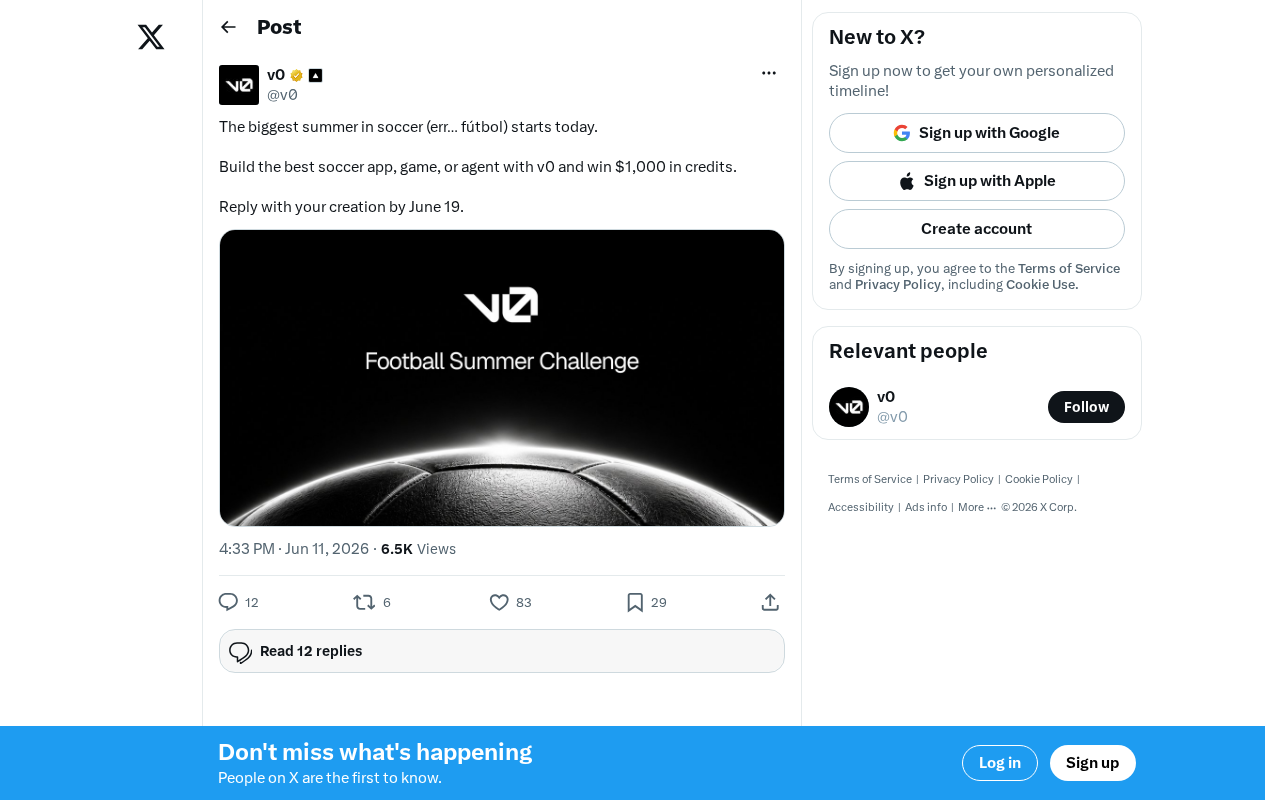
Vercel's v0 football challenge offers $1,000 in credits for the best AI-built soccer app or game.
Vercel has launched a creative challenge inviting developers to build football-themed apps, games, or AI Agents using its AI code generation tool v0, with $1,000 in platform credits as the prize. The article breaks down the challenge rules, explains v0's capabilities as a conversational app builder, explores possible creative directions, and analyzes what this means for the developer community and the broader AI-assisted development landscape.
Event Overview
Vercel recently announced a creative challenge for developers on social media: use its AI code generation tool v0 to build the best football-themed app, game, or AI Agent, with the winner receiving $1,000 in platform credits.
The challenge was launched during the peak summer football season, cleverly combining football fever with AI development tool promotion. It serves as both a community engagement activity and a collective stress test of v0's capabilities.
Who Is Vercel?
Before diving into the challenge details, it's worth understanding Vercel's position in the modern web development ecosystem. Vercel is a company focused on frontend cloud infrastructure, founded by Guillermo Rauch in 2015 (originally named ZEIT). The company is best known for creating and maintaining Next.js — one of the world's most popular full-stack React frameworks, used by well-known products like TikTok, Notion, and Hulu.
Vercel's core business model provides an all-in-one deployment platform that takes you "from code to production." After developers push code to a Git repository, Vercel automatically handles building, deployment, and global CDN distribution. This "zero-config deployment" experience has earned it an outstanding reputation in the frontend developer community. In recent years, with the rise of AI, Vercel has begun deeply integrating AI capabilities into its product lineup, and v0 is the flagship product of this strategic transformation.
What Is v0?
v0 is Vercel's AI-powered code generation tool that allows users to rapidly generate frontend interfaces and application prototypes through natural language descriptions. Built on large language models, it can understand user intent and output runnable React component code.
v0's Technical Architecture and How It Works
v0's underlying technology relies on specially fine-tuned large language models (LLMs). Unlike general-purpose AI assistants, v0's model has been trained on a large corpus of high-quality frontend codebases, giving it deep understanding of modern frontend tech stacks like React, Tailwind CSS, and shadcn/ui. After a user inputs a natural language description, v0 goes through a complete pipeline of "intent parsing → component planning → code generation → live preview," ultimately outputting code that can run directly.
Notably, v0's positioning differs significantly from other AI coding tools on the market. GitHub Copilot and Cursor primarily serve as in-IDE code completion assistants, helping developers write code line by line. v0, on the other hand, is more like an "AI full-stack developer" — it can generate complete application interfaces from scratch and even handle backend logic like data fetching and state management. This "conversational app building" interaction model lowers the barrier to programming from "knowing how to code" to "being able to describe what you need."
v0's Core Capabilities
- Natural language to code: Users simply describe the interface or functionality they want, and v0 generates the corresponding frontend code
- Rapid prototyping: Dramatically shortens the time from idea to working demo
- Deep integration with the Vercel ecosystem: Generated code can be deployed to the Vercel platform with one click
- Iterative conversational refinement: Users can continuously adjust and improve results through multiple rounds of dialogue, much like collaborating with a frontend engineer
In this challenge, v0's role goes beyond code generator — it's a creative accelerator, enabling developers to quickly turn football-related ideas into interactive applications.
Challenge Rules and How to Participate
Basic Rules
- Theme: Football (Soccer/Fútbol) related apps, games, or AI Agents
- Tool requirement: Must be built using v0
- Deadline: June 19, 2025
- Submission method: Reply with your work under Vercel's official tweet
- Prize: $1,000 in Vercel platform credits
Possible Creative Directions
Based on the challenge description, the format for entries is quite flexible:
- Football data apps: Match schedule lookups, live score tracking, player data visualization
- Interactive games: Browser-based football mini-games, prediction/quiz apps
- AI Agents: Football tactical analysis assistants, match prediction bots, team lineup recommendation systems
What Is an AI Agent?
The "AI Agent" mentioned in the challenge is one of the hottest concepts in AI right now, and it's fundamentally different from the chatbots we're familiar with. Traditional chatbots can only passively respond to a user's individual questions, while AI Agents have the ability to autonomously plan, call tools, and perform multi-step reasoning. A football tactical analysis Agent, for example, can do more than just answer factual questions like "How many goals has Messi scored this season" — it can proactively call data APIs to fetch real-time match data, analyze weaknesses in opponent formations, generate visual tactical diagrams, and dynamically adjust recommendations based on how the match unfolds.
Technically, AI Agents typically use a large language model as their "brain," combined with Function Calling mechanisms to connect to external tools and data sources. Developers can use v0 to quickly build the Agent's frontend interaction interface, then connect to APIs from OpenAI, Anthropic, and other model providers to power the backend intelligence. This combined frontend-backend development approach is precisely the capability being put to the test in this challenge.
This open-ended prompt gives developers ample creative freedom while also testing v0's adaptability in real-world application scenarios.
What This Means for the Developer Community
A Real-World Test for AI Coding Tools
Challenges like this are essentially "crowdsourced testing" for AI coding tools. When a large number of developers simultaneously use v0 to build different types of applications, the tool's capability boundaries, common issues, and best practices are quickly exposed and documented.
This is especially important given the fierce competition in the AI coding tools space. In 2024–2025, the AI-assisted programming landscape has developed into a multi-layered competitive arena: Microsoft's GitHub Copilot dominates the code completion market with its first-mover advantage and VS Code ecosystem; Cursor has risen rapidly with its "AI-native IDE" positioning, winning over a large number of independent developers; and products like Replit and Bolt.new target the "no-code/low-code" app building space. v0's unique position in this landscape is "conversational generation of frontend applications," and its seamless integration with the Vercel deployment platform forms its core competitive moat. Through the large volume of real-world use cases collected via the challenge, Vercel can precisely identify where v0 excels and where it still needs improvement, accelerating product iteration.
Low Barriers to Entry Are Becoming the Norm
AI tools are dramatically lowering the barrier to participate in challenges like this. Building a complete web application used to take days or even weeks, but with tools like v0, a creative developer can produce a demo-ready project in just a few hours.
This shift is redefining who can be a "developer." Traditional web development requires mastering a series of technologies — HTML, CSS, JavaScript, React — with a steep learning curve. Under the new paradigm of AI-assisted development, product managers, designers, and even creative individuals with no programming background can turn their ideas into working applications through natural language descriptions. This doesn't mean professional developers will be replaced — quite the opposite. AI tools free up developer productivity, allowing them to focus on more complex architectural design and business logic while delegating repetitive UI construction to AI.
Community-Driven Product Promotion Strategy
From a business perspective, Vercel is trading $1,000 in credits for a wealth of user-generated content and social media exposure. Every reply and share from participants builds word-of-mouth for v0 — a highly efficient form of developer marketing.
This strategy has been proven to be one of the most effective promotion methods in the Developer Relations (DevRel) field. Unlike traditional advertising aimed at consumers, the developer community is naturally resistant to hard sells but highly trusting of "peer recommendations" and "real-world examples." Challenges and hackathons have become standard activities for developer tool companies precisely because they create scenarios where developers "voluntarily experience the product and proactively share their results." Every submission is a genuine product use case, more persuasive than any official marketing material.
Additionally, Vercel's choice to offer platform credits rather than cash as the prize is a carefully designed business strategy: winners will use the credits on Vercel's paid features, which not only reduces the actual cost of the event but also increases user stickiness to the platform, potentially converting participants into long-term paying customers.
Summary
Vercel's football-themed challenge may be modest in scale, but it reflects several trends in the AI coding tools space: gamified showcasing of tool capabilities, community-driven product iteration, and AI-assisted development becoming part of mainstream developers' daily workflows. For interested developers, it's a zero-cost opportunity to experience what v0 can do.
From a broader perspective, events like this also mark another milestone in the democratization of software development. When the barrier to building a fully functional web application drops from "weeks of professional development" to "a few hours of creative expression," the factors that truly determine product quality will shift from technical implementation ability to creative quality and user insight — which happens to be humanity's most irreplaceable advantage over AI.
Related articles

Five Common Claude Code Mistakes — How Many Are You Making?
Five common Claude Code mistakes developers make: copy-pasting code, skipping CLAUDE.md, inefficient prompting, ignoring docs, and poor context management — with fixes.
Andrew Ng's New Course Explained: A Practical Guide to Using OpenAI's O1 Reasoning Model
Deep dive into Andrew Ng and OpenAI's Reasoning with O1 course covering test-time scaling, new prompting paradigms, multi-model orchestration, and practical applications for developers.

Learning AI After College Entrance Exams: A Complete Path from Zero to Freelancing
How to efficiently learn AI skills during summer break after exams? A complete path from mastering prompts and hands-on projects to freelancing on platforms.