Vibe Coding in Practice: Building a Mini-OpenClaw Agent from Scratch Without Writing Code
Vibe Coding in Practice: Building a Mi…
Vibe Coding enables building production-grade Agent frameworks through natural language AI collaboration without code.
This article demonstrates Vibe Coding — a new development paradigm — through building Mini-OpenClaw (a LangChain-based AI Agent framework) without writing code. It breaks down OpenClaw's six core modules (tool invocation, dynamic Skills loading, memory management, workflow engine, autonomous evolution, message queues), showcases the complete development workflow from requirements to code generation, and reveals how developer competitiveness is shifting from coding to system design and AI collaboration.
Vibe Coding Is Redefining Software Development
When the concept of "Vibe Coding" first spread from Silicon Valley, many developers dismissed it as a gimmick. But as AI programming tools have rapidly matured, more and more real-world examples prove that you can indeed build production-grade application systems without writing a single line of code, purely through natural language collaboration with AI.
Vibe Coding was formally introduced by OpenAI co-founder Andrej Karpathy in early 2025. The core idea is that developers describe their intent in natural language, delegate code generation entirely to AI, and simply "feel the vibes" while validating results. The concept quickly sparked debate: supporters believe it lowers the barrier to software development to historic lows, while critics worry about code quality and security spiraling out of control. From a technical evolution perspective, Vibe Coding is a paradigm upgrade from GitHub Copilot-style "code completion" — evolving from assisting code writing to completely replacing handwritten code.
This article presents a highly representative case study — building a Mini-OpenClaw (a lightweight Agent framework based on LangChain) from scratch using Vibe Coding — with an in-depth breakdown of OpenClaw's underlying architecture, core principles, and the complete AI-assisted development workflow.
OpenClaw Core Architecture Breakdown
What Is OpenClaw?
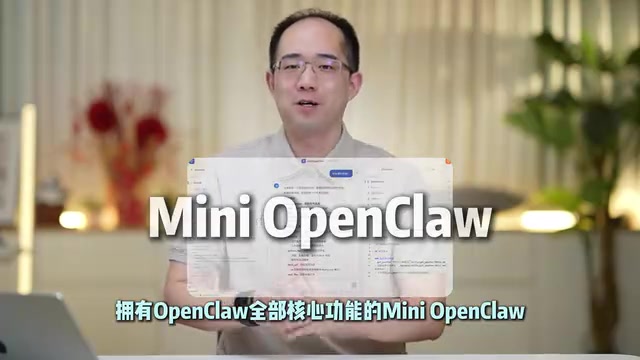
OpenClaw is a widely followed open-source AI Agent framework. Its core philosophy is to transform large language models from mere "chatbots" into intelligent agents with tool invocation, memory management, and autonomous evolution capabilities. Understanding OpenClaw requires first understanding the essence of AI Agent frameworks: unlike pure conversational models, Agent frameworks give LLMs a closed-loop "perceive-plan-act" capability — obtaining external information through tool calls, accumulating context through memory systems, and executing complex tasks through workflow engines. Since 2023, frameworks like AutoGPT, BabyAGI, and CrewAI have emerged one after another, marking the critical leap of LLMs from "language generators" to "autonomous agents," and OpenClaw is a representative product in this evolutionary direction. It comes with a rich built-in toolchain including web search, sandbox environments, command-line tools, browser automation, and more, capable of running stably in enterprise-grade high-concurrency scenarios.
Six Core Capability Modules
Through deep analysis of OpenClaw's source code and architecture, its core capabilities can be summarized into six modules:
- Tool Invocation System: Built-in tools including web search, sandbox code execution, command-line operations, and browser automation
- Agent Skills Mechanism: Supports flexible loading of skill plugins in standard formats for dynamic capability extension
- Memory Management System: Covers six categories of memory document management including session memory, long-term memory retrieval, and memory compression
- Workflow Engine: Supports autonomous invocation of predefined workflows during conversations
- Autonomous Evolution: Can permanently modify memories, enabling adaptive learning that gets "smarter with use"
- Message Queue Management: Real-time management and display of message flow states in current sessions
Building Mini-OpenClaw with Vibe Coding — Zero Code
Technology Choice: Why LangChain?
Mini-OpenClaw's choice of LangChain as its underlying framework is no coincidence. Released by Harrison Chase in October 2022, LangChain is one of the most mature LLM application development frameworks available. Its core abstractions include: Chain (sequential calls), Agent (autonomous decision-making), Tool (tool integration), Memory (memory management), and Retriever (retrieval augmentation). LangChain's modular design allows developers to combine capabilities like building blocks — each module has clear semantic boundaries that AI can precisely understand, generating well-structured, maintainable code. This aligns perfectly with OpenClaw's architectural philosophy and is the fundamental reason it's the preferred framework for Vibe Coding scenarios: you can describe each module's requirements in natural language, have AI generate and assemble them one by one, without worrying about interface chaos between modules.
Complete Replication of Core Features
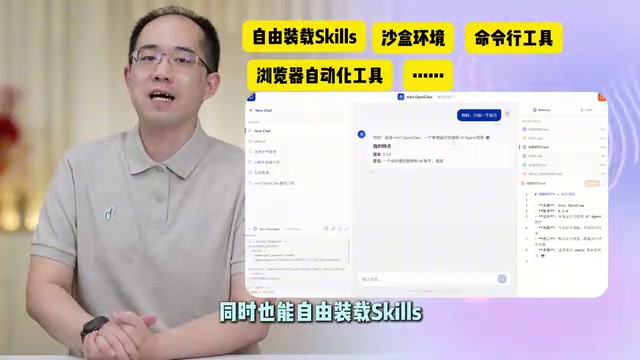
Mini-OpenClaw is not a simple demo but aims for complete replication of OpenClaw's core features:
- Built-in Toolchain: Consistent with OpenClaw, integrating web search, sandbox environments, command-line tools, browser automation, and the full suite of tools
- Dynamic Skills Loading: Supports standard-format Agent Skills that can be flexibly loaded at runtime without restarting the service
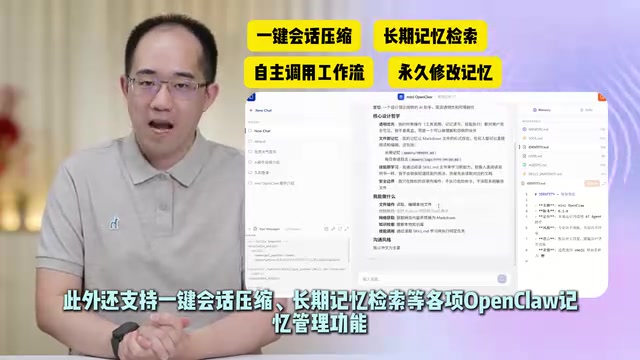
- Autonomous Workflow Invocation: The Agent can determine when to trigger workflows during conversation and execute them autonomously
- Autonomous Memory Evolution: Supports permanent memory modification, allowing the Agent to continuously accumulate experience and knowledge
- One-Click Conversation Compression: Automatically performs intelligent compression when conversation history becomes too long, preserving key information
- Long-Term Memory Retrieval: A vector retrieval-based long-term memory system supporting cross-session knowledge recall
Long-term memory retrieval is the key capability that distinguishes Agent systems from ordinary conversational applications. Its underlying technology relies on vector databases: text information is converted into high-dimensional vectors through Embedding models and stored in vector databases like Chroma, Pinecone, or Weaviate. During queries, the system vectorizes user input similarly and retrieves the most semantically relevant historical memory fragments through cosine similarity or Approximate Nearest Neighbor (ANN) algorithms, injecting them into the current conversation context. This mechanism enables Agents to transcend single-session token limits and achieve true "long-term learning" — this is also the core technical foundation behind OpenClaw's "gets smarter with use" feature.
Teaching Enhancement: Visual Debugging Panel
As an educational project, Mini-OpenClaw adds highly valuable visualization capabilities on top of OpenClaw:
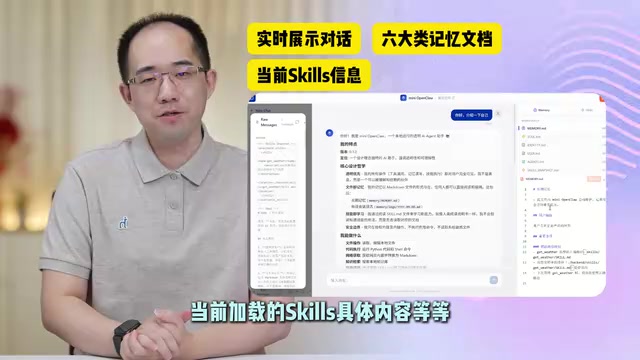
- Real-time Message Queue Display: Intuitively observe the flow of each message in the current session
- Six Categories of Memory Documents: View all types of memory content the Agent currently holds at any time
- Skills Loading Status Monitoring: Clearly display currently loaded skill plugins and their specific content
These visualization features are crucial for understanding Agent internal mechanisms and serve as the best entry point for learning AI Agent development. Traditional Agent debugging often requires tracing through log files line by line, while the visualization panel transforms the "black box" into a "glass box," allowing developers to observe the LLM's decision paths, tool invocation sequences, and memory state changes in real time, greatly reducing the cognitive barrier to Agent systems.
Vibe Coding Development Process and Key Insights
From Requirement Description to Code Generation
The core Vibe Coding process can be summarized as: Describe requirements → AI generates code → Validate and debug → Iterate and optimize. During Mini-OpenClaw's development, the developer wrote no code, instead collaborating with AI through:
- Architecture Design Phase: Describe the system's overall architecture and module divisions in natural language; AI generates the project skeleton
- Module Implementation Phase: Describe each module's functional requirements one by one; AI generates specific implementation code
- Integration and Debugging Phase: Describe inter-module interaction logic; AI completes integration and handles compatibility issues
- Optimization and Iteration Phase: Provide feedback based on runtime results; AI performs targeted fixes and optimizations
Notably, Vibe Coding doesn't mean developers can completely "sit back and relax." Effective requirement description is itself a high-level skill — you need sufficient system design knowledge to transform vague ideas into instructions AI can precisely execute. This is essentially the same as "technical solution design" in traditional development, except the execution layer is now handled by AI.
Key Insight: The Possibility of One-Person Companies
This case reveals an important trend: AI-assisted development is dramatically lowering the human resource barrier in software engineering. Someone with systems design thinking but no coding expertise can independently complete engineering projects that previously required team collaboration.
The "Solo Founder" model existed before AI tools became widespread, but was limited by technical implementation costs to light-asset domains like content and consulting. Vibe Coding is breaking this boundary: Sam Altman has predicted that "unicorn companies run by a single person will emerge in the future." The logic behind this is that AI tools are compressing the most time-consuming "implementation layer" costs in software development, enabling individual entrepreneurs to focus their limited energy on product definition, user insights, and business model design — precisely the areas of human judgment that AI currently cannot replace. This doesn't mean programmers will become unemployed, but rather:
- Developers' core competitiveness is shifting from "writing code" to "designing systems"
- Understanding underlying principles and architectural design becomes even more important
- The "one-person company" model is becoming increasingly viable in technical product domains
- The ability to use AI tools is itself becoming a new professional skill
Conclusion and Reflections
The value of the Mini-OpenClaw project lies not just in replicating an Agent framework, but in demonstrating an entirely new development paradigm. When we can "describe" a production-grade system in natural language and have AI "implement" it, the boundaries of software development are being redefined.
For readers looking to get started with AI Agent development, I recommend beginning with understanding OpenClaw's architectural design and practicing with LangChain's documentation. Mastering the skill of "how to accurately describe requirements to AI" may hold more long-term value than learning any programming language — because at its core, it's the combination of systems thinking and communication ability, which is precisely the scarcest competitive advantage in the era of human-AI collaboration.
Related articles
 Tutorials
Cursor + Codex Dual-IDE Collaboration: A Practical Methodology for Open-Source Project Customization
A complete methodology for open-source project customization based on real-world experience, detailing the Cursor+Codex dual-IDE workflow, seven-stage process, MVP validation, and AI source code reading techniques.
 Tutorials
Cursor Multi-Agent in Practice: Building a Full-Stack Next.js Blog in 50 Minutes
Build a full-stack blog in 50 minutes using Cursor IDE's multi-Agent mode with Next.js, Clerk auth, and Supabase. Learn the 4-phase AI Agent workflow and key integration pitfalls.
 Tutorials
Building an AI Software Factory from Scratch: A Cursor Engineer's Hands-On Experience with Multi-Agent Collaboration
Cursor engineer Eric shares practical insights on building an AI software factory: automation levels, guardrail design, parallel Agent management, and scaling to 1000+ Agents for 24/7 development.