Voice-First AI Phone Operating System: A Deep Dive into the Voice Hack Night Hackathon Grand Prize Project

Voice-first Agentic OS lets users drive AI Agents to execute cross-app phone operations through conversation
At Voice Hack Night, "Agentic OS for a Phone" won the People's Choice award and $50,000 in API credits. The project builds a voice-first mobile OS where users drive a multi-Agent collaboration system to execute complex tasks across apps through natural language conversation, representing a paradigm shift from touch to dialogue in mobile interaction. Maturation of end-to-end voice large models makes this possible, though privacy, latency, and ecosystem compatibility remain core challenges.
A Completely New Mobile Interaction Paradigm
At the recent Voice Hack Night hackathon, the "Agentic OS for a Phone" project built by the @isausmanov team stood out from the competition, winning the People's Choice award along with $50,000 in API credits.
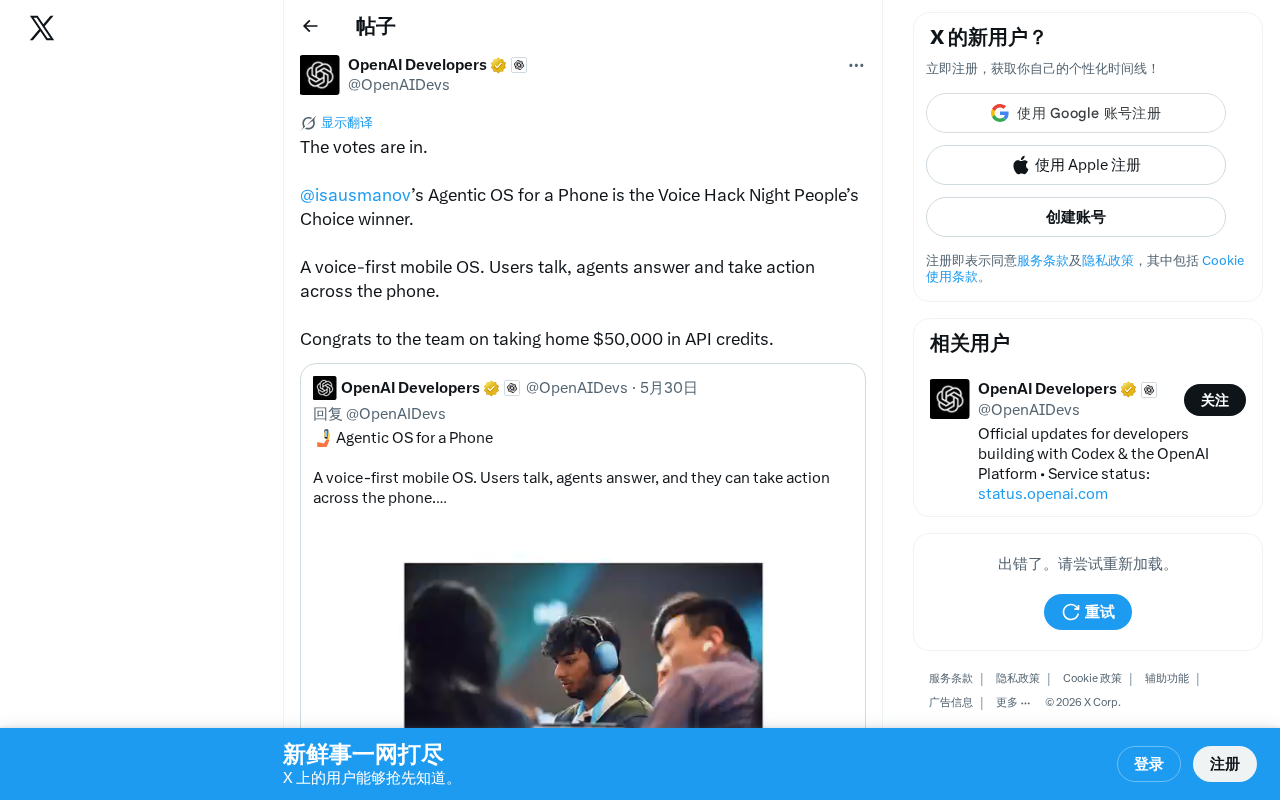
Voice Hack Night is a hackathon focused on voice AI technology, typically sponsored by voice technology platforms or AI infrastructure companies. These events bring together developers interested in voice interaction, conversational AI, and Agent technology to go from idea to prototype within a limited timeframe. The People's Choice award is determined by on-site participant voting, making it more reflective of the tech community's intuitive judgment about a project's practicality and innovation compared to jury awards. The $50,000 in API credits means the team can extensively call LLM APIs for testing and iteration during subsequent development — a critically important resource for early-stage AI projects.
The project's core concept is remarkably straightforward: build a voice-first mobile operating system. Users simply speak, and AI Agents understand their intent and execute operations across apps on the phone.
The Design Philosophy of a Voice-First OS
The Paradigm Shift from Touch to Conversation
Traditional smartphone interaction logic is built on touch — tapping icons, swiping screens, typing text. Agentic OS proposes a fundamental shift: making voice conversation the primary way to interact with your phone.
This isn't a simple voice assistant upgrade. Traditional voice assistants (like early Siri or Alexa) use an Intent-Slot NLU architecture that essentially maps user speech to a predefined set of commands. The limitation of this architecture is that every new feature requires manually defining new intent templates, and it cannot handle dynamic combinations between intents. Unlike Siri or Google Assistant, Agentic OS is positioned as an operating system-level reconstruction. Users no longer need to open a specific app before performing an action — instead, they describe their needs in natural language, and AI Agents autonomously decide which applications to invoke and which steps to execute.
Embedding AI Agents at the operating system level rather than the application level means Agents have system-level permissions to call various APIs and services. In the Android ecosystem, this might involve deep utilization of Accessibility Service, or direct cross-app communication through system-level Intent mechanisms. By contrast, AI assistants in third-party app form are constrained by sandbox mechanisms and can only interact with other applications through limited sharing interfaces. OS-level design also means Agents can perceive system state (battery, network, notifications, etc.) and make smarter contextual decisions.
Cross-App Agent Collaboration Mechanism
The word "Agentic" in the project name reveals a key characteristic of its technical architecture. This isn't a simple speech recognition plus command execution model — it's a multi-Agent collaboration system. The Agentic architecture leverages the reasoning capabilities of large language models to decompose tasks into executable sub-steps, with each sub-step handled by a specialized Agent. Agents collaborate through shared Context and Tool Use/Function Calling mechanisms, dynamically planning execution paths and handling task combinations never seen before. Different Agents are responsible for different capability domains and can work collaboratively across application boundaries to complete complex multi-step tasks.
Here's a concrete scenario: a user might say, "Check tomorrow's weather for me, and if it's going to rain, cancel my outdoor meetup with Zhang San and send him a message to move it to a coffee shop." This request involves weather queries, calendar management, and instant messaging — three different applications. Traditional voice assistants struggle to handle this smoothly, but Agent architecture is naturally suited for such cross-domain tasks. The system decomposes this compound request into: calling the weather Agent to get forecast data → triggering the calendar Agent to modify the event based on conditional logic → finally invoking the messaging Agent to send a message, with the entire process maintaining semantic coherence through shared context.
Why a Voice-First Phone OS Deserves Attention
The Technical Infrastructure Has Matured
LLM reasoning capabilities have made tremendous progress in the past two years, and speech recognition and synthesis technologies have reached near-human levels of naturalness. Between 2023-2024, voice technology underwent a qualitative leap. OpenAI's Whisper model reduced speech recognition error rates to near-human transcriber levels; on the synthesis side, technologies like ElevenLabs and OpenAI TTS achieved extremely natural real-time voice generation with latency controllable to within hundreds of milliseconds. The more critical breakthrough is the emergence of end-to-end voice large models (such as GPT-4o's voice mode), which bypass the traditional ASR→LLM→TTS pipeline to reason directly on the speech modality, dramatically reducing interaction latency while preserving paralinguistic information like tone and emotion. The maturation of this technical infrastructure makes the transition of voice-first OS from concept to reality possible.
Industry Giants' Moves Validate the Direction
Apple continues to strengthen Siri's Agent capabilities in iOS, Google has launched a Gemini-powered phone assistant, and Samsung has deeply integrated AI features into its Galaxy series. These moves indicate that AI-driven, voice-centric phone interaction is an industry consensus direction. As a solution designed from scratch, Agentic OS carries no legacy baggage and may achieve greater consistency in user experience. Notably, Apple's Apple Intelligence framework showcased at WWDC 2024 has already begun allowing Siri to execute operation chains across apps — highly aligned with Agentic OS's philosophy and validating the feasibility of this direction from the side.
Audience Voting Validates Real User Demand
The value of the People's Choice award lies in representing real user votes. The developers and tech enthusiasts present voted with their feet for this project, indicating that a voice-first phone OS truly hits a real pain point — people want their interactions with phones to be more natural and efficient.
Challenges and Outlook
There's still an enormous gap between a hackathon demo and a usable product. Privacy and security, latency control, offline capabilities, and ecosystem compatibility all need to be addressed one by one.
Regarding privacy and security, a voice-first OS needs to continuously monitor ambient audio to capture wake words or commands, which involves balancing sensitive data between local processing and cloud transmission. Latency control requires on-device inference capabilities. Current phone chipset NPU computing power is rapidly improving (such as Qualcomm Snapdragon 8 Gen3's Hexagon NPU and Apple A17 Pro's Neural Engine), but running complete large models on phones remains challenging and requires techniques like model quantization and distillation. Ecosystem compatibility is the biggest non-technical obstacle — for Agents to truly work across apps, each app needs to provide standardized API interfaces or adopt unified Agent protocols (such as the recently much-discussed MCP protocol proposed by Anthropic), requiring coordinated evolution of the entire ecosystem.
But as a directional exploration, Agentic OS demonstrates one possible future for mobile computing: your phone is no longer a device you need to "operate," but an intelligent partner you can "converse" with.
The $50,000 in API credits will help the team continue iterating and validating this vision — their subsequent progress is well worth following.
Key Takeaways
- Agentic OS for a Phone won the People's Choice award at Voice Hack Night hackathon, receiving $50,000 in API credits
- The project is a voice-first mobile operating system where users drive AI Agents to execute tasks across apps through conversation
- It employs a multi-Agent collaboration architecture, handling complex multi-step requests involving multiple applications through shared context and tool-calling mechanisms
- The emergence of voice-first OS is enabled by the maturation of end-to-end voice large models, Whisper-level ASR, and high-naturalness TTS technologies
- From demo to product, core challenges remain including privacy monitoring, on-device inference latency, and ecosystem API standardization
Related articles
 Tech Frontiers
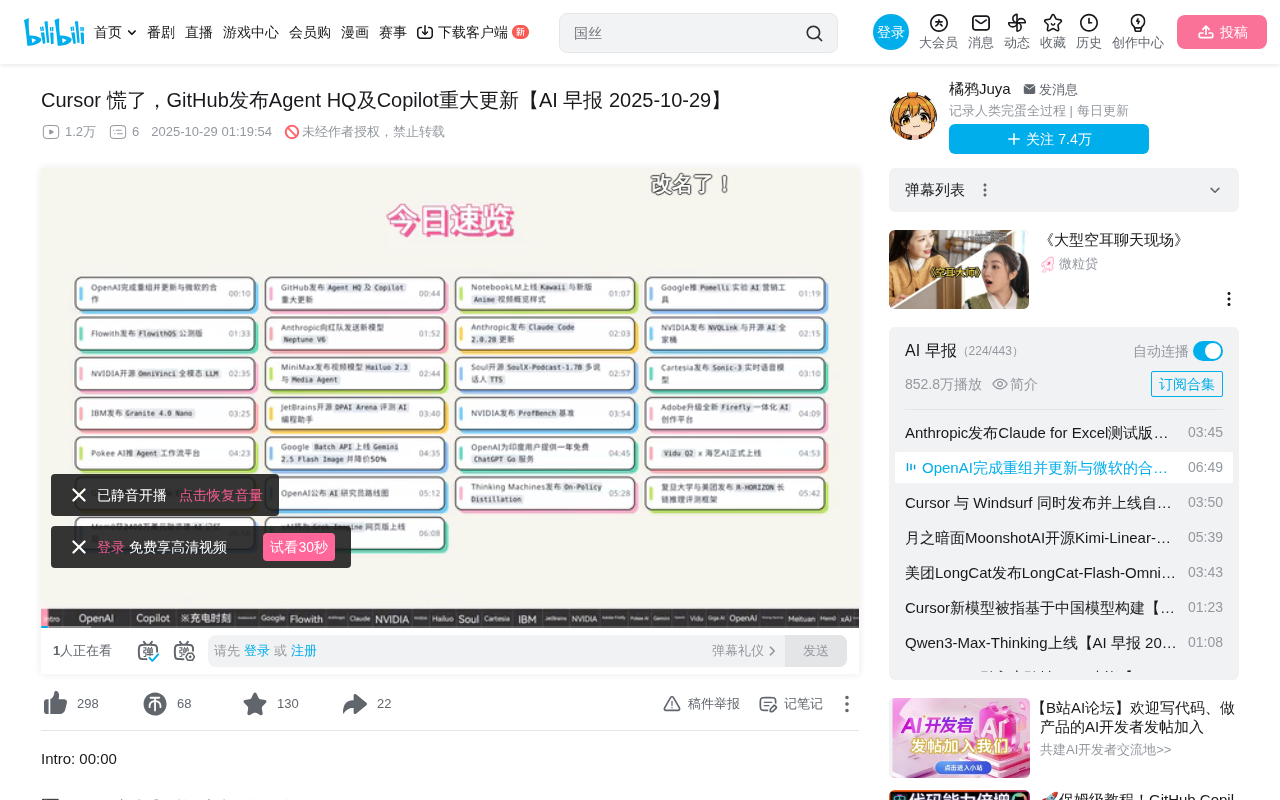
GitHub Agent HQ Launch: AI Coding Tools Enter the Era of Platform Competition
GitHub Universe unveils Agent HQ platform for unified coding agent management, Copilot upgrades with multi-model support. OpenAI completes restructuring, Anthropic tests new model, NVIDIA open-sources AI models.
 Tech Frontiers
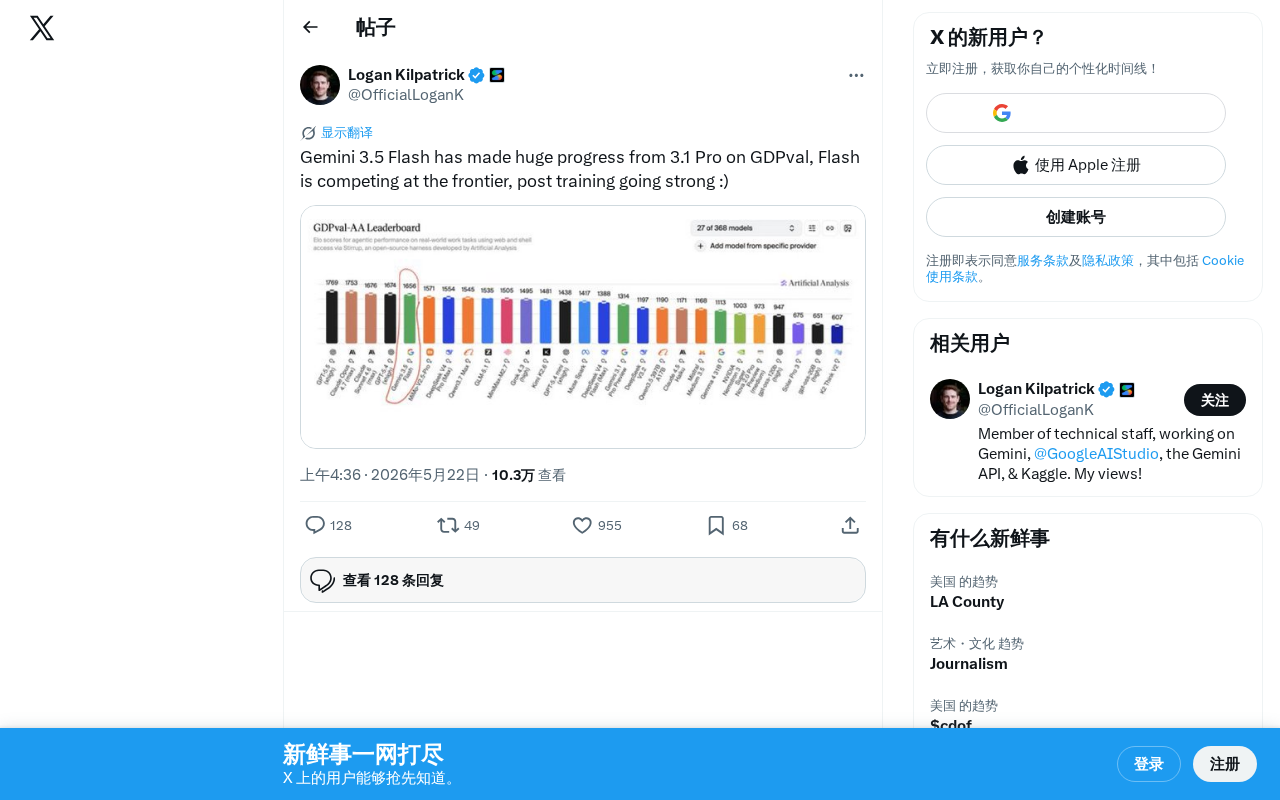
Gemini 3.5 Flash Achieves a Massive Leap on the GDPval Benchmark
Google Gemini 3.5 Flash surpasses Gemini 3.1 Pro on the GDPval benchmark. The lightweight Flash model leverages post-training techniques to approach frontier-level performance, redefining the balance between quality and cost.
 Tech Frontiers
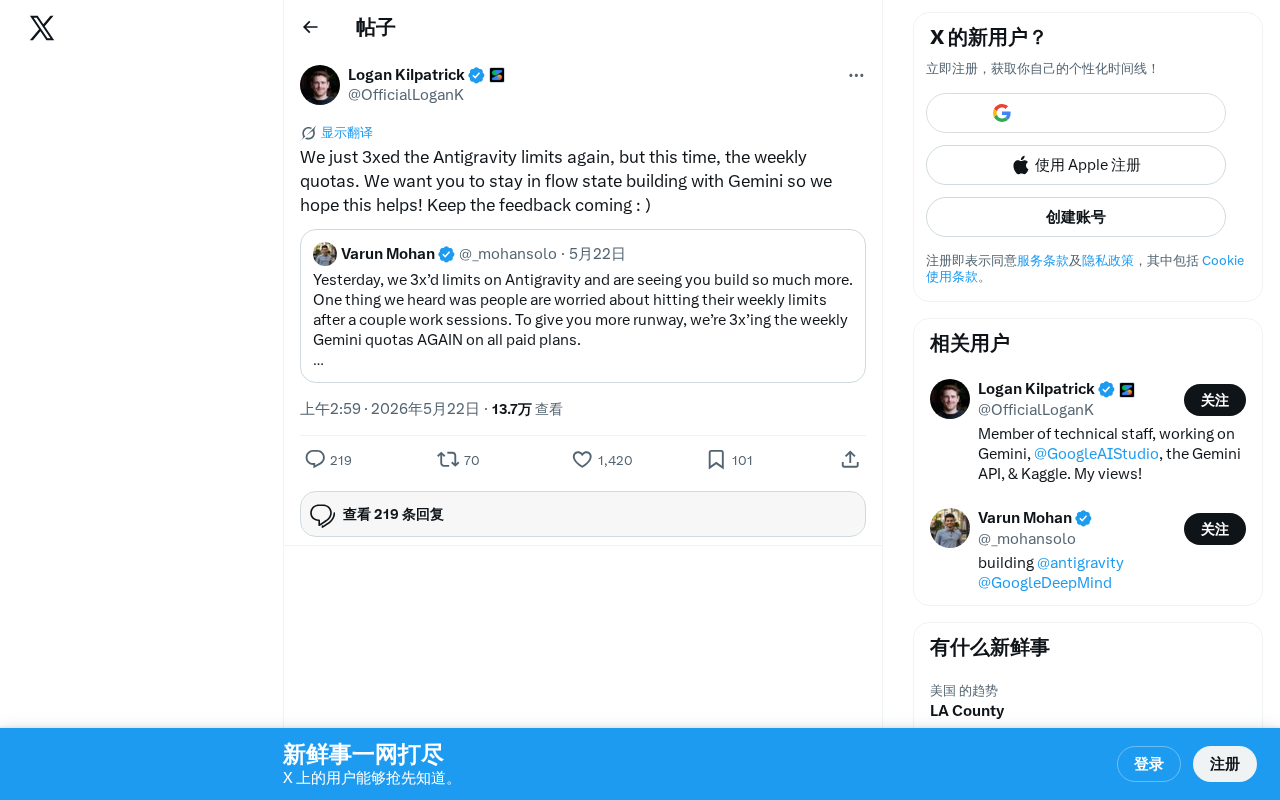
Google Gemini Antigravity Weekly Quota Tripled — AI Coding Without Limits
Google Gemini triples Antigravity weekly quotas following a prior daily quota boost. Analyzing the impact on developers and its strategic significance in AI coding.