What Exactly Is Dark Matter? A Deep Dive from a Particle Physicist
What Exactly Is Dark Matter? A Deep Di…
Evidence for dark matter is strong, but after 30 years of searching, its particle nature remains undetected.
Based on physicist Don Lincoln's interview on the Lex Fridman podcast, this article systematically reviews the evidence for dark matter (galaxy rotation, galaxy cluster motion, gravitational lensing), the logical process of ruling out conventional explanations, key evidence from the Bullet Cluster and Dragonfly galaxies, and three search approaches: direct detection, indirect detection, and collider production. Despite a millionfold improvement in experimental sensitivity, dark matter particles remain undiscovered.
Introduction: The Most Mysterious Thing in the Universe
Dark matter — this mysterious substance that makes up five-sixths of all matter in the universe — remains one of the greatest unsolved mysteries in physics. In a Lex Fridman podcast episode, senior Fermilab physicist Don Lincoln offers an experimentalist's perspective, systematically laying out why we believe dark matter exists, what it might be, and why we still haven't found it.
This conversation not only demonstrates the rigorous logic of scientific reasoning but also reveals a stunning fact: after more than 30 years of searching, with experimental sensitivity improved a millionfold, we still know virtually nothing about dark matter.
Why Do We Believe Dark Matter Exists?
As an experimental physicist, Don Lincoln first emphasizes the observational evidence. There are systematic discrepancies between astronomical measurements and predictions from Newtonian mechanics and general relativity, manifested in three independent observational phenomena:
- Galaxies rotate too fast: Galaxies spin at speeds far exceeding what the gravitational pull of visible matter could sustain — they should tear themselves apart, yet they don't
- Galaxy cluster motion anomalies: Galaxies within clusters also move faster than expected
- Gravitational lensing discrepancies: The distortion of distant galaxies caused by the gravitational fields of foreground galaxies doesn't match predictions based on visible matter alone

These three independent lines of evidence point to the same conclusion: either our understanding of the laws of physics is wrong, or there is matter in the universe that we cannot see.
Process of Elimination: Narrowing Down the Possibilities
Lincoln uses an elegant logical framework to analyze this problem. For the galaxy rotation issue, there's a simple equation: the force needed to maintain circular motion = gravitational force. When predictions don't match observations, it means one of three things:
- The law of gravity (Newtonian gravitation) is wrong
- The law of inertia (F=ma) is wrong
- There is additional mass that we cannot see
Ruling Out Conventional Objects
The most intuitive explanation is that there's more ordinary matter we can't see — black holes, rogue planets, hydrogen gas clouds, etc. But after checking each one:
- Hydrogen gas clouds can be observed via radio waves — there aren't enough of them
- Microlensing experiments in the 1990s (MACHO, OGLE, and other projects) searched for black holes and rogue planets — they do exist, but in far too few numbers
The principle behind microlensing is this: when a massive object passes between a distant star and an observer, it briefly brightens the star. The sensitivity floor of these experiments is about one-third the mass of the Moon — compact objects smaller than that cannot be detected.
Key Evidence: The Bullet Cluster and Dragonfly Galaxies
The Bullet Cluster — Direct Proof of Dark Matter's Existence
The Bullet Cluster is one of the most compelling pieces of evidence for dark matter, according to Lincoln. When two massive galaxy clusters pass through each other:
- The galaxies themselves barely interact and pass right through
- The interstellar gas clouds collide and remain in the middle, reaching extreme temperatures
- If there were no dark matter, gravitational lensing distortion should be concentrated in the middle (since the gas cloud mass far exceeds that of the galaxies)
- If dark matter exists, it doesn't interact with gas and would follow the galaxies through — gravitational lensing distortion should appear where the galaxies are
Observational results clearly support the latter — gravitational lensing effects appear at the galaxy positions, not at the central gas cloud.
Dragonfly Galaxies — The Absence of Dark Matter Actually Proves Its Existence
DF2 and DF4 are two galaxies whose rotation speeds perfectly match Newtonian predictions — meaning they appear to contain no dark matter.
The profound implication of this discovery is: if the galaxy rotation anomaly were a problem with the laws of gravity themselves, then all galaxies should behave anomalously. But the "normal" behavior of these two galaxies shows that whatever causes other galaxies to rotate too fast is not an inherent property of matter, but something that can be stripped away — dark matter.
A galaxy without dark matter is, paradoxically, one of the strongest pieces of evidence that dark matter exists.
Three Paths to Finding Dark Matter Particles
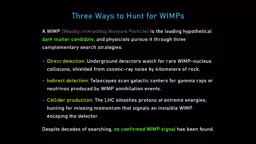
If dark matter consists of real particles (called WIMPs — Weakly Interacting Massive Particles), we have three detection approaches:
1. Direct Detection: Catching Dark Matter Underground
In theory, dark matter is everywhere, passing through Earth like wind. Scientists place detectors deep underground, attempting to catch rare collisions between dark matter particles and ordinary matter.
Result: Nothing detected.

2. Indirect Detection: Searching for Annihilation Signals
In regions where dark matter may be concentrated (such as galactic centers), if dark matter and anti-dark matter annihilate, they would produce gamma rays. Scientists search for these signals.
Problem: Neutron stars and other celestial objects can also produce gamma rays, making background noise difficult to eliminate.
3. Collider Production: Creating Dark Matter with High-Energy Collisions
This is Lincoln's own area of work — attempting to produce dark matter particles in high-energy particle collisions. Since dark matter interacts only through gravity, it would escape the detector. Through conservation of momentum, if there's an energy jet on one side and nothing on the other, it could be a dark matter signal.
Result: Also nothing found.
A Frustrating Reality and Future Hope
The possible mass range for dark matter particles is extraordinarily vast — from asteroid mass to far lighter than an electron, spanning dozens of orders of magnitude. Current experiments have only ruled out a small portion of this parameter space.

Lincoln candidly admits this is precisely why he didn't choose dark matter experiments as his primary research focus: any single experiment can only cover a small slice of the mass range, and finding dark matter requires enormous luck. What the scientific community needs is numerous teams simultaneously conducting vastly different experiments to comprehensively explore the parameter space.
Today's experimental sensitivity has improved by a factor of one million compared to 30 years ago, yet still nothing has been found. This has led some physicists to "hate" the dark matter hypothesis — not because the evidence doesn't support its existence, but because we seem unable to ever catch it.
Conclusion: Scientific Honesty and Humility
What's most striking about this conversation is a top physicist's candor in the face of the unknown: "What is dark matter? I don't know. But I know what it isn't."
Dark matter makes up 83% of all matter in the universe — five times more than ordinary matter. Understanding it would fundamentally transform our knowledge of the cosmos. As Lincoln notes, the possibility of modifying the laws of gravity or inertia still remains — until dark matter is directly observed, we cannot completely rule out any option.
This is perhaps the most fascinating and humbling subject in contemporary physics: we don't even know what the vast majority of the universe is made of.
Related articles
 Deep Dives
Deep Dive into How OpenClaw (Open-Source Crayfish) AI Agent Works
Deep analysis of OpenClaw AI Agent internals: System Prompt, tool calling, SubAgents, Skill system, memory, and Context Engineering explained.
 Deep Dives
Demystifying Transformer: A Word-Continuation Function, Deconstructed
Understand Transformer through the lens of word continuation. Breaking down language generation into Embedding, Transformer Block, and Probability output modules for intuitive understanding.
 Deep Dives
Five Core Differences Between Claude Code and Regular AI Chat
A detailed comparison of Claude Code vs regular AI chat across five dimensions: interaction, context understanding, execution, memory, and tool integration.