What Is Claude Code? A Guide to Choosing Between Terminal Agents and Device Agents
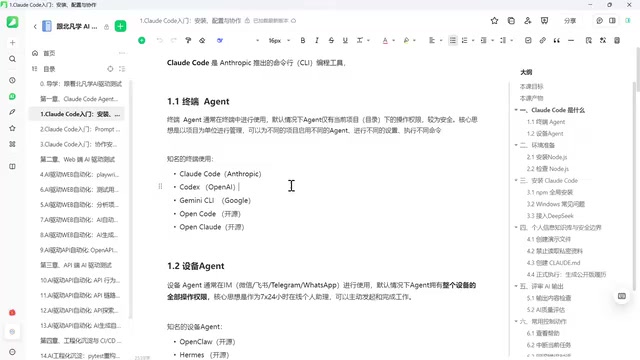
A guide to Claude Code and choosing between Terminal Agents and Device Agents for AI-assisted development.
This article explains what Claude Code is and why it has become the benchmark for enterprise AI programming. It introduces two major AI Agent categories — Terminal Agents (project-scoped, CLI-based) and Device Agents (full device control via chat tools) — comparing their security, controllability, and use cases. The article recommends Claude Code paired with DeepSeek as an optimal, pragmatic combination for teams adopting AI-assisted development.
Introduction: Why Should You Care About Claude Code?
In today's flourishing landscape of AI programming tools, many people are familiar with general-purpose AI assistants like DeepSeek and Doubao, but may be less acquainted with Claude Code. That's because Claude Code is fundamentally a command-line programming tool designed for professional developers, created by Anthropic.
Anthropic has exceptionally deep technical expertise in the AI field. The company was founded in 2021 by siblings Dario Amodei and Daniela Amodei — Dario being the former VP of Research at OpenAI — and its core team brings together a large number of top-tier AI safety researchers. Anthropic's technical philosophy emphasizes "responsible AI development," and its Constitutional AI methodology — which uses a clear set of principles to constrain and guide AI behavior — has become an important reference paradigm in the AI alignment space. Their Opus 4.7 model is currently one of the world's most capable AI models for coding, while MCP (Model Context Protocol) is another significant technical standard from the company. MCP defines a standardized communication method between AI models and external tools and data sources. Much like how the USB protocol unified hardware device connections, MCP enables different AI applications to invoke various external services and data in a unified way, and it has been widely adopted across the industry. Technical standards like SCALES also originate from Anthropic.
This article starts with a classification of AI Agents, explains why Claude Code has become the mainstream choice for enterprise-level AI programming, and highlights the key differences between Terminal Agents and Device Agents.
Two Major Categories of AI Agents: Terminal Agents vs. Device Agents
Before understanding Claude Code, we need to clarify a core concept: AI Agent. An Agent is an AI system capable of thinking autonomously, driving tasks forward, and working until the goal is achieved.
It's important to distinguish the fundamental difference between an Agent and a regular AI assistant. Traditional AI assistants (like ChatGPT's basic conversation mode) follow a "question-and-answer" interaction pattern — the user asks, the AI responds, then waits for the next question. An Agent, on the other hand, has a complete autonomous action loop: perceive the environment → reason and plan → execute actions → observe results → adjust strategy. This loop continues running until the task is complete. In other words, when you give an Agent a goal (such as "refactor the database access layer of this module"), it will autonomously break down the task, execute step by step, and self-adjust when encountering problems — rather than waiting for your instructions at every step. This autonomy is the fundamental reason why Agents demonstrate enormous value in complex programming tasks.
The current mainstream Agents fall into two major categories:
- Terminal Agent: Runs in the command line, works on a per-project basis
- Device Agent: Controlled through chat tools (WeChat, Feishu/Lark, etc.), takes over the entire device
Claude Code is a Terminal Agent — currently the most widely adopted and most secure approach in enterprise environments.
Terminal Agents Explained: A Controllable Approach Bounded by Projects
Three Core Characteristics of Terminal Agents
- Runs in the command line: Just as traditional coding experts and hackers prefer working in the terminal, Terminal Agents operate in a command-line environment
- Works on a per-project basis: The AI can only work within the current project or directory, and humans always retain ultimate decision-making authority over the entire device
- Flexible and controllable: The same computer can have different Agents, different configurations, and execute different commands for different projects
The choice of a command-line environment is no accident. The CLI (Command Line Interface) has always held a central position in professional development. Key aspects of modern software engineering — Git version control, Docker container management, CI/CD pipelines — almost all use CLI as their primary interaction method. The advantages of CLI are: scriptability (every operation can be recorded, reproduced, and automated), composability (multiple commands can be chained through pipes to form complex workflows), and auditability (all operations have clear text records). By choosing CLI as their runtime environment, Terminal Agents naturally inherit these advantages — every step the AI executes is transparent and traceable, which is critical for security auditing and troubleshooting in enterprise applications. In contrast, GUI-based AI tools often operate by simulating mouse clicks and screen recognition, which is not only less efficient but also much harder to precisely record and trace.
This design philosophy aligns well with enterprise realities — computers are company assets that shouldn't be handed over to AI for full control. Assigning a specific directory or project to AI for processing delivers efficiency gains while ensuring overall security.
Comparison of Major Terminal Agent Products
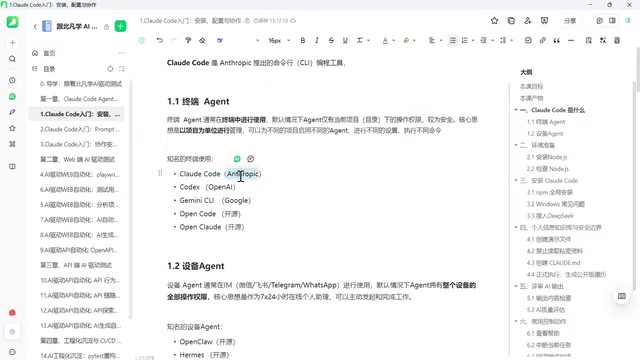
Here are the notable Terminal Agent tools currently available:
| Tool | Company | Default Model | Type |
|---|---|---|---|
| Claude Code | Anthropic | Claude series | Commercial |
| Codex | OpenAI | GPT series | Commercial |
| Gemini CLI | Gemini series | Commercial | |
| Open Code | Open source community | User-selected model | Open source |
| Open Claude | Open source community | User-selected model | Open source |
Commercial tools are typically bound to their own models by default, but the existence of open-source alternatives like Open Code and Open Claude means users aren't locked into any single ecosystem.
It's worth understanding the "framework-model decoupling" design philosophy here. A Terminal Agent essentially consists of two layers: the Agent framework layer (responsible for task decomposition, tool invocation, context management, file operations, and other orchestration logic) and the large model layer (responsible for code understanding, generation, and reasoning). Commercial products bundle these two layers together, while open-source tools allow users to freely swap out the underlying model. The value of this decoupled architecture is that enterprises can choose the most suitable model for different scenarios — using a privately deployed model when handling sensitive code, a more cost-effective cloud model for daily development, and switching to the most powerful reasoning model when tackling technical challenges. Open Code, Open Claude, and similar tools replicate Claude Code's framework design while opening up the model integration layer. As their names suggest, Claude Code has already become the benchmark in the Terminal Agent space.
Device Agents Explained: Full Delegation at the Personal Assistant Level
How Device Agents Work
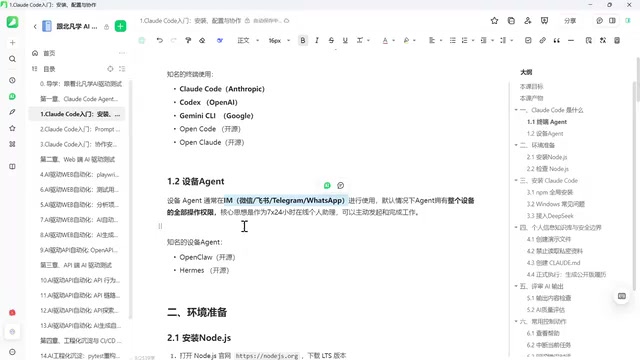
Unlike Terminal Agents, Device Agents interact through chat tools (WeChat, Feishu/Lark, DingTalk, etc.). Users don't even need to open their computers — they can simply send commands from their phones, and the AI will complete a series of complex operations in the background.
Advantages and Risks of Device Agents
The biggest advantage of Device Agents is their extremely low barrier to entry — no command-line knowledge needed; you can drive AI work through everyday chat. But the trade-off is that the AI needs full permissions over the entire device:
- Advantages: Can accomplish highly diverse tasks, truly achieving a personal assistant experience
- Risks: Security incidents such as deleting system files causing system crashes, or leaking confidential information, occur from time to time
From a security architecture perspective, Device Agents face a fundamental permissions dilemma. In computer security, there's a basic principle called the Principle of Least Privilege — any program or user should only be granted the minimum set of permissions needed to complete their task. Terminal Agents naturally follow this principle: they're confined to specific project directories and can only access files and tools related to the current task. Device Agents, however, must obtain broad permissions including file system read/write access, network access, application control, and even system configuration modification to achieve the "all-capable assistant" effect. This means that if the AI's judgment goes awry (the so-called "hallucination" problem), or if it falls victim to a Prompt Injection attack (where an attacker hijacks the AI's behavior through carefully crafted inputs), the scope of damage will far exceed that of a Terminal Agent. Furthermore, Device Agent operations often involve GUI-level screenshots and mouse simulation, which are much harder to precisely record and audit compared to CLI commands, further increasing the difficulty of security governance.
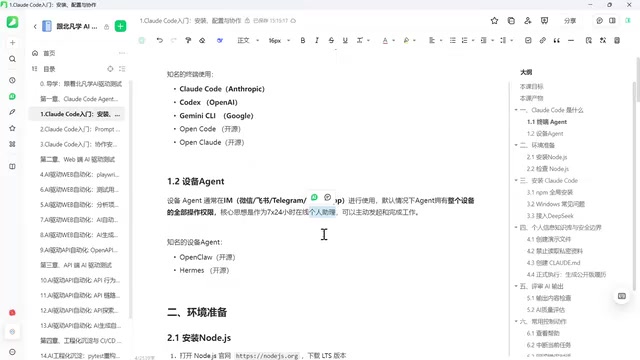
Notable Device Agent products include:
- Open Club (Xiaolongxia): Went viral in a short period; national security authorities issued usage warnings
- iPhone Agent: A new product supporting self-evolution, with higher token consumption but greater potential
Why Don't Enterprises Recommend Device Agents?
Many companies have explicitly notified employees: do not use device-level AI tools on company projects. The reason is straightforward — entrusting company assets and confidential information to AI carries too much risk and is difficult to audit. Device Agents are better suited for personal scenarios, such as managing personal affairs on your own computer.
Best Practice: The Claude Code + DeepSeek Combination
Based on the analysis above, the logic for technology selection becomes clear:
- Choose Terminal Agents over Device Agents: Stronger controllability, suitable for enterprise and project-level use cases
- Choose Claude Code as the Agent framework: Anthropic has the deepest technical expertise in AI coding, and the product itself has become the industry benchmark
- Pair it with DeepSeek as the large model: Leverage DeepSeek for more flexible model configuration while maintaining Claude Code's excellent framework
Regarding the choice of DeepSeek, it's worth understanding its technical background. DeepSeek is one of the representative companies in China's AI field, and its models such as DeepSeek-V3 and DeepSeek-R1 have performed impressively across multiple international benchmarks. DeepSeek employs a MoE (Mixture of Experts) architecture — the core idea of this architecture is to split a super-large model into multiple "expert" sub-networks, activating only a subset of experts during each inference. This maintains the model's total parameter count (and capability ceiling) while dramatically reducing actual computational overhead. This gives DeepSeek a significant cost-performance advantage: API call costs are far lower than competing models of comparable capability. By integrating DeepSeek into the Claude Code framework, enterprises can enjoy low-cost, high-quality AI assistance for daily coding tasks, and switch to Claude's native model for the strongest reasoning capabilities when encountering particularly complex architectural designs or tricky bugs. This "fixed framework, flexible model" strategy is a practical dividend of the Terminal Agent's decoupled architecture.
This combination ensures professionalism and security at the tool level while retaining flexibility at the model level — a highly pragmatic AI-assisted development approach.
Conclusion
The Terminal Agent approach represented by Claude Code is built on a core philosophy: human-AI collaboration, not full delegation. In an era of rapidly advancing AI capabilities, choosing a controllable, professional, project-bounded AI tool is more pragmatic and secure than pursuing "AI takes over everything." For developers and teams looking to adopt AI programming capabilities, Claude Code is a tool well worth exploring and putting into practice.
Key Takeaways
Related articles
Five Common Claude Code Mistakes — How Many Are You Making?
Five common Claude Code mistakes developers make: copy-pasting code, skipping CLAUDE.md, inefficient prompting, ignoring docs, and poor context management — with fixes.
Andrew Ng's New Course Explained: A Practical Guide to Using OpenAI's O1 Reasoning Model
Deep dive into Andrew Ng and OpenAI's Reasoning with O1 course covering test-time scaling, new prompting paradigms, multi-model orchestration, and practical applications for developers.

Learning AI After College Entrance Exams: A Complete Path from Zero to Freelancing
How to efficiently learn AI skills during summer break after exams? A complete path from mastering prompts and hands-on projects to freelancing on platforms.