Where Did the Antimatter Go? The Most Profound Unsolved Mystery of the Universe
Where Did the Antimatter Go? The Most …
From Dirac's prediction to CERN experiments: antimatter's discovery, production, and the cosmic asymmetry mystery
This article traces antimatter from Dirac's 1928 theoretical prediction to experimental verification, introduces CERN's latest achievements in producing antihydrogen atoms and confirming antimatter responds to normal gravity, reveals the extremely low production efficiency (a billion years to make one gram), discusses engineering challenges of antimatter as interstellar propulsion fuel, and focuses on the universe's greatest mystery — why almost only matter remains — as scientists search for answers through neutrino oscillation experiments.
From Mathematical Prophecy to Experimental Verification: The Discovery of Antimatter
The story of antimatter begins in 1928, and it's one of the most legendary cases in scientific history where "mathematics led physics." Paul Dirac was attempting to unify quantum mechanics with relativity, and during his derivation he encountered a mathematical structure similar to "the square of an equation equals 1" — taking the square root yielded two solutions: +1 and -1. The +1 corresponded to the electron, while the -1 corresponded to some unknown particle.
After a period of discussion (initially some speculated it might be the proton, but that didn't work out), Dirac insisted his equation was correct and predicted a positively charged "sibling" of the electron — what we now call the positron (the antimatter electron).
In 1932, Carl Anderson and his student Seth Neddermeyer observed the positron in experiments, transforming antimatter from theoretical prediction to experimental fact. In 1956, the antiproton was produced at Berkeley's large particle accelerator; a year later, the antineutron was also discovered.
How CERN Produces and Studies Antimatter Hydrogen Atoms
Today, scientists have gone far beyond what anyone imagined. At CERN (the European Organization for Nuclear Research), researchers have successfully produced antimatter hydrogen atoms — they obtain antiproton beams from low-energy accelerators, collect and cool them to near absolute zero, then use sodium-22 to produce positrons, combining the two to form complete antihydrogen atoms.
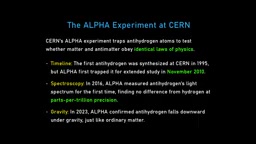
Even more remarkable are the precision measurements that followed. Scientists excite antihydrogen atoms to make them emit light, then check whether their spectral characteristics are completely identical to those of ordinary hydrogen atoms. Theory predicts they should be the same, and experimental results have confirmed this.
In 2023, CERN's ALPHA experiment group completed a milestone measurement: they placed antihydrogen atoms in a container and released them, observing whether they "floated" up or "fell" down. While intuition might suggest antimatter would experience "anti-gravity," substantial theoretical evidence indicates that antimatter should also be subject to normal gravitational attraction. The experimental result confirmed: antimatter does indeed fall downward. The current measurement precision is 0.75±0.29 times normal gravitational acceleration, consistent with the standard value of 1.0, and the team is continuously improving measurement precision.
How Hard Is It to Make Antimatter? The Staggering Numbers of Yield and Cost
Fermilab was once Earth's most powerful antiproton production facility (operating until 2011). Its production efficiency is jaw-dropping: every 2.3 seconds, 10¹³ protons are slammed into a target, yielding only about 10⁸ antiprotons — meaning every single antiproton produced requires 100,000 protons.
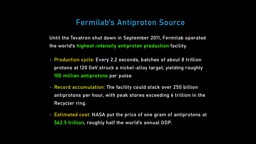
After 12 to 24 hours of collection and cooling, approximately 10¹² antiprotons can be accumulated. That sounds like a trillion, but consider that one gram of antimatter contains about 10²³ antiprotons. This means a day's production amounts to only about one hundred-billionth of a gram, and a year's output is roughly one nanogram (one billionth of a gram).
At this rate, producing one gram of antimatter would require a billion years of operation. And the energy released when one gram of antimatter annihilates with one gram of matter is equivalent to the combined yield of the Hiroshima and Nagasaki atomic bombs. To achieve a one-megaton yield (requiring approximately 25 grams of antimatter), NASA estimates the cost at about $1.5 quadrillion — compared to roughly $50 million for a nuclear warhead of equivalent yield.
Antimatter Energy and Interstellar Propulsion: An Engineering Challenge, Not a Physics Problem
In theory, antimatter could serve as the ultimate energy source for interstellar propulsion. Some estimates suggest that one gram of antimatter could accelerate a spacecraft to 0.2 times the speed of light, reaching the Alpha Centauri system within 20 years.

Fermilab physicist Don Lincoln offers a pragmatic assessment: "This isn't a physics problem — it's an engineering problem." We already know the principle — use energy to create antimatter, store it, use it to heat matter, and expel it from the rocket's exhaust. But the greatest challenge lies in storage: antimatter annihilates upon contact with ordinary matter, and even losing containment for a mere millionth of a second would be catastrophic.
Regarding whether more efficient antimatter production methods exist, Lincoln's answer is quite direct: the key lies in "energy density." Accelerators work because they concentrate energy into a volume the size of a proton. If someone could invent another way to achieve such extreme energy density concentration, then producing antimatter wouldn't be a problem — but that is precisely the core challenge.
The Universe's Greatest Mystery: The Asymmetry Between Matter and Antimatter
This is one of the most profound unsolved mysteries in physics. Einstein's equations tell us that when energy converts into matter, it must simultaneously produce an equal amount of antimatter. After the Big Bang, the universe was filled with enormous energy and should have produced equal amounts of matter and antimatter. Yet when we look around the universe, we see almost exclusively matter. Where did the antimatter go?
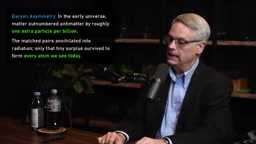
By calculating the number of protons in the universe and comparing it with the number of photons in the cosmic microwave background radiation, scientists have reached a stunning conclusion: in the early universe, for every one billion antimatter particles, there were one billion and one matter particles. Those billion-versus-billion pairs annihilated each other, and the remaining "one" — that's us, the entire source of galaxies, stars, planets, and life.
Searching for Answers: From Baryogenesis to Leptogenesis
The physical mechanism behind this tiny asymmetry remains unknown, but there are several leading hypotheses:
Hypothesis One: Initial Conditions
The universe was born with the asymmetry already built in, not produced by matter-antimatter processes.
Hypothesis Two: Baryogenesis
Quantum mechanics allows matter and antimatter to oscillate and transform into each other, and this transformation exhibits a tiny asymmetry. Experiments in the 1960s already observed this difference in certain short-lived particles, but its magnitude is insufficient to explain the asymmetry observed in the universe.
Hypothesis Three: Leptogenesis
This is the direction Fermilab is currently testing. We already know that neutrinos oscillate between three types (confirmed in 1998), and Fermilab is producing neutrino beams and antineutrino beams to compare the oscillation behavior of both. If a difference in oscillation rates is found, combined with other conditions, it could explain why matter dominates the universe.
Currently, experimental groups at Fermilab and in Japan are racing to see who can complete this critical measurement first. Lincoln admits: "If I had to bet, I'd wager that the two oscillation rates are the same — but until the measurement is made, nobody knows the answer."
Conclusion
Everything about our existence stems from a one-in-a-billion "lucky deviation" in the early universe. Understanding the origin of this deviation is not only about the completeness of fundamental physics — it may also open entirely new doors for future energy and propulsion technologies. As Lincoln says: "If you're not confused, you're not doing serious research." This mystery of antimatter is one of the driving forces behind humanity's exploration of the universe's deepest laws.
Related articles
 Deep Dives
Deep Dive into How OpenClaw (Open-Source Crayfish) AI Agent Works
Deep analysis of OpenClaw AI Agent internals: System Prompt, tool calling, SubAgents, Skill system, memory, and Context Engineering explained.
 Deep Dives
Demystifying Transformer: A Word-Continuation Function, Deconstructed
Understand Transformer through the lens of word continuation. Breaking down language generation into Embedding, Transformer Block, and Probability output modules for intuitive understanding.
 Deep Dives
Five Core Differences Between Claude Code and Regular AI Chat
A detailed comparison of Claude Code vs regular AI chat across five dimensions: interaction, context understanding, execution, memory, and tool integration.