Why Pure Vector Search Fails at Precision: A Deep Dive into Enterprise Hybrid Retrieval Architecture

RAG knowledge bases need hybrid retrieval—keyword and vector search are complementary, not replacements.
When building AI knowledge bases (RAG), relying solely on vector search fails to precisely match non-semantic keywords like business IDs and professional terminology—this is a fundamental capability boundary. The proven approach is hybrid retrieval architecture: keyword search (BM25) as the precision safety net, vector search for semantic understanding and user experience, results merged via algorithms like RRF, combined with Reranker precision ranking and query routing strategies to build production-ready RAG systems.
Many developers building AI knowledge bases (RAG) chase semantic intelligence exclusively, relying entirely on vector search to optimize Q&A experiences. Yet they overlook a critical fact: in real business scenarios, users don't just ask vague, conversational questions—they also need exact matches for specific keywords, professional terminology, and business identifiers.
If you only use vector search, you'll encounter a baffling problem—data clearly exists in the knowledge base, but when users input exact keywords, nothing matches. Many people repeatedly tweak models and adjust parameters, only to remain stuck. This isn't a code bug—it's a failure to understand the true capability boundaries of vector search.
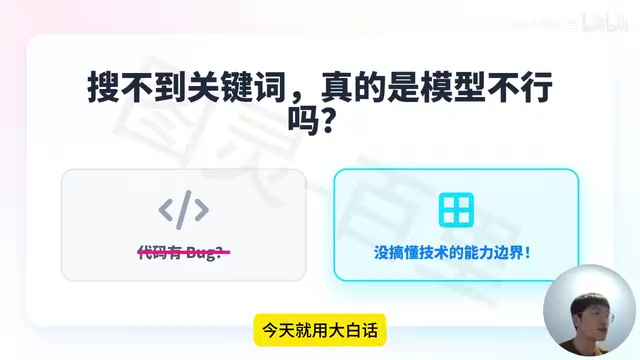
The Fundamental Difference Between Vector Search and Keyword Search
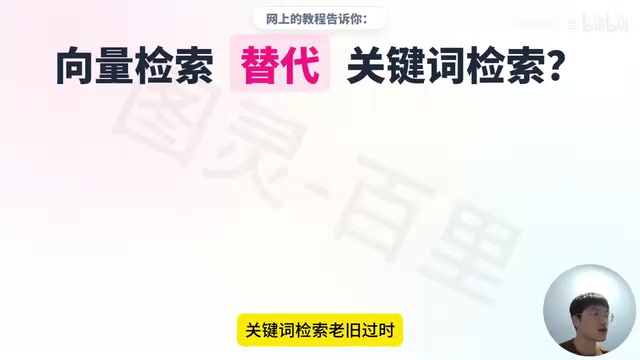
The vast majority of online tutorials push a single narrative: vector search is more advanced, keyword search is outdated, just replace it. But anyone who's worked on enterprise-grade projects knows that these two technologies were never meant to replace each other—they're complementary.
Keyword Search: Not Smart, But Extremely Precise
The principle behind keyword search is straightforward—it compares text literally, and if the characters match, it finds the result. It doesn't understand semantics or user intent, but its advantage is rock-solid: extremely high precision, purpose-built for rigorous business data. When a user inputs an order number, a product model, or a professional term, keyword search delivers exact matches without hesitation.
It's worth noting that BM25 (Best Match 25), the core algorithm behind modern keyword search, isn't simple string matching—it's a probabilistic ranking framework refined over decades. Developed by Stephen Robertson and others in the 1990s based on probabilistic information retrieval theory, it's a significant improvement over TF-IDF. BM25 introduces term frequency saturation and document length normalization, solving TF-IDF's problem of inflated term frequency in long documents—the longer a document, the more a single term's weight gets appropriately compressed, preventing "keyword-stuffed" documents from dominating rankings. To this day, BM25 remains the default ranking algorithm in mainstream search engines like Elasticsearch and Lucene, performing extremely reliably in exact keyword matching scenarios. This is precisely why it serves as the "safety net" in hybrid retrieval architectures.
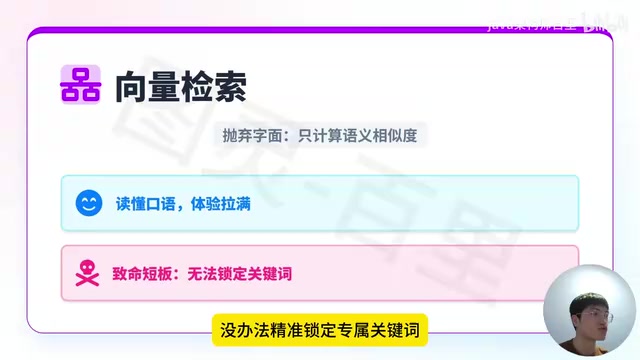
Vector Search: Great UX, But Can't Lock Onto Specific Keywords
Vector search works in the opposite direction—it abandons literal matching, converts text into high-dimensional vectors, and only computes semantic similarity. It can understand conversational language and grasp vague requests, maximizing user experience. But its weakness is equally critical—it cannot precisely lock onto specific keywords.
Vector search fundamentally relies on Embedding models to convert text into high-dimensional floating-point arrays (typically 512 to 4096 dimensions), essentially encoding semantic information into vector space. Semantically similar texts are closer together in vector space, and retrieval uses ANN (Approximate Nearest Neighbor) algorithms to quickly find similar vectors. Leading vector databases like Milvus use HNSW (Hierarchical Navigable Small World) indexing, Pinecone offers fully managed vector search services, and Weaviate provides modular Embedding integration capabilities. The core challenge for these databases is balancing recall rate against search speed—and this balance often completely breaks down when facing non-semantic business identifiers.
Why Vector Search Can't Accurately Find Keywords
Many people don't understand this point, so let me explain the underlying logic in simpler terms.
Terms like business IDs and professional terminology have extremely narrow semantics—no synonyms, no extended meanings. The core logic of vector models is finding semantically similar content. When facing these unique terms with zero similarity space, even if the text matches character-for-character, the model can't find sufficient matching evidence, ultimately returning empty results or irrelevant content.
Here's a concrete example: when a user queries "BJ-2024-0078"—a business identifier—the vector model tries to understand the "semantics" of this string, but it's fundamentally a non-semantic identifier. The model might decompose and recombine it, ultimately matching completely irrelevant content, while the document actually containing this identifier gets ranked far behind or lost entirely.
So the root cause isn't buggy code or insufficient model accuracy—it's a technology-scenario fit problem. Vector search is inherently designed for semantic understanding, optimizing user experience; keyword search is inherently designed for precise data location, providing a safety net.
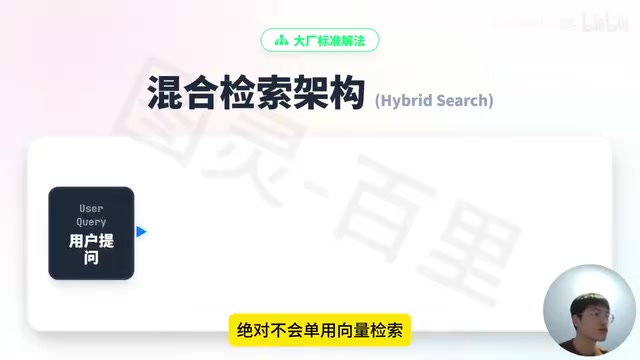
The Universal Enterprise Solution: Hybrid Retrieval Architecture
This is also the universal solution across all mature enterprise projects—never use vector search alone; always adopt a hybrid retrieval architecture where both mechanisms serve their respective roles.
Core Design Principles of Hybrid Retrieval Architecture
The core design logic of hybrid retrieval architecture is as follows:
-
Keyword search as the precision safety net: Protecting retrieval scenarios involving proper nouns, user IDs, and business terminology, preventing data loss. Typical implementations include Elasticsearch's BM25 algorithm, database full-text indexes, etc.
-
Vector search for experience optimization: Handling diverse conversational queries, understanding user intent, and enhancing the intelligence of Q&A interactions. Common vector databases include Milvus, Pinecone, Weaviate, etc.
-
Unified weighted ranking to merge results: Combining results from both retrieval paths through Reciprocal Rank Fusion (RRF) or custom weighting strategies for final optimal output.
RRF is a training-free, parameter-free multi-path result fusion algorithm proposed by Cormack et al. in 2009. Its core formula: each document's final score equals the sum of reciprocal ranks across all retrieval paths, i.e., Score = Σ 1/(k + rank_i), where k is typically set to 60 as a smoothing constant. RRF's advantage is its insensitivity to the raw score distributions of each retrieval path, avoiding fusion bias caused by different scoring scales across retrieval systems—compared to simple linear weighting, RRF is more robust in hybrid retrieval scenarios and is one of the most commonly used result fusion strategies in current RAG systems.
This architecture balances AI intelligence with production stability. This is what a truly production-ready RAG architecture looks like.
Practical Implementation Recommendations for Hybrid Retrieval
In real projects, weight distribution in hybrid retrieval needs dynamic adjustment based on business scenarios:
- Precision-heavy scenarios (e.g., internal ticket systems, regulatory queries): Increase keyword search weight to ensure exact matching of identifiers and clauses
- Experience-heavy scenarios (e.g., customer service Q&A, product inquiries): Increase vector search weight to enhance semantic understanding
- General scenarios: Split 50/50 or 60/40, then apply a Reranker model for secondary precision ranking
Reranker (re-ranking model) serves as the precision ranking layer in the RAG pipeline, typically using a Cross-Encoder architecture that contrasts with the Bi-Encoder architecture used in vector search. Bi-Encoder encodes queries and documents separately before computing similarity—fast but with some precision loss; Cross-Encoder concatenates the query and candidate document as joint input to the model, capturing finer-grained semantic interactions with higher accuracy but greater computational cost. Therefore, engineering practice typically uses vector search and keyword search for fast Top-K candidate recall, then applies a Reranker for fine-grained sorting of these candidates, forming a two-stage "coarse recall + precision ranking" architecture. Popular open-source Rerankers include BGE-Reranker, Cohere Rerank, etc.
Additionally, you can implement intent recognition at the query layer—if the user input contains obvious patterns like identifiers or codes, prioritize the keyword search channel; if it's natural language description, prioritize the vector search channel. This query routing strategy further improves overall retrieval effectiveness.
Query routing implementations range from simple to complex across three levels: first, rule-based regex matching to identify fixed-format patterns like order numbers, ID numbers, and product codes; second, lightweight classification models for multi-class query intent prediction; third, LLM-based dynamic routing, where the large model determines whether the current query is better suited for exact retrieval or semantic retrieval. Introducing query routing significantly reduces unnecessary computational overhead while improving end-to-end retrieval accuracy—it's a critical engineering step for taking RAG systems from prototype to production.
Architectural Thinking Matters More Than Technology Selection
Enterprise architecture isn't about who uses the newest technology. Technology has no inherent hierarchy of old versus new—only scenario fit. Legacy tech holds the baseline, new tech pushes the ceiling—don't blindly follow trends; thoroughly understand technology boundaries before combining them. That's the architectural thinking that truly creates value.
Returning to the RAG knowledge base scenario, the core takeaways are:
- Don't blindly trust a single technology path; understand the capability boundaries of each technology
- Hybrid architecture isn't simple stacking—it's letting different technologies excel in their respective scenarios
- The key to production implementation lies in weight tuning and query routing, which requires iterative refinement with real business data
The essence of technology selection is scenario matching, not chasing novelty. Internalize this mindset, and it applies not just to retrieval architecture but to every aspect of AI engineering.
Key Takeaways
- Vector search excels at semantic understanding but cannot precisely match non-semantic keywords like business IDs and professional terminology—this is a fundamental capability boundary, not a code issue
- Keyword search (e.g., BM25) doesn't understand semantics but is irreplaceable for exact matching scenarios; the two technologies are complementary, not substitutes
- Enterprises universally adopt hybrid retrieval architecture: keyword search as the precision safety net, vector search for user experience optimization, with results merged through weighted ranking algorithms like RRF
- Reranker models serve as the precision ranking layer, using Cross-Encoder architecture for secondary fine-grained sorting of coarse recall results—a critical component for production RAG systems
- Query routing strategies use intent recognition to dispatch different query types to the most suitable retrieval channel, further improving end-to-end retrieval effectiveness
- The core of architectural thinking is scenario fit rather than chasing new technology—legacy tech holds the baseline, new tech pushes the ceiling—that's the engineering approach for production-ready systems
Related articles
 Deep Dives
Deep Dive into How OpenClaw (Open-Source Crayfish) AI Agent Works
Deep analysis of OpenClaw AI Agent internals: System Prompt, tool calling, SubAgents, Skill system, memory, and Context Engineering explained.
 Deep Dives
Demystifying Transformer: A Word-Continuation Function, Deconstructed
Understand Transformer through the lens of word continuation. Breaking down language generation into Embedding, Transformer Block, and Probability output modules for intuitive understanding.
 Deep Dives
Five Core Differences Between Claude Code and Regular AI Chat
A detailed comparison of Claude Code vs regular AI chat across five dimensions: interaction, context understanding, execution, memory, and tool integration.