Why Qwen3 Is the Best Open-Source Model for MCP Agent Development
Why Qwen3 Is the Best Open-Source Mode…
Qwen3 is the best open-source model for MCP agent development, surpassing DeepSeek R1's limitations.
LLM developers must understand the capability boundaries of multiple models for proper technical selection. DeepSeek R1, as a reasoning model, doesn't support Function Calling or JSON Output, making it unsuitable for agent and MCP development without fine-tuning; DeepSeek V3 fully supports both. Qwen3 stands out as the best open-source choice for agent development thanks to seamless thinking mode switching and enhanced MCP protocol support, achieving superior agent task performance with its MoE architecture using far fewer parameters.
LLM Development Requires More Than Just One Model
A common misconception in LLM application development is focusing exclusively on a single "trending" model. Many beginners say, "I've only learned DeepSeek," but in real-world enterprise development, your boss might ask: Should we use DeepSeek for this project, or Qwen, or OpenAI's GPT-O3, or Claude 3.7?
If you're only familiar with one model, you clearly can't handle this kind of technical decision-making. You need to have a thorough understanding of each model's characteristics, pricing, open-source licensing, and capability boundaries.
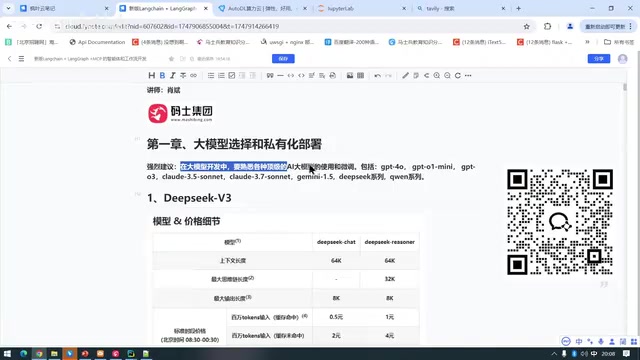
A competent LLM developer should be able to freely switch between different models within the same project — from DeepSeek to GPT-O3, then to Claude 3.7, and then to Qwen3 — with the code running correctly every time. That's what real engineering capability looks like.
DeepSeek R1's Fatal Weakness: No Function Calling Support
Why You Can't Use DeepSeek R1 for Agent Development
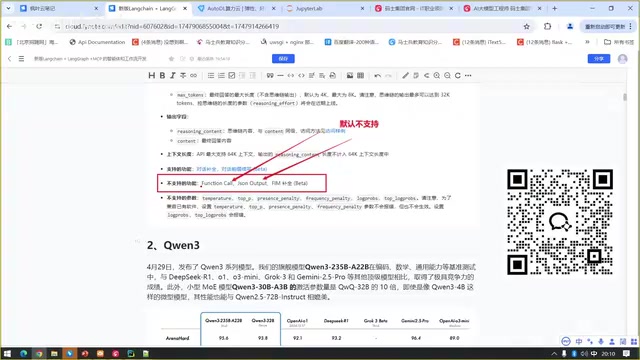
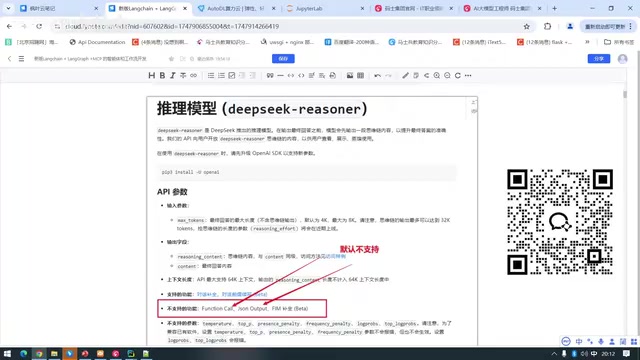
Many people confuse the capability boundaries of DeepSeek V3 and DeepSeek R1. According to DeepSeek's official documentation, DeepSeek R1 (a.k.a. DeepSeek-Reasoner) does not support three critical features:
- Function Calling (local tool invocation)
- JSON Output (structured JSON output)
- FIM (Fill-in-the-Middle / chat completion)
Understanding the Essence of Function Calling
Function Calling is the core mechanism through which LLMs interact with the external world. Its essence is enabling the model to recognize when it needs to invoke an external tool during response generation, output the invocation parameters in a structured format, have the host program execute the call, and then return the results to the model. This capability was first formally introduced by OpenAI in June 2023 with the GPT-3.5/4 API and quickly became a standard requirement for agent development. Without Function Calling, a model can only engage in plain text conversations — it cannot proactively query databases, call APIs, or manipulate file systems. The agent's "ability to act" simply doesn't exist without it.
These three limitations are fatal for agent development. Function Calling is the foundation of local tool invocation — without it, agents cannot interact with external tools. JSON Output is practically essential for MCP (Model Context Protocol) development, since MCP data transmission relies almost entirely on JSON format.
Why Does R1 Have These Limitations?
DeepSeek R1 belongs to the emerging category of "Reasoning Models," sharing the same technical direction as GPT-O1/O3 and Claude 3.7 Sonnet's extended thinking mode. These models perform extensive internal "chain-of-thought" reasoning before generating final answers, excelling at tasks like math, coding, and logical reasoning. However, their architecture prioritizes reasoning depth at the expense of precise control over structured output formats. Forcing formatted output interferes with their internal reasoning process and degrades performance — this is the fundamental reason R1 doesn't support Function Calling and JSON Output, and it represents the core engineering tension between reasoning models and tool-calling capabilities.
How Do Enterprises Solve This Problem?
Some enterprises do use DeepSeek R1 for agent development, but here's what they do: they download the DeepSeek R1 model and fine-tune it to add Function Calling and JSON Output capabilities. Only the resulting fine-tuned model can be used for agent or MCP development.
It's important to emphasize that DeepSeek V3 (especially the V3-0424 version) fully supports Function Calling and JSON Output — don't conflate V3 with R1. The upcoming R2 version is expected to support these features as well, but it hasn't been released yet.
Qwen3: The Top Choice for Agent Development Among Open-Source Models
Model Matrix and Architecture Options
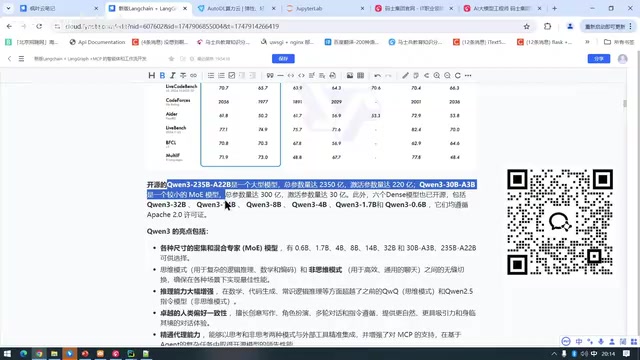
Qwen3 has open-sourced six models covering different application scales:
- Flagship model: Qwen3-235B (MoE architecture), with far fewer activated parameters than DeepSeek's 671B
- Sub-flagship: Qwen3-30B (MoE architecture)
- Lightweight models: Qwen3-8B, Qwen3-14B, Qwen3-32B, etc. (Dense architecture)
Two key architectures are involved here, and understanding their differences is crucial for technical decision-making:
MoE (Mixture of Experts) is a sparsely activated neural network architecture. Its core idea is to divide model parameters into multiple "expert" sub-networks, with a gating network (Router) dynamically selecting only a few experts to participate in computation during each inference pass, rather than activating all parameters. This allows the model to have an extremely large total parameter count while requiring far less actual computation than a Dense model of equivalent size. Both DeepSeek V3/R1 and Qwen3's flagship version adopt this architecture, dramatically reducing inference costs while maintaining high performance. It's the mainstream technical approach for scaling up large models today.
Dense (Dense architecture) is the traditional full-parameter activation approach, used by most modern models including OpenAI's GPT-4o. Every inference pass activates all parameters, making computation proportional to parameter count. However, the architecture is simple and deployment-friendly, making it suitable for local lightweight scenarios.
Qwen3's flagship version uses the MoE architecture with roughly one-third the parameter count of DeepSeek's flagship, yet delivers superior performance on agent tasks.
Qwen3's Two Core Advantages
While the official release highlights five major features, the two most critical for MCP and agent developers are:
1. Seamless Thinking Mode Switching
Qwen3 supports free switching between deep thinking mode and non-deep thinking mode, with seamless transitions. This is unique among current open-source models. This design elegantly resolves the engineering tension between reasoning models and tool-calling capabilities — enabling deep thinking mode for complex reasoning tasks and switching to non-thinking mode for structured output and tool invocation. Both capabilities coexist within a single model. Deep thinking mode is ideal for complex reasoning tasks, while non-thinking mode suits rapid response scenarios, giving developers the flexibility to choose based on actual needs.
2. Mastery of Agent Proxying and MCP Protocol
MCP (Model Context Protocol) is a standardized protocol proposed and open-sourced by Anthropic in late 2024, designed to solve the fragmentation problem of integrating LLMs with external data sources and tools. Analogous to how USB-C unified hardware connection standards, MCP defines a unified communication specification between AI models and various tools (file systems, databases, web services, etc.). MCP uses JSON-RPC as its underlying transport format, which is precisely why JSON Output capability is so critical for MCP development — the model must be able to reliably output JSON structures that conform to the specification in order to communicate properly with MCP servers.
Qwen3 can precisely integrate with external tools in both thinking and non-thinking modes, with enhanced support for the MCP protocol. The official statement reads: "Achieved leading performance among open-source models in complex agent-based tasks."
This means that in the open-source space, if you're doing agent development or MCP integration, Qwen3 is currently the best choice, bar none. Even Meta's LLaMA 3.2 supports MCP development, but in terms of actual effectiveness, it falls short of Qwen3.
Technical Selection Guide for MCP Agent Development
For developers preparing to build MCP agents, here are some practical selection references:
| Scenario | Recommended Model | Notes |
|---|---|---|
| Open-source agent development | Qwen3-235B/30B | Currently the best open-source option |
| DeepSeek ecosystem | DeepSeek V3-0424 | Supports Function Calling |
| Commercial API calls | GPT-O3/Claude 3.7 | Each has its strengths |
| Local lightweight deployment | Qwen3-14B/32B | Dense architecture, deployment-friendly |
Never use the original DeepSeek R1 for agent development unless you have the capability to fine-tune it. Qwen3 has already demonstrated strong competitiveness in the agent development space and is well worth every LLM developer's time to study and practice.
Conclusion
The core competitive advantage in LLM development isn't about which single model you know — it's about whether you can understand the capability boundaries of different models and make the right technical choices in real projects. Qwen3's performance in MCP agent development proves that Chinese open-source models have achieved world-class competitiveness. For developers, the real hard skills lie in mastering model-switching capabilities, understanding the differences between MoE and Dense architectures, and being familiar with each model's Function Calling support scope.
Key Takeaways
- DeepSeek R1 does not support Function Calling or JSON Output; the original version is unsuitable for agent and MCP development and requires fine-tuning before use
- DeepSeek V3 (especially V3-0424) fully supports Function Calling and JSON Output — don't confuse it with R1
- Qwen3 is currently the best open-source model for agent development and MCP integration, with seamless thinking mode switching
- Qwen3's flagship version uses MoE architecture with only one-third the parameters of DeepSeek's flagship, yet delivers superior agent task performance
- MCP protocol uses JSON-RPC transport format, which is the fundamental reason JSON Output capability is a prerequisite for MCP development
- LLM developers should master multiple models and be able to flexibly switch between them in projects
Related articles
 Tutorials
Cursor + Codex Dual-IDE Collaboration: A Practical Methodology for Open-Source Project Customization
A complete methodology for open-source project customization based on real-world experience, detailing the Cursor+Codex dual-IDE workflow, seven-stage process, MVP validation, and AI source code reading techniques.
 Tutorials
Cursor Multi-Agent in Practice: Building a Full-Stack Next.js Blog in 50 Minutes
Build a full-stack blog in 50 minutes using Cursor IDE's multi-Agent mode with Next.js, Clerk auth, and Supabase. Learn the 4-phase AI Agent workflow and key integration pitfalls.
 Tutorials
Building an AI Software Factory from Scratch: A Cursor Engineer's Hands-On Experience with Multi-Agent Collaboration
Cursor engineer Eric shares practical insights on building an AI software factory: automation levels, guardrail design, parallel Agent management, and scaling to 1000+ Agents for 24/7 development.