Writing Web Novels with DeepSeek: A Complete Prompt Tutorial from Outline to Publication

A complete tutorial on systematically creating AI web novels using DeepSeek's five-step method
This article presents a five-step workflow for writing web novels using DeepSeek's Deep Think mode: generating an outline, reviewing causal chains, fleshing out characters, outputting chapter sub-outlines, and generating body text chapter by chapter. It emphasizes using tools like Doubao to polish and remove AI traces before publishing to pass platform review, and recommends a horse race mechanism for operations—trading quantity for quality to find hit topics.
Introduction
As AI writing tools mature, more and more people are experimenting with AI-assisted web novel creation. A 27-year-old creator shared their complete workflow for writing novels at home using DeepSeek, claiming the process is simple, generates consistently growing metrics, and can successfully pass review on platforms like Tomato Novel (番茄小说). This article organizes that method into a systematic tutorial for interested readers.
Core Tools & Preparation
The core tool for the entire workflow is DeepSeek, with its Deep Think mode enabled. Deep Think mode allows the AI to more thoroughly understand creative requirements and generate content with better logic and coherence.
DeepSeek is a large language model developed by DeepSeek (深度求索). Its Deep Think mode is essentially a Chain-of-Thought reasoning mechanism. Compared to standard conversation mode, Deep Think mode has the model perform multi-step internal reasoning before generating its final response—similar to how humans deliberate when solving complex problems. This mode is particularly suited for tasks requiring logical coherence and long-range planning, such as novel outline design and plot causality analysis. With this mode enabled, response time increases slightly, but output quality shows significant improvement in structure and logic.
Preparation is straightforward: open the DeepSeek chat interface, confirm that Deep Think mode is enabled, and then execute the following five steps in sequence.
The Five-Step Creation Method Explained
Step 1: Generate the Novel Outline
Prompt reference format: "I want to write a [genre] novel, approximately [word count] words, with the following requirements: [specific requirements]."
For example: "I want to write an urban underdog-to-success novel, approximately 500,000 words, with tight pacing, satisfying payoffs, and a male protagonist who rises from the bottom."
After sending this, the AI will intelligently generate an outline including the main storyline, core conflicts, and general direction. The key to this step is making your requirements as specific as possible—genre, word count, style, and target audience can all be included.
Step 2: Review the Story's Causal Chain
This step is critical and often overlooked. Have the AI analyze whether the novel's setup is logical using the "Problem → Conditions → Solution" framework.
Causal chain analysis originates from plot logic theory in narratology. Aristotle proposed in Poetics that good stories should follow a causal sequence of "because of this, therefore that" rather than a temporal sequence of "after this, that happened." In web novel creation, the rigor of the causal chain directly affects reader immersion—once readers notice that "the protagonist gained an ability out of nowhere" or "the antagonist's actions have no motivation," they break out of the story. AI is particularly prone to causal breaks when generating long-form content because large language models have limited attention windows and struggle to consistently track all previously established constraints.
Specifically, have the AI check:
- What is the protagonist's core problem?
- What conditions are needed to solve the problem?
- Are the means of obtaining these conditions reasonable?
- Are there any logical holes in the overall causal chain?
This step effectively prevents plot holes and logic bugs in subsequent writing, making the story hold up to scrutiny.
Step 3: Flesh Out Character Background Details
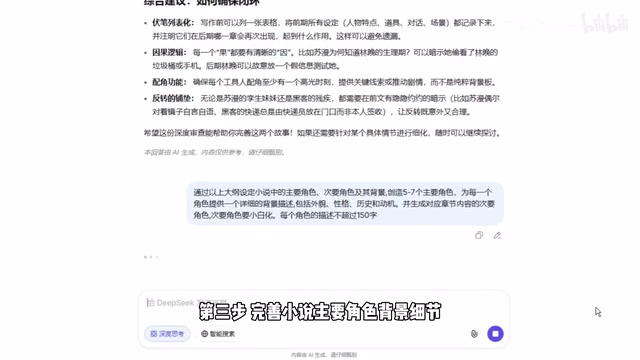
Prompt key point: Ask the AI to generate vivid personality descriptions for each major character, with each character's description not exceeding 150 words.
The 150-word limit is a clever design choice—it ensures character traits are distinctive enough without causing AI memory confusion during subsequent writing due to overly long descriptions. This word limit relates to context window management in large language models. Although modern LLMs have expanded context windows to tens or even hundreds of thousands of tokens, research shows that models don't utilize information uniformly across long contexts—there's a phenomenon called "Lost in the Middle," where models remember information at the beginning and end of the context better while tending to overlook the middle. Keeping character descriptions under 150 words ensures sufficient key information density while reducing information noise in the context, allowing the model to more accurately invoke character settings when generating body text later.
Character cards should include: personality traits, core motivations, relationship with the protagonist, and signature characteristics.
Step 4: Output Chapter Outlines
Core prompt: "Based on the above settings, divide the novel outline into X chapters. No need to introduce chapter content—provide a detailed sub-outline with main content."
The "detailed sub-outline" here refers to each chapter's core events and turning points, not detailed content expansion. The benefit of this approach is leaving enough creative space for subsequent body text writing while ensuring the overall structure doesn't fall apart.
Step 5: Output Body Text Chapter by Chapter
Starting from Chapter 1, have the AI output body text according to the sub-outline. This step has one extremely important constraint that must be added:
"Please do not deviate from the main storyline. If deviation is detected, automatically correct it."
This sentence acts as a self-correction mechanism for the AI. Repeat this operation for every subsequent chapter, and include as many detailed constraints as possible in your prompts—word count, style, pacing, etc.—to prevent the AI from going off track.
Critical Pre-Publication Processing
Content Review & Self-Check
Before publishing, input a dedicated review prompt asking the AI to analyze whether the output contains:
- Contradictory plot points
- Dialogue that breaks character
- Sections with sluggish pacing
- Content that violates platform guidelines
Web novel platforms like Tomato Novel currently employ multi-layered review mechanisms, including automated machine review and manual spot-checks. Machine review primarily detects sensitive words, prohibited content, and text quality metrics (such as repetition rate, readability scores, etc.). Some platforms have begun deploying AI-generated content detection tools that analyze statistical features like text perplexity, vocabulary diversity, and sentence structure variation frequency to determine whether content is AI-generated. Excessively low perplexity (i.e., text that is too "smooth and uniform") is a typical characteristic of AI text—which is why post-processing polish is necessary.
Techniques for Removing AI Traces
This is the critical step for getting approved. You can use tools like Doubao (豆包) to polish content and effectively remove typical AI writing traces. AI text usually has obvious characteristics: overly neat parallel structures, lack of colloquial expressions, formulaic emotional descriptions, etc. The purpose of polishing is to make the text read more like it was written by a human.
Doubao is an AI assistant product launched by ByteDance. Its text polishing function essentially uses another large language model to rewrite existing text. Using AI to rewrite AI-generated text effectively breaks the statistical feature patterns of the original text—because different models have different vocabulary preferences, sentence habits, and expression styles. This "model stacking" approach is similar to style transfer in image processing, making the final text's statistical features closer to the randomness and diversity of human writing. Additionally, manually adding colloquial expressions, irregular line breaks, personalized metaphors, and other elements can further reduce the probability of being identified by AI detection tools.
Operational Strategy Recommendations
After uploading and publishing, the creator recommends adopting a "horse race mechanism":
- Works with good metrics: Continue serializing and maintain update frequency
- Works with mediocre metrics: Decisively abandon them and start fresh with a new topic
The core logic of this strategy is: AI dramatically reduces creation costs, so you can trade quantity for quality, finding topic directions that readers enjoy through multiple attempts.
The horse race mechanism borrows from A/B testing thinking in internet products and traffic distribution logic from short video platforms. On platforms like Tomato Novel, new works typically receive a certain amount of initial recommendation traffic (cold-start traffic pool), and the platform algorithm decides whether to grant more recommendations based on core metrics like click-through rate, completion rate, and follow-up reading rate. Works with good data performance enter larger traffic pools, creating a positive cycle; those with poor data quickly sink. Since AI compresses the creation cost of a single book from weeks to days or even hours, creators can simultaneously test multiple topic directions, using the law of large numbers in statistics to increase the probability of "producing a hit."
Final Thoughts
It should be objectively noted that AI writing still has limitations: insufficient long-form coherence, limited emotional depth in characters, and creative homogenization remain ongoing issues. This method is better suited as an introductory experiment. Creators who truly want to develop long-term in the web novel space still need to inject their own creativity and style on top of AI assistance.
Additionally, platform policies regarding AI-generated content are constantly evolving. Creators are advised to stay updated on the latest platform rules to ensure compliant operations.
Key Takeaways
- Use DeepSeek's Deep Think mode with the five-step method (Outline → Causal Review → Characters → Chapters → Body Text) to systematically generate novel content
- Ensure story logic through "Problem → Conditions → Solution" causal chain analysis
- When generating body text, always include the constraint: "Do not deviate from the main storyline; if deviation occurs, automatically correct it"
- Polishing with tools like Doubao to remove AI traces before publishing is the critical step for passing platform review
- Adopt a horse race operational mechanism: continue serializing works with good data, switch topics for those with poor data, trading quantity for quality
Related articles
 Tutorials
Cursor + Codex Dual-IDE Collaboration: A Practical Methodology for Open-Source Project Customization
A complete methodology for open-source project customization based on real-world experience, detailing the Cursor+Codex dual-IDE workflow, seven-stage process, MVP validation, and AI source code reading techniques.
 Tutorials
Cursor Multi-Agent in Practice: Building a Full-Stack Next.js Blog in 50 Minutes
Build a full-stack blog in 50 minutes using Cursor IDE's multi-Agent mode with Next.js, Clerk auth, and Supabase. Learn the 4-phase AI Agent workflow and key integration pitfalls.
 Tutorials
Building an AI Software Factory from Scratch: A Cursor Engineer's Hands-On Experience with Multi-Agent Collaboration
Cursor engineer Eric shares practical insights on building an AI software factory: automation levels, guardrail design, parallel Agent management, and scaling to 1000+ Agents for 24/7 development.