xAI Merges with SpaceX, GPT-5.5-Cyber Preview, Gemini 3.1 Flash Released

AI industry surges forward: mergers, security models, lightweight AI, enterprise adoption, and energy bottlenecks converge.
The AI industry sees multiple major developments: Musk merges xAI with SpaceX into SpaceX AI for deep AI-aerospace data synergy; OpenAI launches security-focused GPT-5.5-Cyber; Google releases lightweight Gemini 3.1 Flash to compete for developer ecosystems; Airbnb reveals AI writes 60% of new code, proving enterprise adoption depth; and grid strain exposes the energy bottleneck of AI compute expansion, with nuclear power becoming a strategic focus for tech giants.
Another Wave of Major AI Industry Announcements
The AI industry has once again been hit with a barrage of major news: Musk announced that xAI will merge with SpaceX, OpenAI launched GPT-5.5-Cyber for the security domain, Google released the lightweight Gemini 3.1 Flash model, and Airbnb revealed that AI now writes 60% of its new code. These developments—spanning organizational restructuring, product security, model iteration, and enterprise adoption—showcase the accelerating evolution of the AI industry from every angle.
Musk's Big Move: xAI Merges with SpaceX, Rebranded as SpaceX AI
Musk officially announced that xAI will no longer exist as an independent entity but will merge with SpaceX, with the new organization rebranded as SpaceX AI. This decision signals a fundamental restructuring at the intersection of two cutting-edge fields: AI and aerospace.
The strategic intent behind this merger is crystal clear. SpaceX has a massive engineering team, rocket launch data, and the Starlink satellite network, while xAI focuses on large model and AGI research. Post-merger, AI capabilities can directly empower autonomous decision-making in space missions, orbital calculations, and satellite communication optimization, while SpaceX's hardware infrastructure and data resources can feed back into AI model training.
From a technical synergy perspective, this merger's value extends far beyond the organizational level. xAI was founded in 2023, and its core product, the Grok large model, has consistently faced challenges in training data and compute resources. SpaceX's Starlink network currently has over 6,000 satellites in orbit, generating massive amounts of orbital dynamics, communication link, and ground station data daily—all invaluable training data for autonomous decision-making AI models. Additionally, SpaceX's Raptor engines and Falcon rocket series have accumulated sensor data from thousands of launches, offering unique value for training engineering reasoning AI. If the merged SpaceX AI can bridge this proprietary data with large model capabilities, it will create a moat in vertical AI that other companies will find nearly impossible to replicate.
Calling this merger a "collision of worlds" is no exaggeration—this may be one of the most imaginative organizational restructurings in tech history.
Defense and Security: AI's High-Value Battleground
Scale AI Lands $500 Million Defense Contract
Scale AI secured a $500 million contract from the U.S. Department of Defense to develop the Proxy AI system for the U.S. Air Force. You might not have noticed, but this amount is 5x the previous contract, reflecting the exponential growth of defense investment in AI.

Proxy AI is a class of AI systems designed specifically for military decision support, with core capabilities including intelligence fusion, target identification, and mission planning automation. Scale AI's core competitive advantage lies in data labeling and RLHF (Reinforcement Learning from Human Feedback) pipelines—precisely the critical components for training high-reliability military AI. The U.S. Department of Defense has been steadily advancing AI militarization through JAIC (Joint Artificial Intelligence Center) and its successor CDAO in recent years, and this $500 million contract is one of the largest single defense AI procurements since Project Maven. Notably, defense AI contracts typically come with strict data security and explainability requirements, posing compliance challenges to AI companies' technical architectures far exceeding those of the commercial market.
The burn rate for defense AI is staggering, but it also points to a clear trend: AI applications in military and national security have moved from the experimental phase into large-scale deployment.
OpenAI Launches GPT-5.5-Cyber Limited Preview
OpenAI has opened a limited preview of GPT-5.5-Cyber, targeting critical infrastructure organizations and focused on helping developers identify and fix code vulnerabilities. This is a significant step in OpenAI's productization of security capabilities.

The "Cyber" suffix in the name clearly positions this model for cybersecurity. The code vulnerability identification that GPT-5.5-Cyber targets is technically a combination of static analysis and semantic understanding. Traditional SAST (Static Application Security Testing) tools rely on rule engines, suffer from high false-positive rates, and cannot understand business logic context; large language models, however, can understand code intent and identify complex vulnerability patterns such as SQL injection, buffer overflow, and privilege escalation. The global cybersecurity market is projected to exceed $200 billion in 2025, with vulnerability management being the fastest-growing segment. OpenAI's choice of "limited preview" rather than full availability serves two purposes: preventing attackers from using the same model to reverse-engineer exploit code, and establishing a responsible AI deployment case study from a regulatory perspective—reflecting their cautious approach to the security domain.
Google's Intensive Updates: Full-Spectrum Push from Models to Ecosystem
Gemini 3.1 Flash Officially Released
Google released Gemini 3.1 Flash (the official GA version of the light model), emphasizing low latency and low cost, now available to developers worldwide through Google Cloud.

Lightweight models are a critical competitive track in the current large model landscape, driven by a practical contradiction: flagship models at the GPT-4 level can cost several cents per inference call, making costs unsustainable for high-frequency enterprise applications. Gemini 3.1 Flash uses Knowledge Distillation and quantization compression techniques to dramatically reduce parameter count and computational overhead while retaining the reasoning capabilities of larger models. Not every use case requires the most powerful model—many real-world business applications prioritize response speed and call cost. The release of Gemini 3.1 Flash is a key move in Google's battle for the developer ecosystem, directly competing with OpenAI's GPT-4o-mini and similar lightweight offerings.
Pre-I/O Ecosystem Warm-Up
With Google I/O just 11 days away, Google has already begun releasing updates at an accelerated pace:
- Google Health app uses Gemini as a personalized health coach
- Gemini 4 introduces Multi-Token Prediction technology
- Ecosystem update frequency has noticeably increased

Gemini 4's Multi-Token Prediction (MTP) technology deserves special attention: traditional autoregressive models predict only one token at a time, while MTP allows the model to predict multiple subsequent tokens in parallel, theoretically boosting inference speed by 2-4x while improving long-range coherence. This doesn't contradict Gemini 3.1 Flash's lightweight approach—the former addresses cost, while the latter balances speed and quality. Together, these two technical paths form Google's model competition matrix. This "warm-up release" strategy shows that Google has a clear plan for its AI narrative at this year's I/O, attempting to establish a perception of technical leadership before the conference even begins.
Developer Tools and Enterprise Adoption: AI Penetration Accelerates
Airbnb: AI Now Writes 60% of New Code
Airbnb revealed that AI now writes 60% of its new code, and its customer service bots can handle 40% of issues without human escalation. These numbers are incredibly compelling, directly proving the depth of AI adoption in major tech companies.
Behind this figure is the systematic integration of AI coding tools like GitHub Copilot and Cursor into enterprise development workflows. These tools use RAG (Retrieval-Augmented Generation) to connect with private enterprise code repositories, understanding specific project architecture conventions and coding standards to generate code snippets that match team style. In terms of job impact, junior developers' tasks—boilerplate code writing, unit test generation, and documentation—are hit hardest, while demand for higher-order skills like system architecture design, requirements understanding, and code review is actually rising. When a company worth tens of billions of dollars publicly states that AI handles most of its coding work, the entire industry needs to seriously rethink human-AI collaboration models.
OpenAI Codex Evolves into an Operations Gateway
OpenAI released a Chrome extension for Codex and is testing remote control capabilities. Codex is gradually evolving from a coding assistant into a developer's operations gateway. This evolution means AI is leaping from "code completion tool" to "autonomous software engineer," capable of independently completing the full development cycle from requirements understanding to code submission, rather than merely responding passively to developers' one-off instructions.
Simultaneously, OpenAI launched new voice intelligence features for its API, covering customer service, education, and content creation scenarios. Real-time voice interaction as a key AI interface continues to gain momentum.
The Hidden Concern of Compute Expansion: Power Infrastructure Under Strain
According to TechCrunch, the power grid managed by PJM in data center-dense regions is under strain from AI demand, and the organization is pushing for reform. This reveals a critical bottleneck behind the AI industry's rapid growth—power infrastructure.
PJM Interconnection is the largest regional transmission organization in the United States, covering 13 states and Washington D.C., managing approximately 180GW of generation capacity. Data centers are densely concentrated in Northern Virginia (one of the world's largest data center clusters), where power demand growth has outpaced grid expansion capacity. Training a GPT-4-scale large model consumes approximately 50GWh of electricity—equivalent to about 5,000 American households' annual consumption; ongoing inference services represent an even larger long-term power burden. This explains why Microsoft invested in restarting the Three Mile Island nuclear plant, Google signed a nuclear energy agreement with Kairos Power, and Amazon acquired nuclear-powered data centers—the stable baseload power provided by nuclear energy is one of the most realistic paths to meeting AI compute power demands, rather than relying on intermittent wind and solar energy. The AI competition may ultimately come down to the most fundamental competition of all: energy.
Summary
Today's AI industry developments reveal several clear trends: bold organizational consolidation (xAI + SpaceX), accelerating security productization (GPT-5.5-Cyber), ecosystem competition through lightweight models (Gemini 3.1 Flash), deep enterprise penetration (Airbnb's 60% AI-written code), and real-world infrastructure challenges (power grid strain). AI is transitioning from a technology race into a comprehensive phase of industrial transformation.
Key Takeaways
- Musk announced the merger of xAI and SpaceX under the name SpaceX AI; bridging Starlink data with large model capabilities will create an almost irreplicable moat in vertical AI
- OpenAI launched GPT-5.5-Cyber in limited preview, using LLM semantic understanding to break through the rule-engine limitations of traditional SAST tools
- Google released the lightweight Gemini 3.1 Flash model and introduced Multi-Token Prediction technology in Gemini 4 to boost inference speed
- Airbnb disclosed that AI writes 60% of new code and handles 40% of customer service issues, with RAG technology driving deep integration of AI coding tools into enterprise development workflows
- PJM grid strain reveals the energy bottleneck of AI compute expansion, with nuclear baseload power becoming a strategic priority for tech giants
Related articles
 Tech Frontiers
GitHub Agent HQ Launch: AI Coding Tools Enter the Era of Platform Competition
GitHub Universe unveils Agent HQ platform for unified coding agent management, Copilot upgrades with multi-model support. OpenAI completes restructuring, Anthropic tests new model, NVIDIA open-sources AI models.
 Tech Frontiers
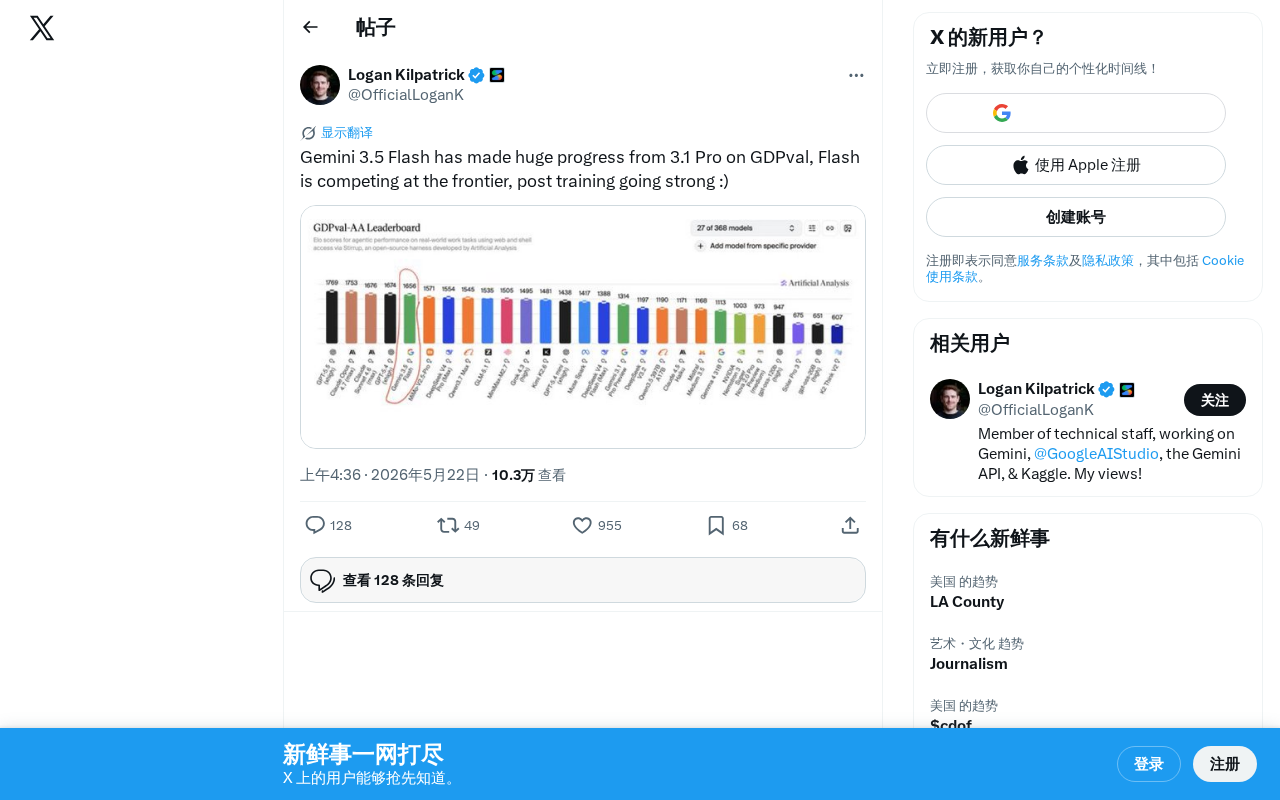
Gemini 3.5 Flash Achieves a Massive Leap on the GDPval Benchmark
Google Gemini 3.5 Flash surpasses Gemini 3.1 Pro on the GDPval benchmark. The lightweight Flash model leverages post-training techniques to approach frontier-level performance, redefining the balance between quality and cost.
 Tech Frontiers
Google Gemini Antigravity Weekly Quota Tripled — AI Coding Without Limits
Google Gemini triples Antigravity weekly quotas following a prior daily quota boost. Analyzing the impact on developers and its strategic significance in AI coding.