Gemini Digital Avatar: Create Your Virtual Double for Video with AI
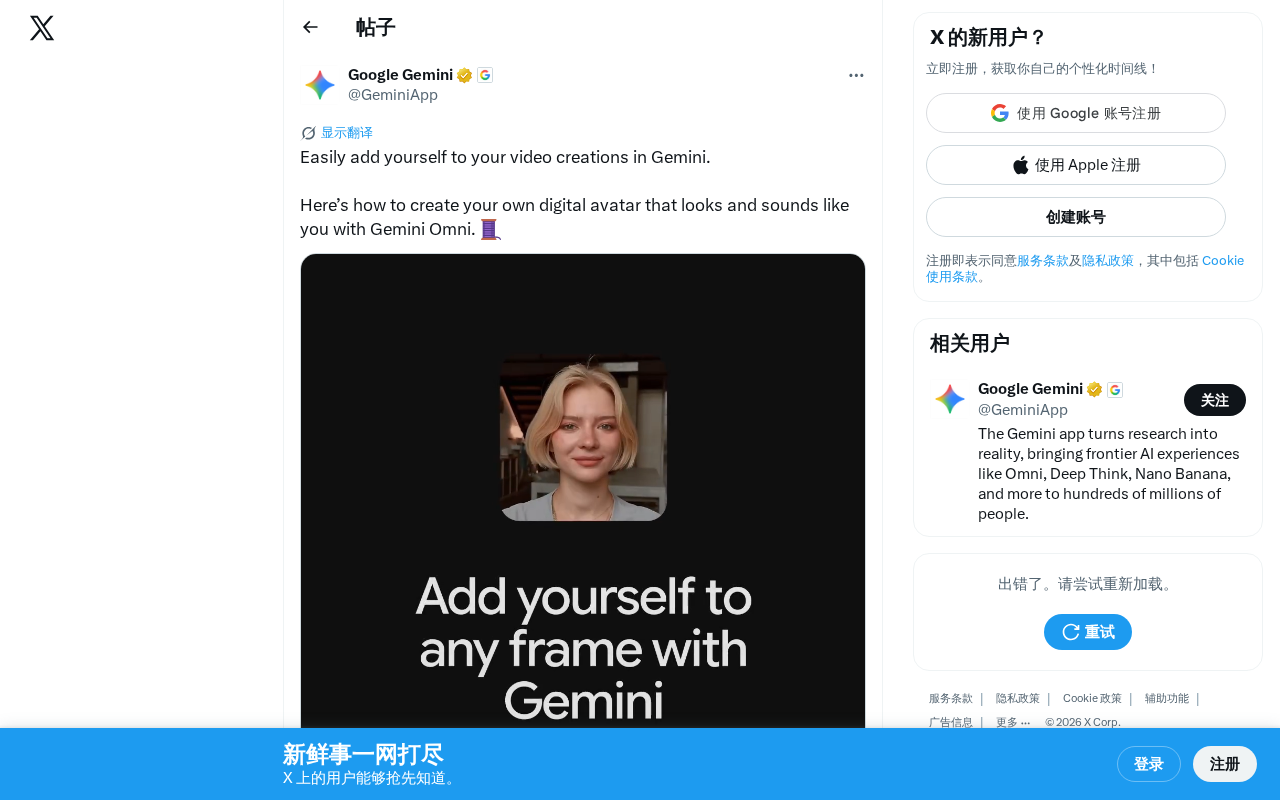
Google Gemini launches digital avatar feature to clone users' appearance and voice for video creation.
Google Gemini Omni introduces a digital avatar feature leveraging 3D face reconstruction, voice cloning, and lip sync technology to create virtual personas highly similar to users in both appearance and voice, embeddable in video productions. Compared to competitors like HeyGen and Synthesia, this feature benefits from Google's ecosystem integration with lower barriers and stronger synergy, though it also raises ethical concerns around identity impersonation and deepfakes.
Overview
Google Gemini has just launched an exciting new feature — creating your own Digital Avatar through Gemini Omni. This digital double not only resembles you in appearance but can also mimic your voice, making it easy to incorporate yourself into various video productions.
What Is a Gemini Digital Avatar?
A Digital Avatar is a virtual persona generated using AI technology that can replicate a real person's facial features, expressions, and vocal characteristics. This Gemini Omni feature means that everyday users can create a realistic digital double without professional video production skills or expensive equipment.
Core Capabilities
- Appearance Cloning: The digital avatar is visually highly similar to you
- Voice Replication: AI can learn and reproduce your vocal characteristics
- Video Integration: The digital avatar can be seamlessly embedded into video productions
Key Technologies Behind It
Creating a realistic digital avatar involves the coordinated work of multiple core technologies. First is 3D Face Reconstruction, which builds a three-dimensional facial model of the user from just a few photos or video clips. Next are next-generation rendering technologies like Neural Radiance Fields (NeRF) or Gaussian Splatting, used to generate photorealistic visual effects. Third is Voice Cloning, based on TTS (Text-to-Speech) technology, which analyzes the user's voice samples to extract timbre, intonation, rhythm, and other characteristics to generate synthetic speech highly similar to the original. Finally, Lip Sync technology ensures that the digital avatar's mouth movements precisely match the speech content. Only the deep integration of these technologies can produce a convincing digital double.
Use Cases and Practical Value
A Productivity Tool for Content Creators
For video bloggers, educators, and marketers, this feature dramatically lowers the barrier to video production. You no longer need to appear on camera every time — your digital avatar can handle repetitive video recording tasks, including:
- Tutorial and explainer videos
- Product introductions and demos
- Social media short-form video content
- Multi-language versions of videos
Say Goodbye to Tedious Filming Processes
In traditional video production, on-camera filming is often the most time-consuming step — setting up lighting, adjusting makeup, recording multiple takes. With a digital avatar, creators can focus more energy on content planning and scriptwriting, leaving the "on-camera" part to AI.
Technical Background and Industry Landscape
Gemini Omni's Multimodal Advantage
As Google's multimodal AI model, Gemini Omni has the ability to simultaneously process text, images, audio, and video. The digital avatar feature is a quintessential application of this multimodal capability — it requires simultaneously understanding and generating both visual and auditory information.
A multimodal AI model refers to an artificial intelligence system capable of processing and understanding multiple data types simultaneously. Traditional AI models typically excel at only a single modality — for example, the GPT series focuses on text processing, while DALL-E focuses on image generation. Gemini Omni's breakthrough lies in unifying these capabilities within a single model architecture, enabling the model to understand cross-modal semantic relationships. In the digital avatar scenario, the model needs to simultaneously perform facial feature extraction, lip sync generation, voice synthesis, and expression animation — tasks that are strongly coupled. Only a unified multimodal architecture can achieve naturally coordinated output.
Comparison with HeyGen, Synthesia, and Other Competitors
Digital avatars are not an entirely new concept — companies like HeyGen and Synthesia have been deeply invested in this space for years. Synthesia, founded in 2017 and headquartered in London, reached a valuation exceeding $1 billion in 2023. Its core product allows users to generate videos featuring AI presenters from text input, widely used in corporate training and internal communications. HeyGen (formerly Movio), founded in 2020, has risen rapidly with more accessible pricing and flexible features, particularly gaining viral attention on social media for its video translation and lip-adaptation capabilities. These two companies have validated the commercial value of AI digital humans, but as standalone SaaS platforms, they face inherent limitations in user acquisition and ecosystem integration.
Google's direct integration of this feature into the Gemini ecosystem brings several clear advantages:
- Lower barrier to entry: No need to register on a third-party platform
- Stronger ecosystem synergy: Seamless integration with Google's other creative tools
- Larger user base: Gemini's massive user base will accelerate adoption of this feature
Synergy Effects of Google's AI Ecosystem
Integrating digital avatar functionality into Gemini is a key part of Google's AI ecosystem synergy strategy. Google's current creative tool matrix includes: YouTube (video distribution platform), Google Workspace (document collaboration), Google Ads (advertising), and the recently launched Veo (video generation model) and Imagen (image generation model). The digital avatar feature can form a complete closed loop with these tools: users create a digital avatar in Gemini, generate background video with Veo, write scripts through Workspace, and ultimately publish the finished product to YouTube or use it for Google Ads campaigns. This end-to-end integration capability is a competitive moat that independent third-party platforms find difficult to replicate.
Privacy and Ethical Considerations
While digital avatar technology brings tremendous convenience, it also raises some concerns worth noting:
- Identity impersonation risk: How do you prevent others from creating your digital avatar without authorization?
- Deepfake boundaries: Where is the line between digital avatars and Deepfakes?
- Informed consent: Do viewers have the right to know whether a video features a digital avatar rather than a real person?
Deepfake Technology Development and Regulatory Status
Deepfake technology can be traced back to 2017, when face-swapping technology based on Generative Adversarial Networks (GANs) caused an uproar on the internet. Since then, the technology has evolved from GANs to Diffusion Models, with significant improvements in both generation quality and efficiency. Multiple countries and regions around the world have begun legislating in response: the EU AI Act requires AI-generated content to be clearly labeled; multiple U.S. states have passed Deepfake-specific legislation; and China's "Interim Measures for the Management of Generative AI Services," implemented in 2023, also sets clear labeling requirements for deep synthesis technology.
When launching the digital avatar feature, Google is expected to employ technical measures such as Digital Watermarks and the C2PA content provenance standard to embed invisible source identifiers in generated content, distinguishing legitimate use from malicious forgery. C2PA (Coalition for Content Provenance and Authenticity) is a content provenance alliance jointly initiated by tech giants including Adobe, Microsoft, and Google, aimed at establishing verifiable provenance for digital content. This will become critical trust infrastructure in the era of AI-generated content.
When launching features like this, Google must inevitably establish corresponding security mechanisms and usage guidelines to ensure the technology is not misused.
Conclusion
Gemini's digital avatar feature represents an important direction in AI video creation — enabling everyone to easily have their own "digital double." As the technology continues to mature, future video content creation will become more efficient and personalized. For content creators, now is the time to start exploring this new tool and thinking about how to integrate it into your creative workflow.
Key Takeaways
- Gemini Omni supports creating digital avatars that resemble the user in both appearance and voice
- Digital avatars can be directly embedded in video productions, dramatically lowering the barrier to on-camera filming
- The feature is integrated within the Gemini ecosystem, offering lower barriers and stronger synergy compared to third-party platforms
- AI digital human technology raises ethical concerns around identity impersonation and deepfakes alongside its convenience
- Content creators can leverage digital avatars to boost video production efficiency and focus on the content itself
Related articles
 Tutorials
Cursor + Codex Dual-IDE Collaboration: A Practical Methodology for Open-Source Project Customization
A complete methodology for open-source project customization based on real-world experience, detailing the Cursor+Codex dual-IDE workflow, seven-stage process, MVP validation, and AI source code reading techniques.
 Tutorials
Cursor Multi-Agent in Practice: Building a Full-Stack Next.js Blog in 50 Minutes
Build a full-stack blog in 50 minutes using Cursor IDE's multi-Agent mode with Next.js, Clerk auth, and Supabase. Learn the 4-phase AI Agent workflow and key integration pitfalls.
 Tutorials
Building an AI Software Factory from Scratch: A Cursor Engineer's Hands-On Experience with Multi-Agent Collaboration
Cursor engineer Eric shares practical insights on building an AI software factory: automation levels, guardrail design, parallel Agent management, and scaling to 1000+ Agents for 24/7 development.