Zero Coding Experience to SaaS in 48 Hours: A Complete Breakdown of Reaching $20K MRR in 90 Days
Zero Coding Experience to SaaS in 48 H…
Non-technical Amazon seller uses Cursor to build a SaaS in 48 hours, hitting $20K MRR in 90 days
Amazon seller Hassam, with no programming background, used Cursor AI coding tools to build product research tool LaunchFast in 48 hours. Leveraging his domain expertise as his core advantage, he partnered with a training company that already had his target customers, trading equity for distribution channels and skipping the lengthy user acquisition phase to reach $21.8K MRR in 90 days. His success reveals a key truth of the AI era: domain knowledge + distribution strategy matters far more than coding ability.
An Amazon seller with no programming background used Cursor to build a SaaS product in 48 hours. Through a clever distribution strategy, he achieved over $20,000 in monthly recurring revenue within 90 days. This story not only demonstrates the power of AI coding tools but also reveals a replicable startup methodology.
From Amazon Seller to SaaS Founder
Hassam's background isn't particularly special—he worked a 9-to-5 job at a company while running two Amazon brands on the side. No computer science degree, no development experience, a typical "side hustle" guy.

The turning point came when he discovered Cursor and AI coding tools through Twitter. Cursor is an AI-native code editor built on VS Code, developed by Anysphere. Unlike the "code completion" approach of tools like GitHub Copilot, Cursor supports multi-file context understanding, generating complete functional modules directly from natural language, and autonomously completing debugging and refactoring tasks through its "Agent mode." Its Max subscription ($200/month) provides unlimited access to top-tier models like Claude 3.5 and GPT-4o, enabling non-professional developers to describe requirements in natural language and have AI generate runnable code—dramatically lowering the technical barrier from idea to product.
Hassam realized he finally had the ability to build software products without a CS degree. So he went on a building spree, working on 10 to 12 projects covering everything from lyrics-to-AI-video generators to automated job applications. But nearly all of these projects failed—none of them ever made it to production.
However, these failures weren't without value. Each project helped him accumulate experience using AI tools to build products. More importantly, he eventually arrived at a critical insight: He possessed something most developers don't—deep domain expertise in the Amazon space.
Product Ideation Starting from Pain Points
The idea that ultimately succeeded came from pure frustration. Amazon Private Label is a model where sellers source products from manufacturers, brand them, and sell on Amazon's platform. Product research is the most time-consuming part—sellers need to analyze dozens of data dimensions including search volume, competition level, profit margins, and supplier quotes. This data is scattered across multiple platforms like Jungle Scout, Helium 10, Alibaba, and Amazon Seller Central, making manual consolidation extremely inefficient. As an Amazon seller, Hassam spent 20 to 30 hours every time he researched a new product, constantly copying and pasting data in Google Sheets. The tools on the market appeared to solve important problems, but none of them actually addressed the real bottleneck.
So he decided to build a tool he genuinely needed—LaunchFast, an AI-powered Amazon product research tool designed specifically for private label sellers. It could complete product discovery, validation, and supplier matching in minutes rather than weeks.
There's a logic here worth deep reflection for all entrepreneurs: Don't solve problems you imagine exist—solve problems you've personally experienced. Hassam's previous 12 failed projects failed precisely because he didn't understand the end users' real needs. But in the Amazon space, he knew from A to Z what problems new sellers encounter and what data they need.
The Complete 48-Hour MVP Build Process
Once Hassam identified his product direction, he faced an even bigger problem: Zero followers meant zero distribution channels. No matter how good the product was, it would be meaningless if nobody knew about it.
The MVP (Minimum Viable Product) concept was systematically articulated by Eric Ries in The Lean Startup. The core idea is to validate key assumptions at the lowest possible cost, avoiding over-investment in unvalidated directions. Hassam's 48-hour MVP practice is an extreme embodiment of this philosophy: he deliberately didn't pursue perfection, implementing only the core functionality with the "highest ROI and simplest implementation." Even more notably, he made the partner's confirmation a prerequisite for the MVP—completing "distribution channel validation" before writing a single line of code. This goes further than the traditional "build first, find users later" model, fundamentally mitigating the biggest risk of "building something nobody uses."
That's when he thought of a training program he'd purchased two years earlier—LegacyX. This company had thousands of active Amazon sellers—exactly his target customer base. So he proactively reached out to LegacyX with a proposal they couldn't refuse: "Give me 48 hours. If you like what I build, we'll partner up. No strings attached, you have nothing to lose."
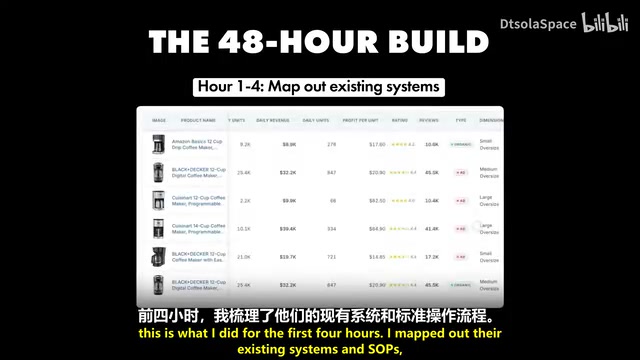
Over the next 48 hours, he followed a strict timeline:
- Hours 1-4: Mapped out LegacyX's existing systems, SOPs, and workflows, combining them with his own processes to design the MVP architecture
- Hours 5-12: Built core functionality using Cursor—not pursuing perfection, just making it functional
- Hours 13-20: Bug testing and iterative fixes—Cursor played a huge role in this phase
- Hours 21-30: Polished UI and brand design—from his Amazon experience, he learned that branding is everything
- Hours 31-40: Edge case testing to ensure smooth overall operation
- Final stage: Final polish and demo video preparation
The day after sending the video, he got a call: "Quit your job. We're doing this full-time."
Distribution Strategy: Trading Equity for Growth
Hassam's distribution strategy is the most instructive part of this story. Instead of spending months or even years building a social media presence and accumulating followers, he partnered directly with a company that already had his target customer base, trading equity for immediate distribution channels.
Traditional user growth paths (SEO, content marketing, paid ads) typically take 6-18 months to produce significant results, and for new products without brand recognition, this timeline is often fatal. The Channel Partnership model achieves "riding someone else's wave" by granting distribution rights to partners who already have access to target users. Hassam's strategy worked because he precisely identified LegacyX's interest alignment: training companies need to provide complementary tools for their students to enhance course value, and LaunchFast perfectly filled this gap. The two parties formed a genuinely complementary relationship rather than a simple buyer-seller transaction.
His logic was crystal clear: 50% of $20K MRR is far better than 100% of $0 MRR. Rather than spending time on marketing—something he wasn't good at—he gave that value to a partner who already had distribution capabilities.
The growth trajectory after launch validated this strategy:
- Day 0: Launched through the LegacyX partnership
- Day 30: Reached $10K MRR
- Day 60: Grew to $17-18K
- Day 90: Broke through $21.8K
For pricing, he offered LegacyX students a discounted rate of $50/month, while the public price was $199/month. He also launched a Chrome extension with 330 active paying users.
Tech Stack Selection: The Most AI-Friendly Modern Combination
Hassam's tech stack wasn't chosen by accident—it was deliberately selected as the optimal combination for "AI operability":
- Code writing: Cursor (Max subscription at $200/month)
- Deployment & hosting: Vercel, deployable directly from Cursor via CLI with zero configuration
- Database & authentication: Supabase, replacing Firebase, seamlessly integrated with Cursor through MCP
- Email service: Resend, an email delivery service designed for developers
- Data collection: Apify, simplifying data aggregation workflows
- Technical framework: TypeScript + Next.js, the most AI-friendly tech stack
The underlying logic of this combination is worth understanding deeply. Next.js is a full-stack framework based on React. Due to its massive open-source community, it has an extremely high representation in AI model training data, meaning Cursor generates Next.js code with significantly higher quality and accuracy compared to niche frameworks. Supabase provides PostgreSQL databases, authentication, and real-time subscriptions. Its MCP (Model Context Protocol) integration allows Cursor to directly read and write database structures, enabling "natural language database operations." Vercel provides zero-configuration deployment natively adapted to Next.js, supporting one-click publishing from the Cursor terminal. The essence of this tech stack is: perfectly aligning AI tool capabilities with tech stack maturity to maximize non-professional developers' productivity. Before finding Product-Market Fit, the main expense was just the Cursor subscription.
Six-Step Startup Methodology: A Replicable Path from Zero to $20K MRR
If Hassam were starting from scratch, he would follow these six steps:
Step 1: Identify your domain knowledge. Write down 3 to 5 industries or domains where you have deep knowledge and have personally solved problems.
Step 2: Validate market demand. Look for niches within these domains where successful SaaS tools already exist. If others are already making money, the market exists—you just need to execute better.
Step 3: Deep-dive into user pain points. Go to Reddit, Facebook groups, Twitter, and review sites to find target users' real pain points and existing tools' shortcomings.
Step 4: Build the MVP. Focus on only one feature—the one with the highest ROI and simplest implementation. Don't pursue perfection; just make it usable and get it into users' hands as fast as possible.
Step 5: Find distribution partners. List 5 potential distribution partners—training companies, communities, or KOLs. Contact 3 of them this week, provide a demo, and propose a partnership.
Step 6: Iterate daily. After launch, iterate rapidly based on real user feedback. Commit to shipping at least one improvement per day for the first 30 days.
Final Thoughts
Hassam's story sends a clear signal: the barrier to building software products has been dramatically lowered by AI tools. The real competitive advantage is no longer coding ability, but the combination of domain knowledge + distribution strategy.
As he put it: "You no longer need to be an engineer to build production-grade software. If you can put 1,000 hours into a project, thoroughly test it, and inject your domain knowledge, you will succeed."
For those who've been watching from the sidelines, his advice boils down to one sentence: Stop waiting, stop planning, start building. Ship something this weekend.
Related articles
 Tutorials
Cursor + Codex Dual-IDE Collaboration: A Practical Methodology for Open-Source Project Customization
A complete methodology for open-source project customization based on real-world experience, detailing the Cursor+Codex dual-IDE workflow, seven-stage process, MVP validation, and AI source code reading techniques.
 Tutorials
Cursor Multi-Agent in Practice: Building a Full-Stack Next.js Blog in 50 Minutes
Build a full-stack blog in 50 minutes using Cursor IDE's multi-Agent mode with Next.js, Clerk auth, and Supabase. Learn the 4-phase AI Agent workflow and key integration pitfalls.
 Tutorials
Building an AI Software Factory from Scratch: A Cursor Engineer's Hands-On Experience with Multi-Agent Collaboration
Cursor engineer Eric shares practical insights on building an AI software factory: automation levels, guardrail design, parallel Agent management, and scaling to 1000+ Agents for 24/7 development.