Zero2Agent: An Open-Source Job Interview Prep Tutorial for Agent Engineer Positions at Top Tech Companies

Open-source tutorial Zero2Agent helps job seekers systematically prepare for AI Agent engineer interviews at top tech companies.
A job seeker open-sourced the Zero2Agent tutorial website based on three months of interview experience, specifically targeting Agent R&D positions at major tech companies. The tutorial covers Agent fundamentals, in-depth analysis of major frameworks (LangGraph, Claude Code, OpenAI SDK), high-frequency interview questions (such as MCP protocol), and an accompanying written test practice tool. Its core value lies in strong specificity and timeliness, emphasizing that technical depth and project experience are the keys to Agent interviews.
The Pain Points of Interviewing for Agent Positions
As AI Agent technology continues to heat up, major tech companies are actively hiring Agent application development engineers. However, many job seekers find that algorithm practice and basic project experience alone are far from enough — interviewers are increasingly rigorous in assessing Agent technical depth, requiring not only an understanding of underlying architectures but also project experience that can withstand intense scrutiny.
An AI Agent refers to an AI system capable of perceiving its environment, making autonomous decisions, and executing actions to achieve goals. Unlike traditional single-turn Q&A AI applications, Agents possess four core capabilities: Planning, Memory, Tool Use, and Action. Since 2023, as large language models like GPT-4 and Claude have made capability leaps, Agents have rapidly moved from academic concepts to engineering implementation, spawning numerous new positions. Agent engineer roles at major companies typically require candidates to understand not just Prompt Engineering, but also multi-step reasoning orchestration, tool invocation chain design, context management, and other systems engineering skills.
A Bilibili content creator shared his job-hunting experience from March to May: after submitting numerous resumes, he ultimately received only one offer from Huawei. He distilled a core conclusion — the key to Agent interviews lies in technical depth and project experience, not simple algorithm grinding. Based on this experience, he open-sourced a tutorial website called "Zero2Agent," specifically targeting job seekers aiming for Agent R&D positions at major tech companies.
Complete Overview of the Zero2Agent Tutorial System
Part One: Agent Fundamentals
The tutorial starts from the most basic Agent concepts, helping readers understand the essential differences between Agents and traditional AI applications. It covers foundational knowledge including Agent composition principles and core architectural patterns. While this is introductory material, it falls under the "concept assessment" portion of interviews — interviewers use these questions to gauge your depth of understanding about Agents.
Specifically, an Agent's core architecture typically includes the following components: a perception module (receiving user input and environmental information), a brain module (reasoning and planning based on LLMs), a memory module (short-term working memory and long-term knowledge storage), and an action module (calling tools to execute specific operations). Understanding how these components work together is the foundation for answering conceptual interview questions.
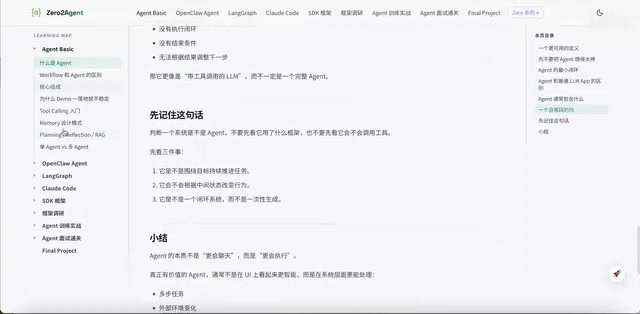
Part Two: In-Depth Analysis of Major Frameworks and Tools
The core section of the tutorial covers the most important frameworks and tools in the current Agent development ecosystem:
OpenClaw (Open-Source Crawler Agent): This is a topic frequently asked by interviewers because it's one of the most widely used Agents in daily practice. The tutorial provides a detailed analysis of its architectural design and working principles. As an intelligent crawler Agent, OpenClaw demonstrates how an Agent chains together multiple capabilities like web browsing, information extraction, and structured output — making it an excellent case study for understanding Agent tool chain design.
LangGraph: As one of the most commonly used frameworks for building Agents, your proficiency with LangGraph directly impacts your practical project capabilities. The tutorial provides a complete learning path from beginner to advanced. LangGraph is an Agent orchestration framework released by the LangChain team, with the core design philosophy of modeling Agent execution flows as directed graphs. Each node represents a computational step (such as LLM calls, tool execution, conditional logic), while edges define state transition logic. Compared to LangChain's earlier chain-based calls, LangGraph supports loops, branching, and parallel execution, enabling expression of more complex Agent behavior patterns like ReAct loops and multi-Agent collaboration. It also includes built-in state persistence and human-in-the-loop breakpoint mechanisms, making production-grade Agent application development more controllable.
Claude Code Source Code Analysis: This is highly targeted content. Interviewers frequently ask: "Have you read the leaked Claude Code source code? Can you explain how it's implemented?" If the position you're interviewing for involves AI Coding or Coding Agent directions, this section is recommended for careful study. Claude Code is Anthropic's AI programming assistant, whose source code was reverse-engineered by the community in early 2025, sparking widespread discussion. Its architecture reveals the core design of a mature Coding Agent: an Agent Loop-based multi-turn interaction mechanism, carefully crafted System Prompt engineering, file system awareness and code context management, and multi-tool coordinated invocation strategies. Understanding these implementation details demonstrates not only technical depth but also awareness of cutting-edge engineering practices.
SDK Framework Practice: Including OpenAI's Agent SDK and Claude's SDK. These frameworks have quite mature technical architectures — developers only need to write prompts to quickly build Agent applications. The tutorial guides you through hands-on development using the strongest models' APIs. OpenAI's Agent SDK (originally named Swarm, later officially released as Agents SDK) provides a lightweight multi-Agent orchestration framework with the design philosophy of "convention over configuration" — developers only need to define an Agent's instructions, available tools, and handoff rules, while the framework automatically handles conversation routing, context passing, and tool execution. The SDK includes built-in production-grade features like Guardrails and Tracing, complementing LangGraph's graph orchestration approach.
Part Three: Training-Related Content
The tutorial also covers Agent training knowledge, though the author admits this section isn't particularly detailed, since only a small portion of people will need it, and those who truly need it probably don't rely on introductory tutorials. Agent training typically involves reinforcement learning-based policy optimization (such as RLHF, DPO), fine-tuning for tool-calling capabilities, and enhancing multi-step reasoning abilities — topics more relevant to algorithm research roles than application development roles.
Interview Mastery: The Most Valuable Practical Module
This is the most valuable part of the entire tutorial. The author collected all Agent-related interview experiences from platforms like Xiaohongshu and Nowcoder, organizing interview questions into different dimensions.
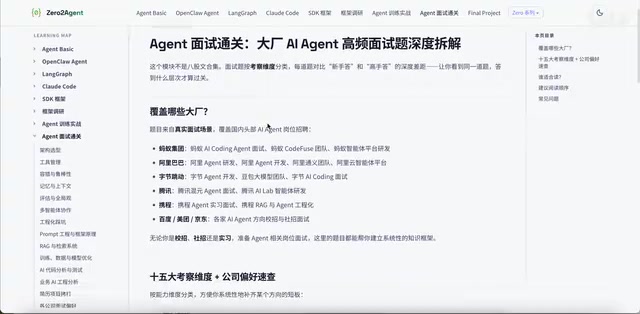
Concept Assessment Question Bank
Interviewers typically start by assessing your depth of understanding of core Agent concepts. The tutorial organizes 15 high-frequency concept assessment areas, each with accompanying flowcharts and architectural analyses. For example:
-
MCP (Model Context Protocol): This is currently the hottest must-ask interview topic, appearing in almost every interview. MCP is an open standard protocol released by Anthropic in late 2024, aimed at unifying the interaction between large language models and external data sources/tools. Before MCP, each Agent framework had its own tool invocation interface definition, leading to severe ecosystem fragmentation. MCP defines a standardized client-server architecture: MCP Servers expose tools and resources, while MCP Clients (typically embedded in Agents) discover and invoke these capabilities through a unified protocol. This is analogous to HTTP in the web domain — once the standard is unified, the tool ecosystem can flourish rapidly. Currently, mainstream AI products including Cursor, Claude Desktop, and VS Code all support MCP. In interviews, you need to clearly articulate MCP's protocol architecture, its differences from traditional Function Calling, and its impact on the Agent ecosystem.
-
Agent Development Roadmap: Tests your comprehensive knowledge and industry awareness, rather than a "crash-course amateur" level. This requires understanding the evolution from early ReAct paradigms and AutoGPT experiments to current multi-Agent collaboration and Agent OS concepts, as well as potential future directions.
-
Skills Mechanism: Requires clear articulation of its definition, purpose, and implementation. Skills are modular encapsulations of Agent capabilities, similar to human skills — Agents can dynamically load and combine different Skills based on task requirements, enabling flexible capability extension.
The author notes that the documentation currently has 18,000 readers, and mastering all this content should be sufficient for handling Agent-direction interviews. Of course, you'll still need to polish a few projects yourself, such as a RAG-based intelligent customer service system.
RAG (Retrieval-Augmented Generation) is one of the most common technical patterns in current Agent projects. Its core approach is to retrieve relevant document fragments from an external knowledge base as context before the LLM generates an answer, thereby addressing the model's knowledge cutoff and hallucination issues. A complete RAG intelligent customer service project typically involves document parsing and chunking, vectorized embedding, vector database storage and retrieval, prompt template design, and answer generation with citation tracing. This type of project is well-suited as an interview project because it involves a broad technology stack, allowing interviewers to probe deeply from multiple dimensions including data processing, retrieval strategies, model invocation, and engineering optimization.
Bonus: Written Test Practice Tool Upgrade
Beyond the Agent tutorial, the author's previously open-sourced practice tool has also received important updates.
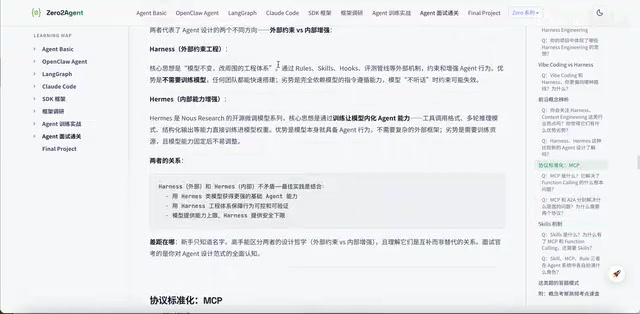
The new version adds several practical features:
Solution Code and ACM Simulation Mode: Clicking "Solution Code" directly shows the Python answer. With ACM simulation mode enabled, code and expected output are auto-filled, and you can verify results with one click. ACM mode refers to the programming format requiring manual handling of standard input/output (as opposed to LeetCode's function-based interface) — this is the mainstream format used in written tests at companies like Huawei and ByteDance. The author used this tool for code debugging during his Huawei interview — clear the code, write your own solution, input test cases, run to verify. The entire workflow is very intuitive without needing to create new projects or handle I/O each time.
Real Company Questions and Frequency Statistics: The tool organizes real written test questions from major companies and provides frequency statistics.
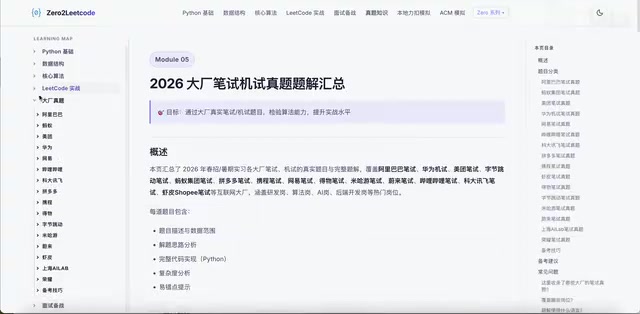
Taking Huawei as an example, high-frequency questions appear two to three times more often than regular ones. The author's strategy is straightforward: when time is tight, write each of the top four high-frequency questions once, and you'll likely encounter the original questions the next day. Additionally, the tool includes Huawei comprehensive assessment guides (reportedly with a non-trivial failure rate), fundamental CS knowledge banks (covering data structures, operating systems, computer networks, databases, system design), and a ByteDance backend fundamentals compilation.
Summary and Assessment
The value of the Zero2Agent project lies in its specificity and timeliness. Compared to the Hello Agent project released earlier by the DataWhale team (which the author considers "outdated"), Zero2Agent better aligns with current fall recruitment needs.
For those preparing for Agent-direction job searches, the recommended learning path is:
- Build a solid foundation: Understand core Agent concepts through Part One of the tutorial, establishing systematic knowledge of the perception-planning-memory-action architecture
- Deep-dive into frameworks: Focus on high-frequency topics like LangGraph and Claude Code source code, understanding core mechanisms like graph orchestration, state management, and tool invocation
- Study interview experiences: Tackle the interview mastery module questions one by one, especially hot topics like MCP, ReAct, and multi-Agent collaboration
- Build projects: Prepare at least 1-2 Agent projects that can withstand deep questioning, such as RAG intelligent customer service or Coding Agents, ensuring you can discuss them from multiple angles including architectural design, technology selection, performance optimization, and lessons learned
- Practice written tests: Use the frequency statistics feature to prepare algorithm questions strategically, and familiarize yourself with ACM input/output format
The project is open-sourced on GitHub — interested readers can check it out and show support with a Star. In an era of increasingly fierce competition for Agent positions, systematic preparation is far more efficient than fragmented learning.
Related articles
 Tutorials
Cursor + Codex Dual-IDE Collaboration: A Practical Methodology for Open-Source Project Customization
A complete methodology for open-source project customization based on real-world experience, detailing the Cursor+Codex dual-IDE workflow, seven-stage process, MVP validation, and AI source code reading techniques.
 Tutorials
Cursor Multi-Agent in Practice: Building a Full-Stack Next.js Blog in 50 Minutes
Build a full-stack blog in 50 minutes using Cursor IDE's multi-Agent mode with Next.js, Clerk auth, and Supabase. Learn the 4-phase AI Agent workflow and key integration pitfalls.
 Tutorials
Building an AI Software Factory from Scratch: A Cursor Engineer's Hands-On Experience with Multi-Agent Collaboration
Cursor engineer Eric shares practical insights on building an AI software factory: automation levels, guardrail design, parallel Agent management, and scaling to 1000+ Agents for 24/7 development.