Zion No-Code Platform: A Complete Hands-On Tutorial for Building AI Agents with Drag-and-Drop
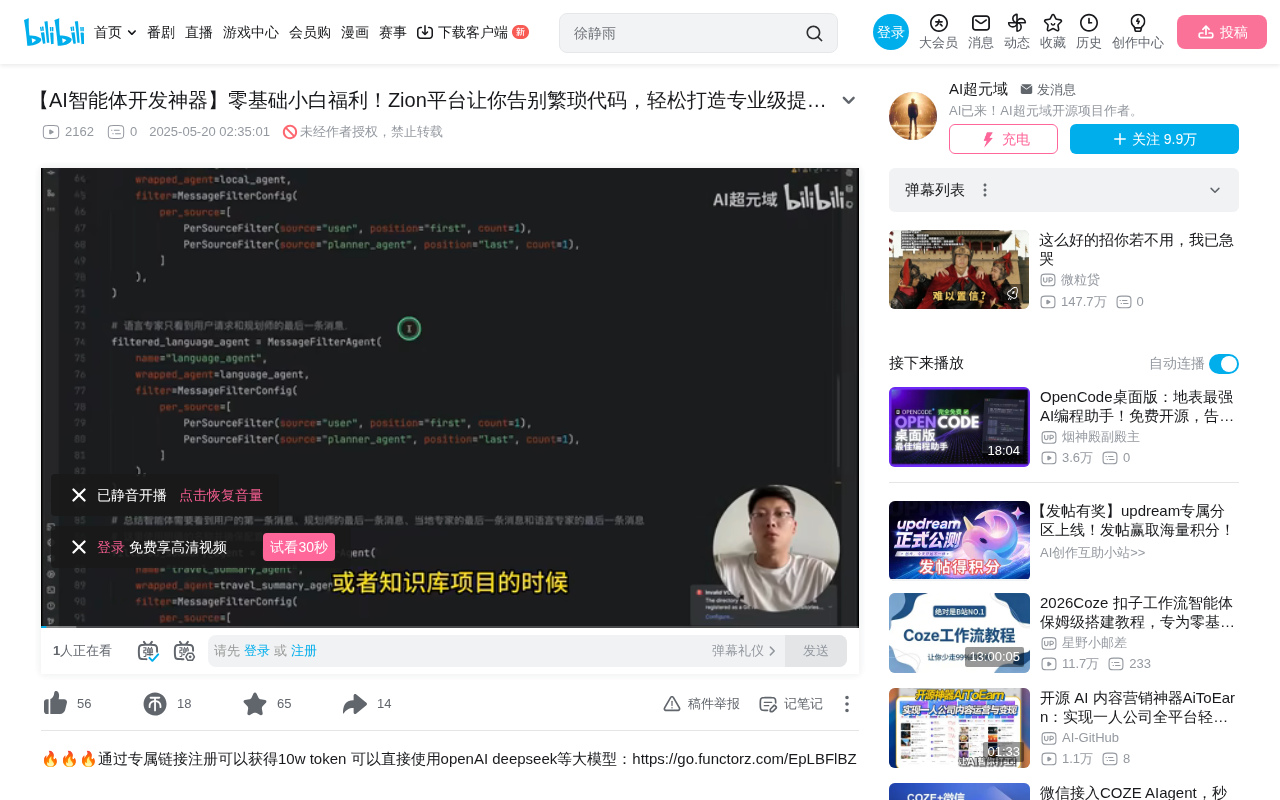
Zion's no-code platform enables anyone to build AI agents through drag-and-drop without programming.
This article uses a "Prompt Optimization Assistant" as a practical example to detail Zion no-code platform's core capabilities: rich templates, knowledge base integration (powered by RAG technology), external API access, and drag-and-drop front-end building. The platform delivers on its promise of writing zero code throughout the process, but no-code doesn't mean no learning—users still need to understand AI agent design logic and prompt engineering principles.
Can No-Code AI Agent Development Really Bring the Barrier Down to Zero?
For creators without programming experience, building an AI agent or knowledge base project typically means a steep learning curve—Python, API calls, front-end development... each one a formidable obstacle. Recently, a no-code platform called Zion has attracted considerable attention, claiming that you can build a complete AI agent workflow simply by dragging and dropping components.
This article uses a practical "Prompt Optimization Assistant" case study to thoroughly break down the platform's core capabilities and workflow, helping you decide whether it's worth trying.
Industry Background of No-Code Development
No-Code development isn't a new concept—its origins trace back to website building tools from the early 2010s (like Wix and Squarespace). With the explosion of AI technology, no-code platforms have evolved from simple webpage building to AI application construction. Gartner predicts that by 2025, 70% of new enterprise applications will use low-code/no-code technologies. The core driver behind this trend is that demand for AI applications is growing far faster than the supply of professional developers, and no-code platforms fill this gap. Zion is a representative product in this wave, specifically focused on AI agent construction.
Overview of Zion's Core Capabilities
Rich Templates, Ready to Use Out of the Box
Zion offers a large collection of ready-made templates covering a wide range of use cases:
- WeChat Mini Program Templates: Ordering apps, knowledge monetization, campus delivery, home services, AI interview assistants, etc.
- Web Templates: DeepSeek-related templates, AI mini-games, multi-agent monetization templates
- Coze Monetization Templates: Including WeChat Mini Program versions and multi-agent versions
For users who prefer more hands-on control, you can also start from a blank project, with support for both WeChat Mini Program and web development modes. This dual-track design of "templates + customization" balances efficiency and flexibility.
Knowledge Base Integration
The platform natively supports integration with mainstream knowledge base systems. In the settings accessed from the top-left corner, you can navigate to the knowledge base page and activate Bao Knowledge Base and WeChat Knowledge Base with one click—these are currently the most commonly used knowledge base systems. This means the AI agents you build can not only have conversations but also provide professional answers based on domain-specific knowledge, establishing the foundation for commercialization.
From a technical perspective, the underlying implementation of these knowledge base features is RAG (Retrieval-Augmented Generation) technology. RAG works as follows: first, uploaded documents are split into chunks (Chunking), then an embedding model converts the text into vectors stored in a vector database. When a user asks a question, the system first retrieves the most relevant document fragments through semantic similarity, then injects these fragments as context into the large model's prompt, enabling the AI to answer questions based on specific knowledge. This approach effectively addresses the "hallucination" problem and knowledge timeliness issues of large models. Zion encapsulates this complex technical process into simple upload and configuration operations, dramatically lowering the barrier to entry.
API Extension Capabilities
Beyond built-in features, Zion also supports external API integration. You can add search engines, data services, and other third-party interfaces to your project, significantly expanding the agent's capability boundaries. This will be covered in detail in the hands-on section below.
The Technical Essence of AI Agents
Before diving into the hands-on work, it's important to understand the technical essence of AI Agents. An AI agent differs from a simple chatbot—it's an autonomous system with perception, decision-making, and action capabilities. A complete AI Agent typically contains four core modules:
- Perception Layer: Receives user input and understands intent
- Memory Layer: Knowledge base and context management, providing long-term and short-term memory
- Reasoning Layer: Logical processing by the large language model, performing analysis and decision-making
- Action Layer: Calling tools or APIs to execute tasks and produce actual output
In traditional development, building such a system requires integrating multiple technology stacks including LangChain, vector databases, and front-end frameworks, while no-code platforms encapsulate these complexities into visual components. Understanding this four-layer architecture helps you design your agent's configurations more effectively in Zion.
Hands-On: Building a Prompt Optimization Assistant with No Code
Now let's get into the core hands-on section. We're going to build a "Prompt Optimization Expert"—users input a simple prompt, and the AI agent combines prompt engineering techniques from the knowledge base to output 5 optimized versions.
Core Methodology of Prompt Engineering
Before building this assistant, understanding the core methodology of Prompt Engineering will help you better design the agent. Prompt engineering is a systematic discipline with core methods including:
- Role Prompting: Assigning a professional identity to the AI, such as "You are a senior prompt engineer"
- Few-shot Learning: Providing examples in the prompt so the AI mimics the output pattern
- Chain of Thought: Guiding the AI to reason step by step rather than giving direct answers
- Structured Output: Explicitly specifying the output format, such as lists, tables, JSON, etc.
An excellent prompt typically contains six elements: role, background, task, format, constraints, and examples. The "Prompt Optimization Assistant" we're building essentially encodes these methodologies into the AI's workflow, achieving automated Few-shot Learning through cases in the knowledge base—teaching the AI how to optimize prompts, not just generate content.
Step 1: Create the Project and AI Agent
- After registering and logging into the Zion platform, click "New Project" in the top-right corner
- Select "Create from Blank" → "Start from Web"
- Enter the project name: Prompt Optimization Master
- Click "AI" in the top-left corner → "Create AI Agent"
On the agent configuration page, set the following key parameters:
- Name: Prompt Optimization Expert
- Input: Add an input field to receive the user's original prompt
- Role: Prompt Optimization Expert
- Task Details: "Based on the user's basic prompt input, query relevant prompt cases in the knowledge base, then refine and optimize the user's prompt to achieve the best results"
- Task Constraints: Provide 5 optimized prompts each time
Here's a crucial operation: in the task details, you need to click the "+" button to reference the input variable (input), so the AI can access the user's actual input content. This step corresponds to the "Perception Layer" in the Agent architecture—establishing the data channel between user input and AI processing logic.
Step 2: Upload the Knowledge Base
A good prompt optimization assistant's core competitive advantage lies in its "understanding" of prompt engineering. Zion supports direct upload of e-books or documents as a knowledge base:
- Click "Upload" in the knowledge base area
- Select an e-book on prompt optimization techniques (those with many examples work better)
- Set "Limited search based on content" with search keywords referencing the user input variable
This way, when optimizing prompts, the AI first searches for relevant cases in the knowledge base rather than relying purely on the large model's general knowledge, significantly improving output quality. From a technical standpoint, this step is actually configuring the retrieval strategy in the RAG pipeline—"limited search" means the system only returns the most relevant document fragments (not all content), which ensures context precision while avoiding exceeding the model's context window limit.
Step 3: Select Model and Parameters
In the top-right corner, select the model to call. In this demo, GPT-4.1 was chosen, with the content generation randomness (Temperature) set to 0.7—a classic value that balances creativity and stability. After configuration, click "Publish" for initial testing.
Deep Understanding of the Temperature Parameter: Temperature is a core sampling parameter when large language models generate text, controlling the randomness and diversity of output. Technically, Temperature works by adjusting the probability distribution of the model's output:
- Value of 0: The model always selects the highest-probability next token, producing highly deterministic and repetitive output, suitable for factual Q&A
- Value of 0.7: An industry-recognized balance point that produces creative variations without generating off-topic content
- Value of 1 or higher: The probability distribution is further flattened, making output more random, suitable for creative writing but potentially less coherent
For prompt optimization scenarios that need diversity (generating 5 different versions) while maintaining quality, 0.7 is a very reasonable choice.
Step 4: Build the Front-End UI
After completing the back-end logic, users need an interactive interface. Zion's front-end building is entirely drag-and-drop:
- Add an Input Box: For users to enter their original prompt
- Add a Button: To trigger the AI conversation, with customizable styling (like an arrow symbol)
- Add a Text Component: Set to multi-line display for showing AI optimization results
- Set a Background Image: Upload a background image to enhance visual appeal
- Add a Title: Such as "AI Super Prompt," adjusting color and size
Key data binding logic:
- Add a "behavior" to the button: start AI conversation on click, with input source bound to the page's input box
- Create a "page variable": to receive the AI's returned results
- Bind the text component's content to that page variable
The concept of "data binding" here is a core paradigm in front-end development—it establishes dynamic associations between UI components and data. In traditional development, this requires JavaScript state management (like React's useState or Vue's reactive data), while Zion simplifies it into visual connection operations. Understanding the "variable → binding → component" data flow is the key mental model for using any no-code platform.
After completion, click "Update Backend" → "Live Preview," enter "How to write viral articles" to test, and you'll see 5 optimized prompt outputs.
Advanced: Integrating an External Search API
If you want your agent to not only rely on the knowledge base but also retrieve real-time web information, Zion's API feature comes into play. Using SERP API (Search Engine API) as an example:
Technical Background of SERP API: SERP (Search Engine Results Page) API is a type of service interface that outputs search engine results in a structured format. Common SERP API providers include SerpAPI, Serper, ValueSERP, etc. The working principle is: API providers maintain large numbers of proxy IPs and browser instances, simulating real users to query search engines like Google and Bing, then parsing the returned search results (titles, snippets, links, featured snippets, etc.) into JSON format for the caller. Integrating SERP API into an AI Agent essentially gives the agent "web search" capability, enabling it to access the latest information after the training data cutoff date—this is also one of the core technical approaches used by mainstream AI assistants (like ChatGPT's browsing mode and Perplexity).
Specific steps:
- Click "API" in the top-left corner → "Get Started"
- Enter the API name (e.g., "Search Engine"), paste the SERP API request URL
- The system will automatically parse parameters; fill in the API Key
- Click "Send" to test, confirm normal search results are returned, then save the configuration
- Return to AI agent settings, associate the search engine interface in the API area
- Set the search keyword to the user's input content, then update the backend
After integrating the search API, the agent can reference the latest web content when optimizing prompts, producing more timely outputs. For example, when a user inputs "How to use AI to generate short video scripts," the agent will not only reference prompt techniques from the knowledge base but also search for currently popular AI video tools and the latest prompt patterns, providing optimization suggestions that better align with current trends.
Pros and Cons Analysis of the Zion Platform
Advantages
- Zero coding barrier: Entirely drag-and-drop operations, no programming knowledge required
- Full workflow coverage: From AI logic, knowledge base, and API to front-end UI, all completed in one place
- Rich template ecosystem: Numerous ready-made templates available for direct use or modification
- New user friendly: 100,000 free tokens per project upon registration
Points to Note
- The platform's flexibility is still limited compared to pure-code solutions; complex business logic (such as multi-turn conditional branching, complex data processing pipelines) may be difficult to implement
- Model selection and parameter tuning options depend on what the platform supports
- Long-term usage costs require attention to token consumption and pricing plans
- Regarding data security and privacy, content uploaded to the platform's knowledge base needs sensitivity assessment
Conclusion
From knowledge base integration to AI agent design, front-end interface building, and external API integration, Zion truly delivers on its promise of "no code written throughout the entire process." For creators who want to quickly validate AI product ideas or commercialize AI capabilities but lack technical backgrounds, no-code platforms like this are becoming a pragmatic choice.
Of course, no-code doesn't mean no learning—you still need to understand AI agent design logic (the four-layer architecture of perception, memory, reasoning, and action), the basic principles of prompt engineering (methods for designing roles, tasks, constraints, and examples), and data flow binding concepts (relationships between variables, events, and components). What tools lower is the coding barrier, not the thinking barrier. What truly determines the quality of an AI application is always your understanding of user needs and your grasp of AI's capability boundaries.
Related articles
 Tutorials
Cursor + Codex Dual-IDE Collaboration: A Practical Methodology for Open-Source Project Customization
A complete methodology for open-source project customization based on real-world experience, detailing the Cursor+Codex dual-IDE workflow, seven-stage process, MVP validation, and AI source code reading techniques.
 Tutorials
Cursor Multi-Agent in Practice: Building a Full-Stack Next.js Blog in 50 Minutes
Build a full-stack blog in 50 minutes using Cursor IDE's multi-Agent mode with Next.js, Clerk auth, and Supabase. Learn the 4-phase AI Agent workflow and key integration pitfalls.
 Tutorials
Building an AI Software Factory from Scratch: A Cursor Engineer's Hands-On Experience with Multi-Agent Collaboration
Cursor engineer Eric shares practical insights on building an AI software factory: automation levels, guardrail design, parallel Agent management, and scaling to 1000+ Agents for 24/7 development.