518 Dance Motion Chains + H3 Relay: Long-Video Choreography Breaks the Duration Limit

Open-source 518 dance motion chains free AI choreography from reference videos, and H3+AddGuide relay enables 60-second long-video generation.
This open-source dance motion library was updated with 518 motion chains containing entry, process, and closing poses, letting users choreograph without reference videos, and proposes a "music first" philosophy. Combined with the rebuilt H3 dance workflow, it relays tail frames through AddGuide nodes and, with segmented prompts, achieves 30- to 60-second long-video generation while avoiding prompt failure. The pipeline also incorporates CF Lift acceleration and VDN technology, sampling at low resolution first then upscaling with added noise to prevent degradation. This director's-console-style workflow is highly flexible and allows custom insertion of various techniques, but requires understanding motion chains and segmentation logic, with some learning cost. Latent Relay is seen as a potentially better solution but has not yet been implemented.
AI-generated dancing character videos are often limited by single-generation duration and stiff motion transfer. Recently, an open-source dance motion library was updated with 518 attachable motion chains. Combined with a rebuilt H3 dance workflow, users can choreograph directly without a reference motion video, and via AddGuide relay achieve long-video generation of 30 to 60 seconds. According to a Bilibili creator, this pipeline has been deployed on an online platform, ready to use out of the box, and also supports deep customization.
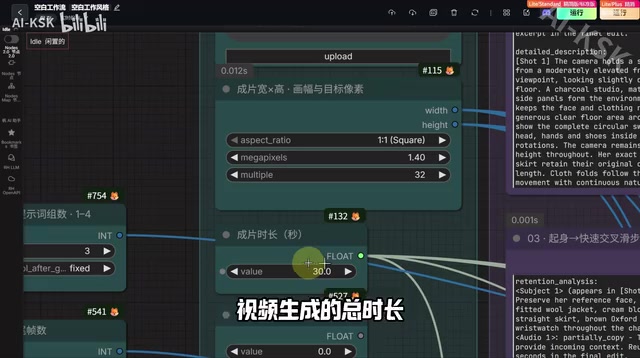
Open-Source Dance Motion Library: 518 Motion Chains Without Reference Video
This open-source project organizes 518 dance motion chains, each containing an entry pose, motion process, and closing pose. Users can create dances based on the motion chain descriptions without providing a reference motion video. This greatly lowers the barrier to motion transfer—the traditional pipeline requires a reference video for transfer, which is time-consuming and tends to be stiff.
The creator suggests handing the entire project directly to an agent (such as DSH), letting the AI learn how to choreograph moves, then combining character images and music to generate prompts. The author also proposes the philosophy of "music first, motion after": when generating dance from scratch, you need music first, cut it into 8 to 15 segments, build a beat and sync-point network, then create prompts. This lets the motion hit the beats.
H3 Long-Video Workflow: AddGuide Relay Breaks Single-Segment Duration
The core of the H3 workflow is the AddGuide node relay. Users first set the aspect ratio and target pixels, then fill in the total duration and number of startup groups. For example, a 30-second case uses three groups of prompts, each responsible for 10 seconds of footage; with four groups, each covers 7.5 seconds. The tail frame count defaults to 22 frames, and the next segment starts with light noise added to the actual output tail frame to maintain continuity.
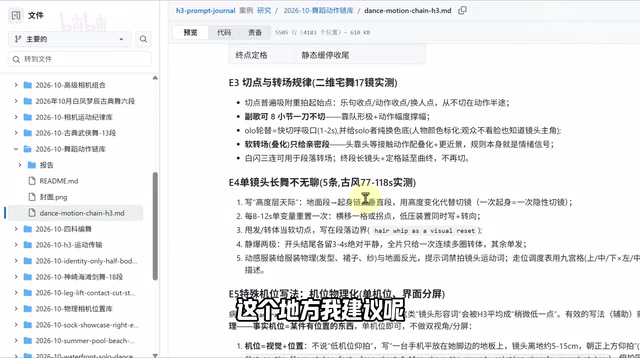
The creator compared Context Window and AddGuide: the former supports long videos but weakens prompt guidance; AddGuide re-encodes the image in a subordinate space, with the advantage of operating in latent space. Each has trade-offs. The creator also mentioned a more ideal solution, Latent Relay—passing directly in latent space—but no node is currently available online, and a mirror will be made later.
The pipeline incorporates CF Lift acceleration and VDN technology. CF Lift's first-pass ratio is 0.7, with 5 steps for the initial sampling and 3 steps for the second pass; at 1.4 megapixels, it first samples at low resolution then upscales, adding appropriate noise to prevent relay degradation. The creator states that each segment can generate up to 15 seconds, and the entire pipeline can produce videos up to 60 seconds.
AddGuide Node is the key mechanism for long-video relay in the H3 workflow. It receives the tail frame image generated by the previous segment and uses it as "guidance" for the next segment's generation, thereby extending total video duration while maintaining visual continuity. Unlike directly stitching videos, AddGuide re-encodes that tail frame when generating the next segment, ensuring the new segment's starting image naturally connects with the previous segment's ending. Its advantage is that the relay process occurs in latent space, better preserving prompt guidance, though it also loses some information due to encoding. Users need to set the tail frame count (default 22 frames) and adjust the noise strength to balance continuity and generation freedom.
CF Lift is a sampling technique used to accelerate image generation, whose core is to perform initial sampling at low resolution, then improve quality through upscaling and second-pass sampling. The "first-pass ratio 0.7" mentioned in the article refers to the scaling ratio used in initial sampling, while "initial sampling 5 steps, second pass 3 steps" correspond to the sampling steps of the two stages. This low-res-then-upscale strategy significantly reduces computation while preventing quality degradation during relay through appropriate noise addition. CF Lift is often paired with VDN (Video Denoising Network) to maintain image detail while ensuring generation speed, especially suitable for segmented long-video generation scenarios.
Director's Console in Practice: Four Steps from Choosing Motion to Final Cut
This pipeline is more like a freely extensible director's console. Users can insert VDN, CF Lift, community-researched noise addition, and other stages, each customizable. Actual operation is divided into four steps:
- Pick motion: Choose from the 518 motion chains, understanding the entry, process, and closing poses.
- Write segments: Public words describe character clothing and scene; each segment writes its own motion. When starting out, first run only one group for 6-8 seconds to check the face, composition, and motion, then enable full segmentation.
- Run the relay: After each segment finishes, feed the tail frame into the next segment's AddGuide (default 22 frames), and the next segment continues generating with its own prompt.
- Choose audio track and export: Reference music and the final heard sound have separate switches; you can choose audio track 1 for beat-synced final cut, or choose track 3 for post-dubbing, turning off the external audio reference master switch.
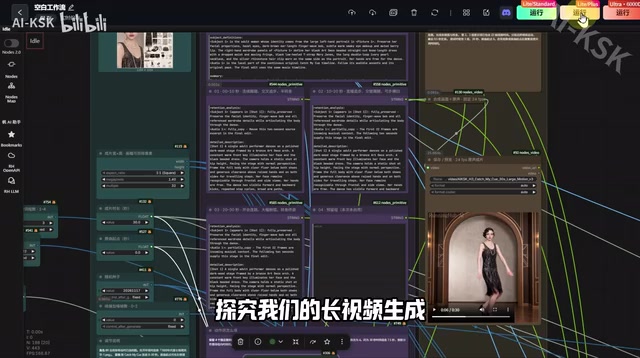
After running, first check the seams, characters, and hands/feet, then listen to the audio track. If it doesn't connect, look at how the previous segment ends, what pose the next segment starts from, and whether there's an abrupt camera angle change.
Multi-Source Perspectives and Limitations
According to analysis from the Bilibili creator and YouTube channels, this workflow indeed lowers the barrier to long-video dance generation at the application level; the 30-second case has significant motion but still shows no obvious degradation. But there is disagreement: while AddGuide relay preserves prompt guidance, it loses some latent-space information due to encoding in a subordinate space; Context Window is the opposite. Latent Relay is seen by both sides as a potentially better solution, but has not yet been implemented.

It should be noted that this pipeline is still exploratory and not fully out-of-the-box. Users need to understand the motion chain structure, segmented prompts, and relay parameters to produce stable results. But as an open-source solution, it provides a reproducible path, suitable for creators willing to debug.
Context Window and AddGuide are two different long-video generation strategies. Context Window expands the model's context window to accommodate longer video sequences, theoretically supporting longer durations, but it dilutes prompt guidance because the model needs to attend to too many frames at once. AddGuide uses a relay approach, with each segment generated independently but kept coherent through tail-frame guidance; prompt guidance is more stable, but the relay point may lose latent-space information. Each has trade-offs: the former suits scenarios with low prompt-guidance requirements, while the latter is better for dance generation requiring precise control of motion and imagery. Latent Relay is considered a potentially better solution, passing information directly in latent space and expected to combine the advantages of both, but no usable node is currently available.
Conclusion
The open-source 518 dance motion chains free AI choreography from reference videos, while H3+AddGuide relay breaks the single-segment duration limit; combined with CF Lift acceleration and VDN, long-video generation becomes more controllable. This director's-console-style workflow offers high flexibility but requires some learning cost. For users wanting to try long-video dance generation, it provides a starting point worth exploring.
One-line Summary
Open-source 518 dance motion chains free AI choreography from reference videos, and H3+AddGuide relay enables 60-second long-video generation.
Paragraph Summary
This open-source dance motion library was updated with 518 motion chains containing entry, process, and closing poses, letting users choreograph without reference videos, and proposes a "music first" philosophy. Combined with the rebuilt H3 dance workflow, it relays tail frames through AddGuide nodes and, with segmented prompts, achieves 30- to 60-second long-video generation while avoiding prompt failure. The pipeline also incorporates CF Lift acceleration and VDN technology, sampling at low resolution first then upscaling with added noise to prevent degradation. This director's-console-style workflow is highly flexible and allows custom insertion of various techniques, but requires understanding motion chains and segmentation logic, with some learning cost. Latent Relay is seen as a potentially better solution but has not yet been implemented.
Related articles

Gemini 4 Neon vs Claude Opus 5.5: Who Wins Across Five Real-World Tasks?
Bilibili creator tests Gemini 4 Neon vs Claude Opus 5.5 across 3D video, games, design, writing, and advice. Neon matches Opus daily, but 3D and design still lag.

Former Huawei Genius Youth Open-Sources AI Agent Guide: 90+ Hands-On Case Studies
Former Huawei Genius Youth Li Bojie open-sources AI Agent Book, the most systematic Chinese Agent learning repo on GitHub, with 90+ runnable examples covering context compression, memory frameworks, MCP tool calling, prompt injection attack and defense, and other enterprise-level hands-on content.

The Most Detailed FDE Tutorial on Bilibili: Case-Based Teaching from Business Practice to Interviews
B站UP主推出FDE从入门到面试实战教程,讲师深入业务一线,用马氏学习平台真实案例讲解FDE岗位要求。本文分析案例教学法、笔记策略与私密信息处理,为AI岗位求职者提供参考。