Former Huawei Genius Youth Open-Sources AI Agent Guide: 90+ Hands-On Case Studies

Former Huawei Genius Youth Li Bojie open-sources an AI Agent engineering curriculum with 90+ runnable examples.
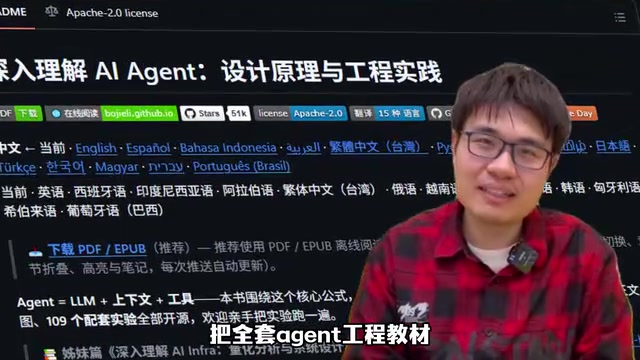
Former Huawei "Genius Youth" Li Bojie has open-sourced an AI Agent engineering curriculum on GitHub called AI Agent Book, which many learners call the most systematic learning repository in the Chinese-speaking community. The repository is clearly positioned: no empty theory, but locally reproducible code, advancing from basic concepts to complex enterprise-level scenarios, with over 90 directly runnable examples. It covers context compression, memory framework comparisons, MCP tool calling, prompt injection attack and defense, and other key aspects of Agent development, emphasizing the real pain points of enterprise deployment. The author claims that after fully studying it, you can meet the needs of most AI jobs on the market—somewhat promotional, but it reflects the breadth of coverage. For Chinese-speaking developers who want to systematically master Agent engineering capabilities, this is an open-source learning resource worth investing time in.
AI Agent learning resources are plentiful, but open-source repositories that are systematic, runnable, and aligned with real enterprise deployment are rare. Recently, Li Bojie, a former Huawei "Genius Youth" program member, brought a complete AI Agent engineering curriculum to GitHub under the name AI Agent Book, which many learners have called the most systematic learning repository in the Chinese-speaking community.
One Curriculum, From Beginner to Enterprise-Level Practice
The repository's positioning is clear: no empty theory padding, but directly runnable code that can be reproduced locally. The content starts from basic concepts and advances all the way to complex enterprise-level scenarios, with over 90 directly runnable examples included.
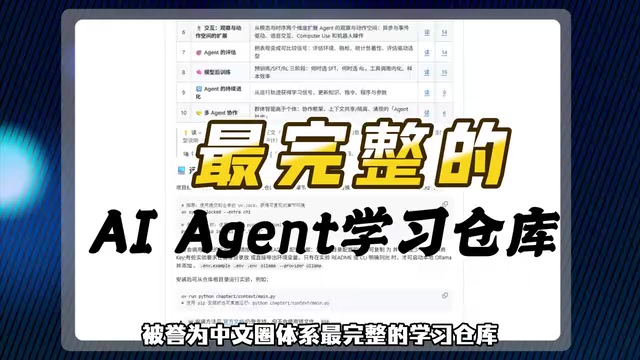
For self-learners, the biggest pain point is often "I understand it, but I can't get it to run." AI Agent Book grounds every knowledge point in code, so you can personally verify mechanisms like context compression and memory frameworks on your own machine, rather than staying at the conceptual level.
Covering the Core Modules of Agent Engineering
The repository's content is designed around the key aspects of Agent development, including context compression, memory framework comparisons, MCP tool calling, and prompt injection attack and defense. These modules are exactly the technical points you can't avoid when building practical Agents.
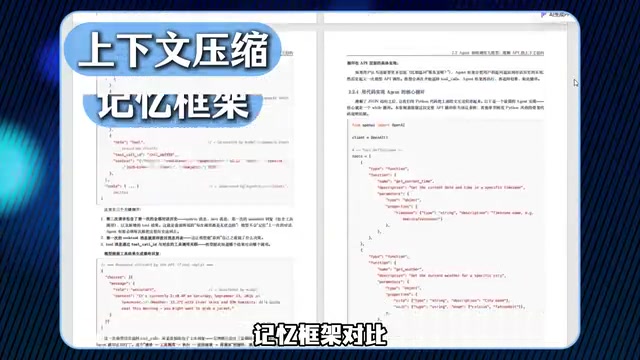
Take MCP (Model Context Protocol) tool calling as an example—it is becoming an important protocol for connecting models with external tools. The repository provides corresponding hands-on cases to help developers understand how to let Agents call external capabilities safely and controllably.
MCP (Model Context Protocol) is an open protocol proposed and open-sourced by Anthropic at the end of 2024, aimed at establishing a standardized way to connect AI models with external data sources and tools. Before MCP emerged, developers typically had to write a separate adapter layer for each tool to let an Agent call external capabilities, with inconsistent interface styles and difficult reuse. Drawing on the ideas of the Language Server Protocol (LSP), MCP defines a client-server architecture: the model side acts as the client, while tools or data sources expose their capabilities as MCP Servers, and the two sides interact through unified JSON-RPC messages. This way, the same MCP Server can be reused by different models or Agent frameworks, significantly reducing integration costs. Currently, a large number of official and third-party MCP Servers have emerged in the community, covering scenarios such as file systems, databases, search, and code repositories, making it gradually become one of the de facto standards for Agent tool calling.
Targeting the Real Pain Points of Enterprise Deployment
In the repository description, Li Bojie emphasizes that all content targets the pain points of enterprise deployment. This means learners are not just studying technical points, but simulating problems in real production environments: how to manage the context window, how to choose a memory solution, and how to defend against prompt injection attacks.

According to the original sharing, after fully working through this content, you can easily handle 90% of AI jobs on the market. Of course, this claim has some promotional flavor, but it reflects the breadth of the repository's coverage—from basics to advanced, from individual techniques to engineering practice, forming a relatively complete learning path.
Prompt Injection is a type of security risk faced by LLM applications: attackers hide malicious instructions in content that the model will read (such as web pages, documents, or tool return results), inducing the model to deviate from its original task, leak system prompts, or perform unauthorized operations. Unlike traditional SQL injection, prompt injection has no clear syntactic boundary, and models struggle to reliably distinguish "data" from "instructions," making defense difficult. Common mitigation measures include: marking and isolating the source of input content, limiting the permission scope of tool calls, introducing human confirmation before critical operations, and performing structured validation of model outputs. For enterprise-level Agents that need to call external tools, prompt injection attack and defense is a security step that must be evaluated before launch, which is why the repository lists it as an independent module.
Context Compression refers to techniques for trimming, summarizing, or structurally reorganizing the growing context window during conversations or task execution. Because mainstream models have an upper limit on context length, and overly long contexts lead to increased costs and problems such as "lost in the middle," Agents must actively manage memory when executing multi-turn tasks. Common approaches include: rolling summarization of historical conversations, retaining key entities and decision records, scoring messages by importance and discarding low-value content, and externalizing long-term information into vector databases or structured storage for on-demand retrieval. Context compression and memory frameworks often need to be used together, and the choice of strategy directly affects an Agent's stability and consistency in long tasks—an engineering problem that cannot be avoided in enterprise deployment.
Why It's Worth Following
In the AI Agent field, knowledge updates extremely quickly and fragmented tutorials are everywhere, but a "living" textbook is lacking. The value of AI Agent Book lies in the fact that it is maintained by an author with frontline engineering experience, emphasizes runnability and reproducibility, and is directly open-sourced to the community. For Chinese-speaking developers who want to systematically master Agent engineering capabilities, this is a learning resource worth investing time in.
The repository is currently open-sourced on GitHub, with accompanying code and a learning path available. If you are looking for an Agent learning path from theory to hands-on practice, you might start with this curriculum.
One-line Summary
Former Huawei Genius Youth Li Bojie open-sources an AI Agent engineering curriculum with 90+ runnable examples.
Paragraph Summary
Former Huawei "Genius Youth" Li Bojie has open-sourced an AI Agent engineering curriculum on GitHub called AI Agent Book, which many learners have called the most systematic learning repository in the Chinese-speaking community. The repository's positioning is clear: no empty theory padding, but locally reproducible code, with content advancing from basic concepts all the way to complex enterprise-level scenarios, accompanied by over 90 directly runnable examples. Covered modules include context compression, memory framework comparisons, MCP tool calling, prompt injection attack and defense, and other key aspects of Agent development, with an emphasis on the real pain points of enterprise deployment. The author claims that after fully studying it, you can meet the needs of most AI jobs on the market; while this has some promotional flavor, it reflects the breadth of coverage. For Chinese-speaking developers who want to systematically master Agent engineering capabilities, this is an open-source learning resource worth investing time in.
Related articles

Gemini 4 Neon vs Claude Opus 5.5: Who Wins Across Five Real-World Tasks?
Bilibili creator tests Gemini 4 Neon vs Claude Opus 5.5 across 3D video, games, design, writing, and advice. Neon matches Opus daily, but 3D and design still lag.

The Most Detailed FDE Tutorial on Bilibili: Case-Based Teaching from Business Practice to Interviews
B站UP主推出FDE从入门到面试实战教程,讲师深入业务一线,用马氏学习平台真实案例讲解FDE岗位要求。本文分析案例教学法、笔记策略与私密信息处理,为AI岗位求职者提供参考。

518 Dance Motion Chains + H3 Relay: Long-Video Choreography Breaks the Duration Limit
The open-source dance motion library adds 518 motion chains for choreography without reference videos. The H3 workflow combines AddGuide relay, CF Lift acceleration, and VDN to enable 30–60s long-video generation, breaking single-segment duration limits with independently controlled segmented prompts.