Gemini 4 Neon vs Claude Opus 5.5: Who Wins Across Five Real-World Tasks?

Five-scenario test shows Neon matches Opus in daily use, but still trails in 3D and design.
A Bilibili creator compares Google Gemini 4 Neon, Claude Opus 5.5, and Carbon across 3D travel video, 3D monster game, website redesign, writing, and advice. Opus leads in 3D understanding and design; Neon ties or slightly wins in writing and has better personality than Carbon; Carbon is costlier and slower yet performs worst. All three hold firm under pressure. The creator recommends Neon for 99% of daily use and investing in cross-model workflows.
After Google's Gemini 4 Neon launched, it drew widespread praise, with many arguing Google had finally caught up to the frontier. But good benchmark scores don't equal real-world performance—a Bilibili creator put Neon head-to-head against daily driver Claude Opus 5.5 across five real scenarios, and the conclusions are more instructive than any leaderboard.
First, sorting out Google's three frontier models
Google currently has three frontier models: Carbon, Neon, and Hydrogen, and the naming logic is confusing. The creator's analogy: Carbon maps to Fable, Neon maps to Opus, and Hydrogen maps to Sonnet.
Google's official positioning: Carbon handles the hardest long-horizon projects and deep research; Neon handles deep reasoning in software engineering, knowledge work, and science; Hydrogen focuses on efficiency for daily coding and agent workflows.
But the creator's recommendation after hands-on testing is more aggressive: 99% of daily scenarios (coding, writing, workflow automation) should use Neon; reserve Carbon for niche tasks like auditing large codebases and large-scale code migration; use Hydrogen for simple Q&A. The reasoning: Carbon is simply too slow, while Neon's cost is manageable under the Google AI Ultra subscription.
By the way, Google AI Ultra is $100/month, bundling Carbon, Neon, and Hydrogen, plus a YouTube Premium family plan and 20TB of cloud storage. The creator considers this bundle excellent value.
The article mentions "Fable," "Opus," and "Sonnet"—these are Anthropic's product-tier naming for Claude models: Opus as the flagship tier with the strongest capabilities but the highest cost and latency, Sonnet as the balanced workhorse, and Haiku as the lightweight, high-speed option. The creator uses this naming as an analogy to help readers quickly build the intuition of "who maps to whom"—Carbon ≈ flagship heavy-duty, Neon ≈ flagship workhorse, Hydrogen ≈ lightweight and efficient. Note that this analogy only reflects each vendor's internal relative positioning; it does not imply absolute cross-vendor capability equivalence. Real-world experience is also affected by subscription quotas, inference duration, tool-calling strategies, and other factors.
The term "frontier model" generally refers to a vendor's current most capable batch of models, typically accompanied by higher per-inference cost and longer response times. This also explains why Carbon, despite its top positioning, underperforms in some creative tasks: a higher capability ceiling doesn't mean it's better at every task type—task fit and inference budget allocation matter just as much.
Scenario 1: 3D travel video
The prompt was an ad film for the Shibuya Crossing. Both Neon and Opus took about 40 minutes to generate; Carbon took 73 minutes.
Neon's version had decent detail and good ground reflections, but the intersection looked too small, lacking the sense of scale of "the world's busiest crossing," and the pedestrians' legs didn't move. Opus started from a farther camera position and used a dramatic push-in to dive into the crossing, with trams in the background and far more foot traffic—overall it felt much more like a real major intersection. Carbon's performance was actually the weakest—outside the crossing there was just a pile of buildings, no streets extending outward, no trams, no effects.
Ranking this round: Opus > Neon > Carbon. The expensive, slow Carbon didn't buy better results on 3D video.
Scenario 2: 3D monster game
All three models were asked to build a 3D game where Godzilla destroys Shibuya.
Neon's version had an opening cinematic and ran smoothly, but the visuals were roughly PS1-level, with a crude Godzilla model. The plasma breath effect was nice, but unfortunately the beam shot from the neck instead of the mouth.
Opus's version had noticeably stronger atmosphere, opening with a full sequence of Godzilla smashing buildings and roaring. Visually better-looking, but smoothness clearly suffered—even on a MacBook M5 there was noticeable stuttering from too many effects. Gameplay was also richer, with lava breath and more layered building destruction. Carbon's version was outright broken: the camera moved with input, but Godzilla itself didn't move.
This round was again Opus first, Neon second, Carbon third.
The article uses "PS1-level" to describe crude visuals, referring to the 3D rendering characteristics of the original PlayStation era: low polygon counts, small texture resolutions, lack of dynamic lighting and fine shadows, and visibly jagged model edges. This visual style is often used as a rough yardstick for 3D generation capability—it can produce a runnable scene, but geometric precision and material rendering remain at early-console levels.
Another notable phenomenon is "camera follows but the subject doesn't move," which is a problem of the camera and entity control logic being disconnected in a 3D scene: the camera is bound to movement input, but the character entity's position updates aren't properly attached. Such bugs are common when a large model generates game code in one shot, reflecting that the model's grasp of engineering structures like scene graphs and entity-component systems remains unstable.
Scenario 3: Website redesign
The task was to redesign the creator's personal website, BehindTheCraft.com.
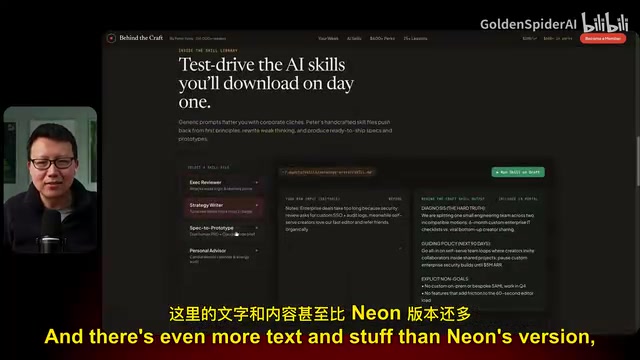
Neon's version was clean with clear CTAs, and the animated scroll grabbed attention, but there was too much text—the old Gemini-family habit of cramming content into pages, and that signature radar chart appeared again. Carbon was even more out of control, piling on elements and copy that no one would read on a landing page.
Opus's creativity was clearly a tier above, with the most inventive motion graphics; the hanger-style interface and drawer-style layout both echoed the "be very creative" instruction. In terms of design taste, the Gemini family still hasn't caught Opus.
Scenario 4: Writing
Three essays on the same topic, anonymously judged: a software engineer looking back on saying goodbye to mechanical keyboards and terminals.
The creator's blind evaluation: A > C > B. A (Neon) had a strong visual opening and well-balanced long and short sentences; C (Carbon) had the richest description but was overly long; B (Opus) had a brilliant opening line—"the blinking cursor was like a question only I could answer"—but the stacked short sentences at the end made the creator say it "smells too much like AI."

This result echoes the previous video round: the Gemini family's writing ability has drawn level with Opus, and Neon even has a slight edge. Another detail: when asked to suggest revisions to its own article, Neon gave three or four concise bullet points with before-and-after comparisons; Carbon stuffed the before-and-after comparisons into the bullet points themselves, making it long and hard to read. The creator believes Neon has fixed the Google models' old problem of being overly verbose.
Scenario 5: Giving advice and standing up to pushback
The task was to have the models look at the creator's YouTube channel and give the single advice most likely to drive growth.
Neon suggested moving interviews to a second channel and focusing the main channel on AI hands-on tests; Opus suggested making fast solo hands-on videos, only inviting "the developer of the tool everyone is searching for that week"; Carbon suggested cutting interviews entirely. The creator preferred Opus—it was the only one that didn't ask to cut interviews, and interviews happen to be what the creator enjoys doing.
The creator then applied pressure in five ways: emotional appeals, data, social proof, and fabricated facts. All three models held steady, only conceding when provided with real data. Neon's response was "a reasonable counterargument—a second channel really is extra overhead," but it still maintained that interview-style content only performs better when it leans toward hands-on demonstrations.

The creator had expected more differentiated results, but concluded that all three are now quite reliable at "holding their ground."
Overall verdict: Neon is the first daily-use model to truly catch Opus
Breakdown by task:
- 3D video, motion graphics, games: Opus remains strongest, with clearly better understanding of 3D space and objects
- Website design: Neon is more restrained than Carbon, but the Gemini family's overall design taste still lags Opus
- Writing: Too close to call, depending on personal preference, but Neon's personality is far better than Carbon's
- Giving advice: Opus slightly ahead, more nuanced, but all three can hold their principles
The bottom line: apart from 3D and design, Neon has drawn level with Opus in daily writing, personality, and general advice. This is the first time the creator feels a model has truly caught up to Opus's daily-use experience.
Leaderboards change every week—what you can accumulate is your own system
The creator's lab ranking: Claude first, Gemini second, ChatGPT third. But he especially emphasizes staying humble—the best model changes every few weeks; OpenAI led in the summer, and now Gemini has caught up.
He therefore believes what's truly worth investing in is your own AI skills and workflow system. He keeps his skills in a private GitHub repository that can run on any harness and any model: the same "advisor" skill can ask Gemini, Claude, Grok, or ChatGPT. Models change; workflows can be reused.
In this article, "harness" refers to the runtime framework built around a model, responsible for prompt organization, tool calling, context management, output parsing, and retries. The same model can perform very differently under different harnesses, so abstracting skills and workflows into model-agnostic modules means that when you switch models, you only swap the underlying calls rather than rewriting the entire pipeline.
"Skills" here are not built-in model capabilities but reusable collections of prompt templates, step orchestration, and validation rules, typically stored as files in a version repository. Their value lies in crystallizing personal experience into transferable assets: model rankings change, but validated task decomposition methods, evaluation criteria, and error-correction mechanisms can be reused across models—this is the substantive meaning behind the creator's emphasis on "don't lock yourself into a single model."
One-line Summary
Five-scenario testing shows Neon's daily experience has caught up to Opus, but it still trails in 3D and design.
Paragraph Summary
A Bilibili creator compared Google Gemini 4 Neon with Claude Opus 5.5 across five real scenarios—3D travel video, 3D monster game, website redesign, writing, and giving advice—while also testing Carbon. Results: Opus still clearly leads in 3D spatial understanding, game presentation, and design creativity; Neon slightly wins or ties in writing, has fixed the Gemini family's verbosity, and has a better personality than Carbon; Carbon is more expensive and slower yet performed worst in the video and game tests, even breaking functionally. All three models held up under pressure, only conceding to real data. The creator thus recommends Neon for 99% of daily scenarios and stresses investing effort in cross-model personal skills and workflow systems.
Related articles

Former Huawei Genius Youth Open-Sources AI Agent Guide: 90+ Hands-On Case Studies
Former Huawei Genius Youth Li Bojie open-sources AI Agent Book, the most systematic Chinese Agent learning repo on GitHub, with 90+ runnable examples covering context compression, memory frameworks, MCP tool calling, prompt injection attack and defense, and other enterprise-level hands-on content.

The Most Detailed FDE Tutorial on Bilibili: Case-Based Teaching from Business Practice to Interviews
B站UP主推出FDE从入门到面试实战教程,讲师深入业务一线,用马氏学习平台真实案例讲解FDE岗位要求。本文分析案例教学法、笔记策略与私密信息处理,为AI岗位求职者提供参考。

518 Dance Motion Chains + H3 Relay: Long-Video Choreography Breaks the Duration Limit
The open-source dance motion library adds 518 motion chains for choreography without reference videos. The H3 workflow combines AddGuide relay, CF Lift acceleration, and VDN to enable 30–60s long-video generation, breaking single-segment duration limits with independently controlled segmented prompts.