A Deep Dive Preview: Jev and AI Agents

A Twitter preview hints at a deep dive on how Jev can optimize AI Agent development.
A brief Twitter preview has caught the AI developer community's attention: a team is researching how a tool called Jev can help build and optimize AI Agents, with @sydneyrunkle set to deliver a technical deep dive. The article uses this as a jumping-off point to highlight why AI Agents — capable of autonomous planning, tool use, and multi-step execution — have become the key paradigm for LLM deployment, making the surrounding toolchain and best practices a central focus for developers.
A Tech Preview Worth Watching
Recently, a brief message on Twitter caught the attention of the AI developer community: a team is actively researching how Jev can help build and optimize AI Agents, with a deep-dive session previewed for the following week, to be presented by @sydneyrunkle.
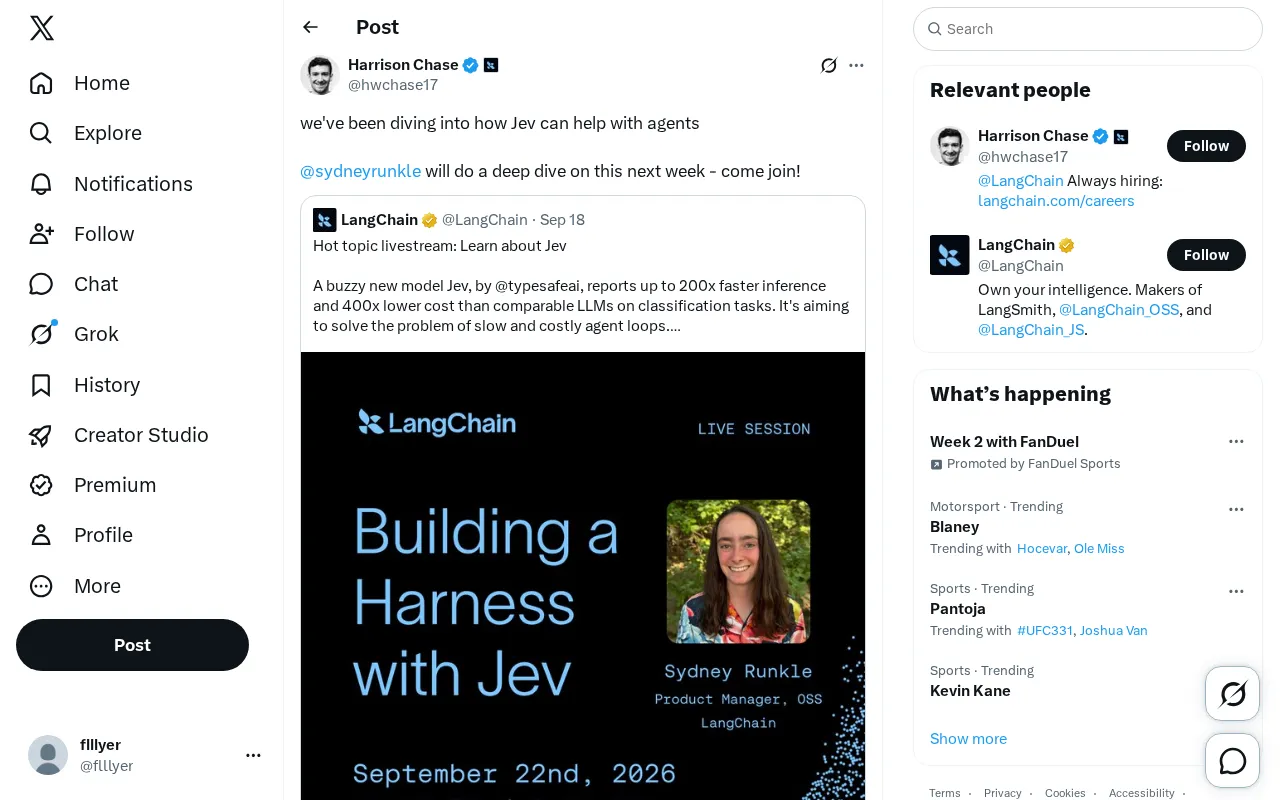
While the original post itself was short, it reflects an important trend in the AI space — how tools and frameworks can better serve the development of Agents.
Jev, as mentioned in the post, doesn't yet have a wide public profile. It's likely an emerging tool or framework aimed at AI Agent development, focusing on a specific aspect such as workflow orchestration, debug visualization, or tool integration. Similar tools have been appearing frequently in this space — for example, LangSmith for Agent observability, CrewAI for multi-agent orchestration, and Flowise for low-code Agent building interfaces. Before the official deep dive is published, Jev's specific capabilities and positioning await further disclosure from @sydneyrunkle's upcoming content.
Why Agents Are Such a Hot Topic Right Now
AI Agents are rapidly becoming the key paradigm for deploying large language model applications in the real world. Unlike simple conversational interactions, Agents can autonomously plan tasks, invoke tools, and execute multi-step operations — enabling them to handle far more complex workloads.
This is precisely why the toolchain and best practices around Agent development have become a focal point in the developer community. Any tool that lowers the barrier to building Agents or improves their reliability is bound to generate significant interest. The research previewed in this announcement is a direct reflection of that trend.
A typical AI Agent architecture consists of four core modules: a perception module (receiving external input), a planning module (reasoning and task decomposition via LLMs), a memory module (short-term context and long-term knowledge storage), and an action module (calling external tools or APIs). Mainstream Agent frameworks today include LangChain, AutoGen, and LlamaIndex Agents, all of which provide standardized abstractions for capabilities like Tool Use, Reflection, and multi-agent collaboration. However, the real challenge in Agent development lies in reliability and observability — errors in a single reasoning step can compound across multi-step execution. Tracking, debugging, and optimizing Agent behavior is therefore one of the most pressing problems in current engineering practice.
What a Deep Dive Like This Can Offer
Technical deep dives led by domain experts typically cover concrete implementation details, hands-on experience, and practical solutions to common pitfalls. For engineers actively exploring Agent development, this kind of content tends to be far more actionable than abstract conceptual introductions.
Developers would do well to follow the upcoming official presentation for more complete technical details and practical guidance.
Summary
Short as this preview may be, it sends a clear signal: the exploration of combining tools with Agents continues to deepen. Readers interested in this space are encouraged to follow @sydneyrunkle for the full presentation when it's released — it promises to deliver substantive technical insights well worth studying.
Related articles

WorkBuddy in Action: How a Desktop Agent Automates Your Work
WorkBuddy is a desktop-level AI agent workbench that drives computers via command line, connects external tools, and automates file processing, data organization, and document generation. This article analyzes its working principles, complex task processing flow, and a practical path from getting started to taking orders.

Turning AI Intruders Against Themselves: A Hands-On Look at AgentCapture
AgentCapture is an AI countermeasure honeypot platform that integrates with existing networks and reverse proxies, using lossless deployment, AI agent identification, attacker profiling, and session replay to turn automated intruders against themselves.

WorkBuddy In-Depth: The Leap from Conversational AI to Office Automation
What is WorkBuddy? Tencent's AI agent desktop tool understands Chinese commands and directly operates computer files, handling office automation from resume sorting to scheduled reports. This article analyzes its fundamental differences from conversational AI like ChatGPT, its core capabilities, and applicable scenarios.