A New Approach to Offline RL: How Variational Consequence-Driven Constraints Solve Dynamic Shift

A new paper proposes StBR, shifting offline RL constraints from action space to state-consequence space with latent space divergence as a bounded proxy.
Offline RL faces distribution shift; traditional methods constrain action distribution divergence, but a new paper argues similar actions do not imply similar consequences. It proposes Structured Behavior Regularization (StBR), which shifts constraints to state-consequence space, using latent space divergence as a theoretically bounded proxy aligned with transition dynamics. This adaptively tightens constraints in dynamically sensitive regions and stays flexible in smooth ones, training only on offline data. Experiments show StBR outperforms baselines on multiple benchmarks, though claims need independent verification.
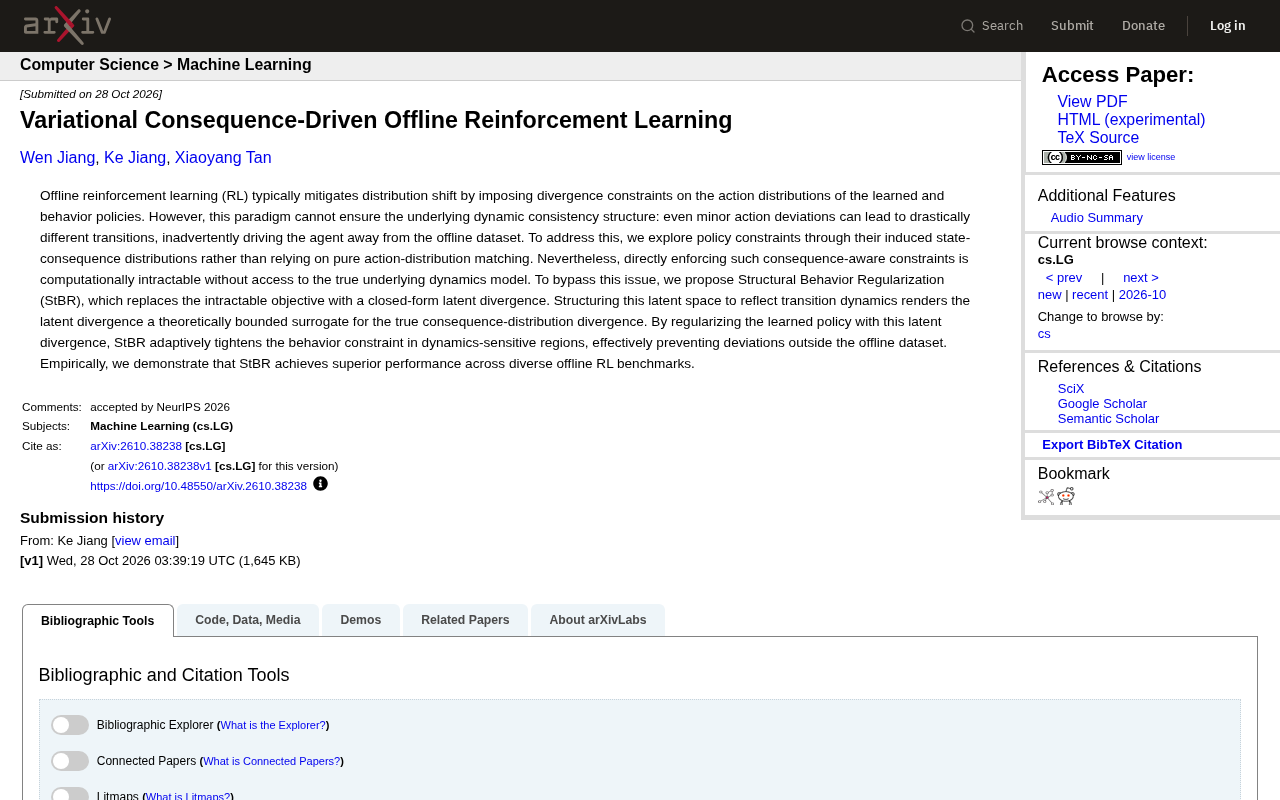
The core challenge of offline reinforcement learning (Offline RL) lies in distribution shift—the learned policy tends to deviate from the behavior policy, thereby encountering unseen state-action pairs in real environments. Traditional methods mitigate this problem by imposing divergence constraints on the action distribution, but a new paper points out that this paradigm has a fundamental flaw: even small action deviations can lead to drastically different state transitions due to discontinuities in the dynamics model. To address this, the researchers propose Structured Behavior Regularization (StBR), which shifts the constraint from action space to state-consequence space, using latent-space divergence as a theoretically bounded proxy objective and adaptively tightening behavior constraints in dynamically sensitive regions.
The Limitation of Action Distribution Matching: Why Small Deviations Cause Big Problems
Traditional offline RL methods typically constrain the divergence between the action distributions of the learned policy and the behavior policy (such as KL divergence, Wasserstein distance, etc.). The intuition behind this approach is: as long as the actions are close, the subsequent trajectory will not deviate too far. However, the authors point out that this assumption does not hold in complex dynamic environments—action distribution matching cannot guarantee dynamically consistent structure. Because the transition function of real environments has non-smooth or even chaotic characteristics, a small action deviation may be amplified by the dynamics model, causing the agent to quickly enter state regions not covered by the offline dataset.
In other words, similar actions do not imply similar consequences. Relying solely on action-level constraints, the policy may still "stumble" in dynamically sensitive regions, leading to a performance gap between offline evaluation and actual deployment. This observation constitutes the core motivation of the paper: rather than constraining actions, it is better to directly constrain the distribution of state consequences induced by actions.
Distribution Shift is the core challenge of offline reinforcement learning. In offline RL, the agent can only learn from a fixed dataset and cannot interact with the environment to collect new data. When the learned policy selects actions that do not appear or rarely appear in the dataset, subsequent states may enter regions not covered by the dataset. At this point, the value function estimate will produce serious errors, and the errors will accumulate continuously as the trajectory unfolds. This phenomenon is called "extrapolation error." Traditional methods attempt to limit this shift by constraining the action distribution distance between the learned policy and the behavior policy (such as KL divergence, maximum mean discrepancy MMD, etc.), but such constraints are at the action level and cannot directly control changes in the state visitation distribution.
From Action Constraints to Consequence Constraints: A Computable Proxy Solution
Directly imposing constraints on the state consequence distribution is computationally infeasible because it requires access to the true dynamics model. The proposed StBR bypasses this difficulty through closed-form latent space divergence. Specifically, StBR constructs a structured latent space that reflects transition dynamics and proves that the divergence in this space is a theoretically bounded proxy for the true consequence distribution divergence. This means that optimizing the latent space divergence is equivalent to approximating the original consequence constraint under computable conditions.
According to the paper, the key design of StBR is to align the structure of the latent space with the transition dynamics. In this way, distances in the latent space can capture differences in dynamic sensitivity: in regions with drastic dynamic changes, the latent space divergence will naturally amplify, thereby automatically tightening behavior constraints. This adaptive mechanism makes the policy more conservative in dynamically sensitive regions and maintains flexibility in dynamically smooth regions, effectively avoiding deviation from the offline dataset.
Latent Space Divergence refers to measuring the distance between two distributions in a low-dimensional embedding space. In StBR, the researchers construct a structured latent space such that distances in this space can reflect differences in state transition consequences. The key theoretical contribution is proving that, under certain conditions, the divergence in the latent space is an upper bound (or bounded proxy) for the divergence of the true state consequence distribution. This means that minimizing the latent space divergence can indirectly minimize the true consequence divergence without accessing the true dynamics model. This "proxy objective" design is particularly important in offline RL because the true dynamics model is unavailable in the offline setting, and directly constraining the consequence distribution is computationally infeasible.
Adaptive Constraints: How Dynamically Sensitive Regions Are Identified
The adaptive nature of StBR is an important advantage that distinguishes it from traditional methods. Traditional action divergence constraints are usually globally uniform—regardless of the state region, the constraint strength is fixed. In contrast, StBR implicitly identifies dynamically sensitive regions through the latent space structure and imposes differentiated constraints. The paper emphasizes that this mechanism "adaptively tightens behavior constraints in dynamically sensitive regions," thereby improving safety without sacrificing overall performance.
From an implementation perspective, StBR does not require explicitly modeling the true dynamics, nor does it require additional manual annotation or environment interaction; training can be completed using only the offline dataset. This gives it good scalability in practical applications—especially suitable for scenarios where online exploration is costly or risks are uncontrollable, such as robot control, medical decision-making, and autonomous driving simulation.
Dynamic Sensitivity refers to the degree to which the system's state transition function is sensitive to small changes in actions. In chaotic systems or non-smooth dynamics, adjacent actions may lead to drastically different next states, and such regions are dynamically sensitive regions. By aligning the latent space structure with the transition dynamics, StBR makes distances in the latent space naturally reflect this sensitivity: in dynamically sensitive regions, the latent space divergence will amplify, thereby implicitly tightening behavior constraints. This adaptive mechanism differs from globally uniform action divergence constraints; it allows the policy to maintain flexibility in dynamically smooth regions while taking conservative behavior in sensitive regions, thereby more effectively avoiding distribution shift.
Experimental Performance: Stable Improvements Across Benchmarks
The paper evaluates StBR on multiple offline RL benchmarks and reports performance that is "superior to comparison methods." Although the abstract does not disclose specific numerical values or benchmark names, the authors emphasize that StBR shows advantages across diverse tasks, suggesting that its generalization ability does not depend on a specific environment type. Combined with its theoretical guarantee—that latent space divergence is a bounded proxy for true consequence divergence—StBR achieves a good balance between empirical performance and theoretical rigor.
It is worth noting that this work advances the constraint design of offline RL from "action space" to "consequence space," providing a new direction for subsequent research. If the latent space structure can more finely encode dynamic uncertainty, future work may further narrow the gap between the theoretical proxy and true consequences, promoting the deployment of offline RL in safety-critical domains.
Multi-Source Cross-Validation Perspective
At present, public information about this work mainly comes from the paper abstract and RSS feeds, lacking independent reproduction or third-party analysis. Therefore, the performance claims cited in this article should be regarded as single-source conclusions, and actual effectiveness needs to await community verification. Nevertheless, from the perspective of method design, StBR's criticism of action distribution constraints is consistent with the recent trend in the offline RL field focusing on dynamic shift, and its "consequence-driven" idea has reasonable research context support.
One-line Summary
A new paper proposes Structured Behavior Regularization (StBR), which shifts offline RL constraints from action space to state-consequence space, using latent space divergence as a bounded proxy to adaptively tighten behavior constraints in dynamically sensitive regions.
Paragraph Summary
Offline reinforcement learning faces the challenge of distribution shift. Traditional methods mitigate it by constraining action distribution divergence, but a new paper points out that similar actions do not imply similar consequences—small action deviations may lead to drastically different state transitions due to dynamic discontinuity. To address this, the researchers propose Structured Behavior Regularization (StBR), which shifts the constraint from action space to state-consequence space. By constructing a latent space aligned with transition dynamics, it uses latent space divergence as a theoretically bounded proxy for true consequence divergence. This mechanism can adaptively tighten constraints in dynamically sensitive regions and maintain flexibility in smooth regions, and can be trained using only offline data. Experiments show that StBR outperforms comparison methods on multiple benchmarks, but the performance claims still require independent verification.
Related articles

Will GitHub Die? Open Source Maintainer Burnout and the Collaboration Crisis in the AI Era
Lex Fridman podcast discussion on open source maintainer burnout and GitHub's predicament: massive pull requests overwhelm core maintainers, and AI worsens code bloat. Using math journal peer review and Poincaré conjecture verification as analogies, the article analyzes why verification in knowledge production must be deliberately slow, and how open source communities can avoid the failure mode of maintainers exiting.

Stop Building Cookie-Cutter AI Websites: 3 Tools That Transform Your Coding Agent
Three tools that boost AI coding agents: FFmpeg skill for local video editing in Claude Code and Cursor, Hallmark's 50 design themes to fix cookie-cutter AI sites, and Jailbreaks' 25+ model prompts.

How America's Gerontocracy Squeezes the Younger Generation
Americans over 55 hold nearly three-quarters of national wealth, alongside an 80-year-old president and elderly congressional leaders. The Atlantic's Idrees Kahloon explains how gerontocracy drives up housing costs, squeezes opportunities for the young, and explores zoning reform and child poverty reduction as practical fixes.