A New Framework for LLM Evaluation: Statistical Efficiency of Self-Confidence and LLM-Assisted Auditing

A unified statistical framework clarifies when confidence-stratified auditing and LLM-judge evaluation are each effective.
The article presents research on the cost-accuracy tension in LLM evaluation. Self-reported confidence is poorly calibrated and human auditing is hard to scale, while LLM-as-a-judge is scalable but not universally cost-saving. The paper builds a unified statistical framework: confidence-stratified sampling recovers accuracy even with uncalibrated confidence, and proportional allocation beats equal allocation under imbalanced distributions; judge-assisted evaluation uses sensitivity and false positive rate for error correction with calibration uncertainty. Only a few target-verifier pairs meet the efficiency conditions.
The evaluation of large language models (LLMs) and multimodal large language models (MLLMs) faces a fundamental tension: models' self-reported confidence is often poorly calibrated, yet human auditing is hard to scale. A recent paper proposes a unified statistical framework that attempts to answer a key question—under what conditions can confidence-guided auditing and LLM-as-a-judge automatic verification actually save costs while guaranteeing accuracy?
Background: Confidence Is Unreliable, but May Still Be Useful
Models' self-reported confidence typically exhibits calibration bias—high confidence does not equal high accuracy. However, the paper points out that even when calibration is imperfect, confidence can still be used for efficient evaluation—provided the right sampling strategy is adopted.
That said, LLM-as-a-judge offers a scalable alternative to human auditing, but its actual benefit depends on calibration quality and inference cost. Each of the two evaluation paths has its strengths and weaknesses, and previously there was no unified statistical framework for comparing them.
Confidence calibration measures the agreement between a model's self-reported probabilities and its actual accuracy. A well-calibrated model should be correct about 80% of the time among samples where it reports confidence of 0.8. In practice, LLMs are generally overconfident: the actual accuracy in high-confidence bins is markedly lower than the reported value, which is typically measured using expected calibration error (ECE) or reliability diagrams. It is important to distinguish calibration, which concerns whether the probability values are trustworthy, from discrimination, which concerns whether high-confidence samples are indeed more likely to be correct than low-confidence ones. Even when calibration is biased, as long as confidence retains some ranking power, it can still serve as an auxiliary variable for stratified sampling—this is precisely the statistical starting point for the paper's argument that confidence is "unreliable but still useful."
A Unified Statistical Framework: Direct Auditing and Judge-Assisted Evaluation
The paper establishes a unified statistical framework for the two evaluation routes, handling different sampling strategies respectively.
Direct Auditing: Confidence-Stratified Sampling
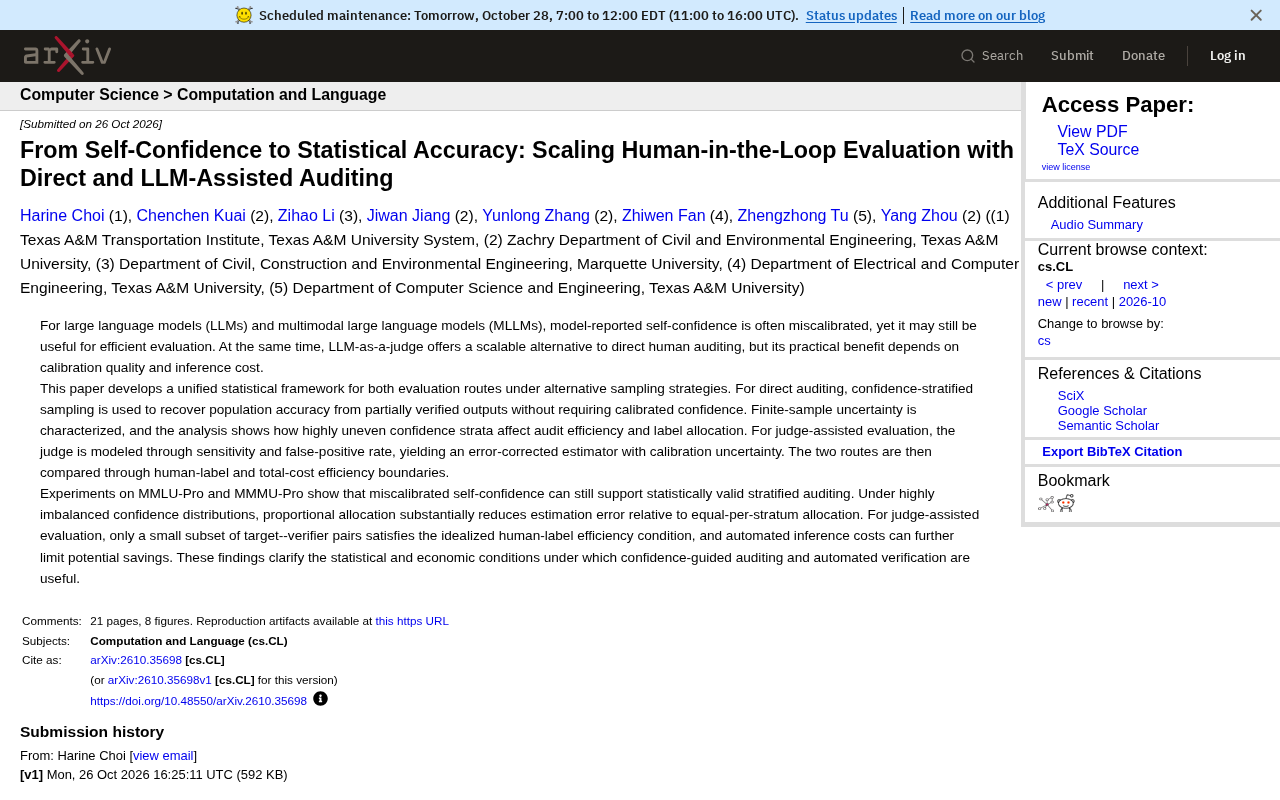
For direct human auditing, the researchers employ confidence-stratified sampling to recover overall accuracy from partially verified outputs, without requiring confidence itself to be calibrated. The framework characterizes finite-sample uncertainty and analyzes how highly imbalanced confidence strata affect auditing efficiency and label allocation.
Experiments on MMLU-Pro and MMMU-Pro show that poorly calibrated self-confidence can still support statistically valid stratified auditing. When the confidence distribution is highly imbalanced, proportional allocation significantly reduces estimation error compared with equal-per-stratum allocation.
Stratified sampling is a classic sampling design: first divide the population into several non-overlapping strata based on an auxiliary variable, then sample independently within each stratum, and finally combine the estimators weighted by stratum size. Its core value lies in reducing estimation variance—when units within a stratum are highly homogeneous, the sampling error is significantly smaller than that of simple random sampling. When applied to model evaluation, confidence scores naturally serve as a stratification variable, since accuracy often differs greatly between high-confidence and low-confidence strata. However, stratified sampling requires a reasonable sample-size configuration across strata: proportional allocation keeps the sampling fraction consistent across strata and suits cases with vastly different stratum sizes; equal allocation draws the same number from each stratum and wastes budget when between-stratum variances are similar but stratum sizes differ greatly. The debate over allocation methods discussed in the original paper is a direct manifestation of this sampling design theory in the LLM evaluation setting.
Judge-Assisted Evaluation: Error Correction with Calibration Uncertainty
For judge-assisted evaluation, the paper models the judge via sensitivity and false positive rate, yielding an error-corrected estimator that carries calibration uncertainty. The two routes are then compared through human-label efficiency and total-cost efficiency frontiers.
The key finding is that only a small fraction of target-verifier pairs satisfy the idealized human-label efficiency conditions, and automatic inference costs may further limit potential savings. This means that LLM-as-a-judge is not a universal cost-reduction solution; its economics depend heavily on the specific scenario.
LLM-as-a-judge refers to using a language model as a reviewer to automatically judge the correctness or quality of another model's outputs. It is cheap and parallelizable, but the judgment itself has errors: it may misjudge a correct output as incorrect (false positive) or let an incorrect output pass (false negative). The idea behind the error-corrected estimator is to first estimate the judge's sensitivity and false positive rate on a small batch of human-labeled samples, then use these parameters to back out the true accuracy, thereby correcting the judge's systematic bias. The key risk here is "calibration uncertainty" in error correction—sensitivity and false positive rate are themselves estimates with sampling error, which propagates into the confidence interval of the final accuracy. If the judge performs very differently across subgroups, this uncertainty is further amplified, so the paper emphasizes that calibration uncertainty must be incorporated into the estimator rather than treating judge decisions as error-free ground truth.
Practical Implications: When to Use Which Evaluation Route
The paper's contribution lies in clarifying the statistical and economic conditions under which confidence-guided auditing and automatic verification are each useful. For practitioners, this means:
- Do not abandon stratified sampling just because confidence is uncalibrated; proportional allocation can effectively reduce error under imbalanced distributions;
- Before introducing an LLM judge, assess whether the target-verifier pair satisfies the efficiency conditions and factor in inference costs;
- The two routes are not mutually exclusive; the unified framework allows hybrid decisions based on cost frontiers.
This research provides an actionable statistical foundation for scaling Human-in-the-Loop evaluation, rather than simply asserting that one route is superior.
One-line Summary
A unified statistical framework clarifies the conditions under which confidence-stratified auditing and LLM-judge evaluation are each effective.
Paragraph Summary
The article presents research on the tension between cost and accuracy in large model evaluation. Self-reported confidence is often poorly calibrated and human auditing is hard to scale, while LLM-as-a-judge is scalable but not a universal cost-reduction solution. The paper builds a unified statistical framework for direct auditing and judge-assisted evaluation: the former uses confidence-stratified sampling, showing that overall accuracy can be recovered even with uncalibrated confidence, and that proportional allocation outperforms equal-per-stratum allocation under highly imbalanced distributions; the latter models the judge via sensitivity and false positive rate to obtain an error-corrected estimator with calibration uncertainty. Comparing the two routes through human-label efficiency and total-cost efficiency frontiers, the conclusion is that only a few target-verifier pairs meet the idealized efficiency conditions, and inference costs further compress the room for savings.
Related articles
AWS AgentCore Gateway: Connecting AI A…
AWS AgentCore Gateway: Connecting AI Agents to Enterprise Backends with MCP
How AWS AgentCore Gateway acts as a primary MCP server to aggregate REST APIs, Lambda, and existing MCP services? Analyzing its AST real-time mapping, zero cold start, semantic search for tool overload, session isolation, and key injection security design, plus the architectural approach to decoupling enterprise AI agents from backends.

One Link Gives Figma AI a New Skill: Hands-On with MCP Connectors
Paste one MCP server link and the AI Agent in Figma gains new tool capabilities. We break down the setup flow, 20+ one-click apps, read/write permissions and execution policies, and the public HTTPS requirement.

Cognition SWE-2 in Practice: One Prompt to Handle the Whole Product Launch Process
Analyzing a YouTube creator's prompt for using Cognition SWE-2 to launch a product: a landing page, seven-email sequence, and non-buyer follow-up tool, plus how the 'test and report' constraint changes AI delivery quality.