After Wikipedia, Can Humanity Ever Replicate Such a Project Again?
Wikipedia is a product of specific historical conditions, and its open collaboration model is hard to replicate in today's internet.
The article centers on a Hacker News discussion that "humans will never again create a project like Wikipedia," analyzing Wikipedia's irreplicability. The author notes that Wikipedia's success depends on a delicate balance of non-profit governance, community self-governance, low-barrier wiki technology, and open collaboration culture—conditions that only came together in a specific historical window. Today's internet has changed dramatically: the attention economy weakens incentives for unpaid public knowledge contribution, platform fragmentation raises the cost of global consensus, and AI has changed how information is obtained. The article argues this judgment can be read as either a pessimistic prophecy or a reminder—Wikipedia's existence is not a given, and public knowledge infrastructure in the AI era needs to be rethought and maintained.
A Collaboration Miracle That Cannot Be Replicated
On Hacker News, a post titled "Humans will never again create a project like Wikipedia" sparked discussion, earning 41 points and 21 comments. The title itself carries an assertive pessimism: a project like Wikipedia may never be created by humans again.
Whether this judgment holds depends on how we understand Wikipedia's uniqueness. It is not merely a technical product, nor a pure commercial success, but a public knowledge infrastructure sustained by global volunteers, open protocols, and extremely low-barrier collaboration. Its existence depends on a series of historical conditions that are hard to reproduce: the open spirit of the early internet, a non-profit governance structure, and a nearly idealistic culture of consensus.
The discussion on Hacker News, though brief, touches on a core question: after the internet's collaborative environment, incentive mechanisms, and user attention have all undergone dramatic changes, is there still soil for projects like Wikipedia to grow?
Where Does Wikipedia's Irreplicability Come From
To understand why it is "hard to replicate again," we need to break down the pillars of Wikipedia's success.
Non-Commercial Governance and Community Self-Governance
Wikipedia is operated by the Wikimedia Foundation, adheres to a non-profit model, and does not rely on advertising revenue. This governance structure allows it to resist commercial pressure and prioritize the neutrality of content. Within the community, complex self-governance rules have formed, from resolving editorial disputes to deletion discussions, all following a bottom-up process. This process is not perfect, but it has maintained the project's long-term operation.
The key to why this model is hard to replicate is that it requires a large number of volunteers to continuously invest time, and volunteers' motivation comes from identification with public knowledge rather than economic reward. In today's world of scarce attention and mature content monetization paths, this motivational structure is very difficult to rebuild on a large scale.
The Wikimedia Foundation is the non-profit organization that operates Wikipedia and its sister projects. It was founded in 2003 by Jimmy Wales and is headquartered in San Francisco, USA. It relies primarily on donations and grants for funding and does not accept advertising, which gives it institutional safeguards for editorial independence. The Foundation's role is mainly to provide servers, legal support, and brand management, while content decisions are left to the global volunteer community through consensus processes. This decentralized structure—"the Foundation manages infrastructure, the community manages content"—is a key design of Wikipedia's governance. It is fundamentally different from the model of commercial platforms where companies unilaterally set rules, and it also means that once the volunteer community shrinks, the Foundation cannot fill the gap in content maintenance through employment relationships. This dual structure relying on donations and volunteer input is precisely the fundamental reason why it is difficult for commercial capital to replicate.
The Balance Between Open Protocols and Technical Barriers
Wikipedia uses wiki technology, and the editing barrier is extremely low—anyone can modify a page. This openness has brought rapid expansion of content scale, but also problems such as vandalism and edit wars, which require community mechanisms to absorb. The low technical barrier and high governance requirements form a delicate balance.
Later comers who want to replicate this model often face a dilemma: lowering the barrier leads to loss of control, while raising it leads to loss of collaborative scale. Wikipedia happened to find this balance point in a historical window.
Wiki technology refers to a content management system that allows multiple people to collaboratively edit web pages. Its core features include version history, inter-page links, and low-cost modification rollback. The earliest WikiWikiWeb was created by Ward Cunningham in 1995, and the MediaWiki used by Wikipedia is open-source software developed on this basis, supporting categories, templates, talk pages, and permission levels. Version history makes every edit traceable and reversible, which is the infrastructure for dealing with vandalism; talk pages provide space for negotiation in editorial disputes. Understanding this helps clarify: Wikipedia's low barrier is not simply an "open edit box," but a collaborative system supported by a whole set of technical functions and community norms. Without version control and rollback mechanisms, openness would quickly turn into chaos—this is also the technical prerequisite most easily underestimated by later imitators.
The Internet Environment Has Changed
The discussion on Hacker News implies a consensus: today's internet environment is different from the era when Wikipedia was born.
The incentive mechanism for content production has changed. Creators are more inclined to publish content on platforms where they can receive direct returns, whether through traffic sharing, subscriptions, or brand partnerships. Pure contribution to public knowledge is at a disadvantage in the attention economy.
The form of collaboration is also changing. The emergence of large language models has shifted the way information is obtained, and users are increasingly accustomed to asking AI directly rather than consulting an encyclopedia page that they must evaluate themselves. This poses a new challenge to projects like Wikipedia: when knowledge is repackaged into instant answers, how is the value of public knowledge bases redefined?
In addition, the fragmentation of the platform ecosystem makes it harder to form cross-community consensus. Wikipedia's success depends on a relatively unified editing community and a set of shared norms, while today's internet is divided into countless closed or semi-closed communities, significantly raising the cost of forming global consensus.
The attention economy refers to a business model in which, in an environment of abundant information, human attention becomes a scarce resource, and platforms monetize by competing for users' time. Under this logic, the value of content is often measured by the traffic, interaction, and advertising exposure it generates, rather than its public knowledge value. This creates a fundamental tension with Wikipedia's operating logic: Wikipedia does not pay contributors, nor does it sell readers' attention to advertisers; its incentives come from reputation, recognition, and altruistic motives. When creators can earn income directly on YouTube, Substack, or social platforms, the opportunity cost of writing unpaid for a public knowledge base rises significantly. This structural change explains why new volunteers are hard to attract on a large scale, and also shows that the motivational ecosystem on which early Wikipedia relied is difficult to replicate today.
Is This a Pessimistic Prophecy or a Reminder
The judgment that "humans will never again create a project like Wikipedia" can be read as a pessimistic prophecy or as a reminder.
From a pessimistic perspective, Wikipedia is indeed a product of specific historical conditions. Its non-commercial governance, volunteer culture, and open collaboration model lack a replicable commercial logic in the current internet economic structure. Any project attempting to replicate it may face the triple challenges of funding, incentives, and governance.
But from the perspective of a reminder, this statement is more like saying: we should not take Wikipedia's existence for granted. It relies on continuous donations, volunteer input, and community self-discipline. If these conditions are eroded, Wikipedia itself may also become fragile.
The Hacker News discussion did not provide a definitive answer, and 21 comments are far from forming a consensus. But the value of this topic lies in forcing us to think: in an era when AI is reshaping information production and consumption, what form should public knowledge infrastructure take, and who should maintain it?
Wikipedia may not be replicable, but the spirit of open collaboration it represents remains a question worth pursuing.
One-line Summary
Wikipedia is a product of specific historical conditions, and its open collaboration model is difficult to replicate in today's internet environment.
Paragraph Summary
The article centers on a Hacker News discussion that "humans will never again create a project like Wikipedia," analyzing Wikipedia's irreplicability. The author points out that Wikipedia's success depends on a delicate balance of non-profit governance, community self-governance, low-barrier wiki technology, and an open collaboration culture—conditions that only came together in a specific historical window. Today's internet environment has changed dramatically: the attention economy weakens the motivation for unpaid public knowledge contribution, platform fragmentation raises the cost of global consensus, and AI has changed the way information is obtained. The article argues that this judgment can be read as either a pessimistic prophecy or a reminder—Wikipedia's existence is not a given, and public knowledge infrastructure in the AI era needs to be rethought and maintained.
Related articles

Codex and AI Coding Agents in Practice: A Complete Guide from Prompts to MCP
A Codex-centered guide to agentic coding: Task-Context-Output prompts, AGENTS.md project memory, plan mode, skills, characterization vs. spec tests, permissions and config.toml, MCP tool calls, plus secrets safety and context management.

GPT-6 Security Model and the AI Attack-Defense Escalation: This Week in AI
This week in AI: OpenAI's GPT-6 Saber found 948 Linux kernel root-escalation paths; Cursor deploys full apps from one sentence; Binance details a social engineering attack; C++26 fails ISO vote.
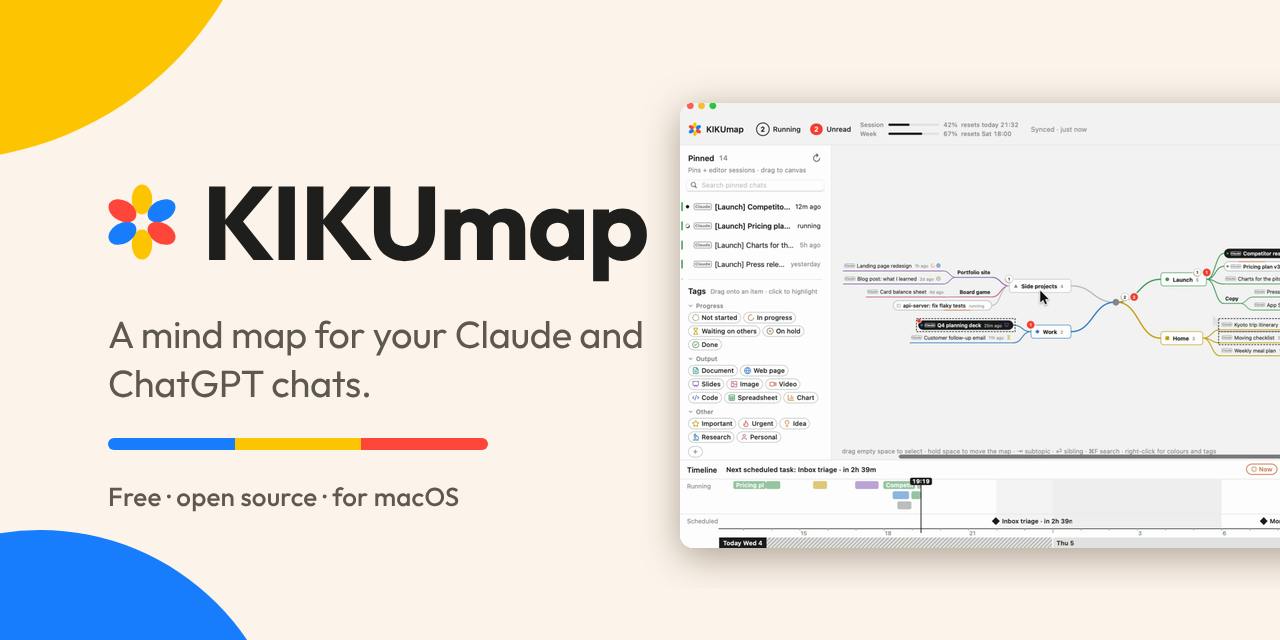
KIKUmap: Manage Your Claude and ChatGPT Conversations with Mind Maps
KIKUmap is a macOS menu bar app that visualizes Claude and ChatGPT conversations as mind maps with real-time status. Free and open source.