AI Agent Tool Permissions Out of Control? Citadel Identity360 Governs Them with an MCP Registry

Citadel Identity360 manages AI Agents with an identity governance framework: discovery, owner binding, MCP whitelists, and auditing.
Citadel Identity360 proposes a governance solution for AI Agents by bringing them into a mature identity governance framework. It highlights that Agents often go live with broad shared credentials, creating permission blind spots and accountability vacuums. Citadel's approach has three steps: automatically discover Agents on platforms like Microsoft Entra and AWS; explicitly bind Agents to accountable human owners; and build an Agent-to-MCP registry to visualize access paths and enforce tool-level authorization via function whitelists. OAuth gating and tokenless access ensure every tool request produces a compliant audit record, reusing proven IAM methodologies as a practical starting point for Agent production.
When an enterprise deploys an AI Agent to a production environment to automatically handle financial data, few people can accurately answer one question: what tools and databases can this Agent actually access right now?
Citadel Identity360's answer is: first find it, then manage it like a human employee, and finally use an MCP registry to map out every one of its access paths clearly.
The Problem: Where Do Agent Permission Blind Spots Come From
AI Agents usually go live as fast as possible. To save effort, development teams often configure them with a set of broad shared credentials so they can call multiple internal services. This improves efficiency in the short term but creates a huge security blind spot: no one knows exactly what permissions the Agent holds.
A cloud Agent deployed to handle sensitive financial data is a typical example. It can access databases, call data formatting services, and execute calculation functions, but these connections are scattered across different platforms and configuration files, lacking a unified view. Once the Agent accesses a database it should not access, accountability becomes impossible to establish—because it is an autonomous entity with no "employee" identity to hold responsible.
Shared Credentials refer to multiple applications or services sharing the same set of identity credentials (such as API keys or service account passwords) to access resources. In traditional application development, broad-permission credentials are often hardcoded or configured across multiple services for convenience. For AI Agents, this approach is especially dangerous: the Agent's autonomy means it dynamically calls tools based on tasks, and shared credentials make its actual call scope far exceed design expectations, while making it impossible to distinguish whether the Agent or another service initiated the request. Once credentials leak, attackers obtain exactly the same permissions as the Agent, and all operations in the logs point to the same identity, making tracing difficult. This is precisely the root of the article's emphasis that "no one knows exactly what permissions the Agent holds"—shared credentials blur permission boundaries.
Citadel Identity360's First Move: Cross-Platform Discovery and Inventory
Governance starts with visibility. Citadel Identity360 first automatically discovers AI Agents on platforms such as Microsoft Entra and AWS, pulling them into a centralized, auditable asset inventory.
This step is critical. Agents are often deployed across clouds and accounts, and manual inventory can hardly be exhaustive. Automatic discovery turns previously "invisible" Agents into records on the inventory, giving subsequent governance actions a target to work with.

Second Move: Bind the Agent to a Human Owner
After discovering the Agent, Citadel's approach is to bring it into the Identity Governance model and treat it like a human employee.
The core action is to explicitly associate the Agent with an accountable human owner. When the Agent performs operations or exhibits unauthorized behavior, the chain of responsibility is clear: find the owner, rather than facing an unclaimed automation script.
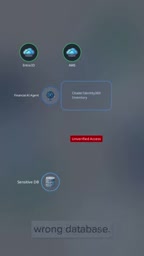
This also solves the "accountability vacuum" mentioned in the original text—an autonomously acting Agent cannot be held responsible, but its owner can.
Identity Governance is a subfield of IAM (Identity and Access Management), whose core goal is to ensure that "the right person accesses the right resources at the right time for the right reason." It typically includes identity lifecycle management (onboarding, transfer, offboarding), access requests and approvals, periodic access reviews, and separation of duties (SoD). Bringing AI Agents into the identity governance model means the Agent is no longer an anonymous automation script, but a "Non-Human Identity" with an auditable identity, a clear owner, and regular permission reviews. This enables enterprises to use existing governance processes (such as quarterly access reviews) to constrain Agents without building a separate system.
Third Move: Map Access Paths with an MCP Registry
For an Agent to get data, it usually goes through a standard service layer that formats data for AI. This connection is the Model Context Protocol (MCP).
Citadel Identity360 establishes an Agent-to-MCP registry that visualizes the precise routes by which Agents reach data. Each path is no longer a black box but an auditable connection graph.
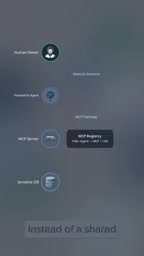
On this basis, governance policy shifts from "shared master keys" to "strict whitelists": the Agent can only call specific functions that are explicitly listed, achieving true tool-level authorization.
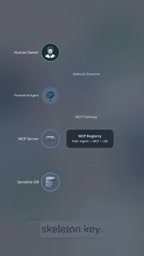
Model Context Protocol (MCP) is an open protocol proposed by Anthropic that aims to standardize how AI models connect to external tools and data sources. In the MCP architecture, an AI Agent acts as a client and performs specific operations through tools exposed by MCP servers, such as querying databases, calling APIs, and reading files. Each tool corresponds to a clear function signature and permission scope. An MCP registry is a directory that centrally records all available MCP servers and their tool inventories. Establishing an Agent-to-MCP registry is equivalent to building a "routing table" for each of the Agent's tool calls: it not only shows which MCP servers the Agent is connected to, but also drills down to which function is called, thereby supporting tool-level authorization and auditing.
Technical Highlights: OAuth Gating and Tokenless Access
Citadel's solution makes two design choices in access mechanisms:
- OAuth gating: The Agent must first go through an OAuth flow before requesting tools, rather than holding a long-lived key.
- Tokenless access: No long-lived tokens are retained on the Agent side, reducing the risk of abuse after credential leakage.
Each tool request generates a clear compliance record, forming a complete audit chain of access paths. For regulated industries, this audit chain itself is compliance evidence.
OAuth gating means that before requesting access to protected resources, the Agent must obtain a short-lived access token through an OAuth 2.0 authorization flow, rather than holding a static key long term. The OAuth flow can introduce user consent, scope restrictions, and token expiration mechanisms, minimizing permissions and making them revocable. Tokenless access goes further: the Agent itself stores no long-lived tokens, and each request is dynamically issued a short-lived credential by the identity provider or authenticated through a proxy. Thus, even if the environment where the Agent resides is compromised, attackers cannot steal long-lived valid credentials. Combined, the two transform the traditional model of "holding a key means having permissions" into "every request requires dynamic authorization," significantly reducing the blast radius after credential leakage and generating audit logs for each call that can be linked to the specific Agent and owner.
What This Means
Citadel Identity360's approach essentially maps "Agent governance" onto the mature "identity governance" framework: discover assets, bind responsible parties, limit permissions, and record audits.
It does not invent an entirely new security paradigm but reuses proven methodologies from the IAM field and adapts them to the Agent's autonomy and MCP's tool-calling characteristics. For enterprises pushing Agents into production, this combination of "accountable human owner + tool-level whitelist + auditable access paths" provides a practical starting point for governance.
The sentence at the end of the original article summarizes it accurately: that financial AI Agent can act on your behalf, but only if there is a clear human owner and a strict, auditable "allow list."
One-line Summary
Citadel Identity360 manages AI Agents with an identity governance framework: discovery, owner binding, MCP whitelists, and auditing.
Paragraph Summary
Citadel Identity360 proposes a governance solution for AI Agents, with the core idea of bringing Agents into a mature identity governance framework. The article points out that Agents often go live quickly with broad shared credentials, leading to permission blind spots and accountability vacuums. Citadel's solution has three steps: first, automatically discover Agents on platforms such as Microsoft Entra and AWS and include them in a centralized inventory; second, explicitly bind Agents to accountable human owners; finally, establish an Agent-to-MCP registry to visualize access paths and implement tool-level authorization through function whitelists. At the technical level, it uses OAuth gating and tokenless access to ensure that every tool request generates a compliant audit record. The overall approach reuses proven IAM methodologies and provides a practical starting point for putting Agents into production.
Related articles
AWS AgentCore Gateway: Connecting AI A…
AWS AgentCore Gateway: Connecting AI Agents to Enterprise Backends with MCP
How AWS AgentCore Gateway acts as a primary MCP server to aggregate REST APIs, Lambda, and existing MCP services? Analyzing its AST real-time mapping, zero cold start, semantic search for tool overload, session isolation, and key injection security design, plus the architectural approach to decoupling enterprise AI agents from backends.

One Link Gives Figma AI a New Skill: Hands-On with MCP Connectors
Paste one MCP server link and the AI Agent in Figma gains new tool capabilities. We break down the setup flow, 20+ one-click apps, read/write permissions and execution policies, and the public HTTPS requirement.

Cognition SWE-2 in Practice: One Prompt to Handle the Whole Product Launch Process
Analyzing a YouTube creator's prompt for using Cognition SWE-2 to launch a product: a landing page, seven-email sequence, and non-buyer follow-up tool, plus how the 'test and report' constraint changes AI delivery quality.