AI Agents Allowed to Incorporate? Delaware Proposal Sparks Legal and Ethical Debate
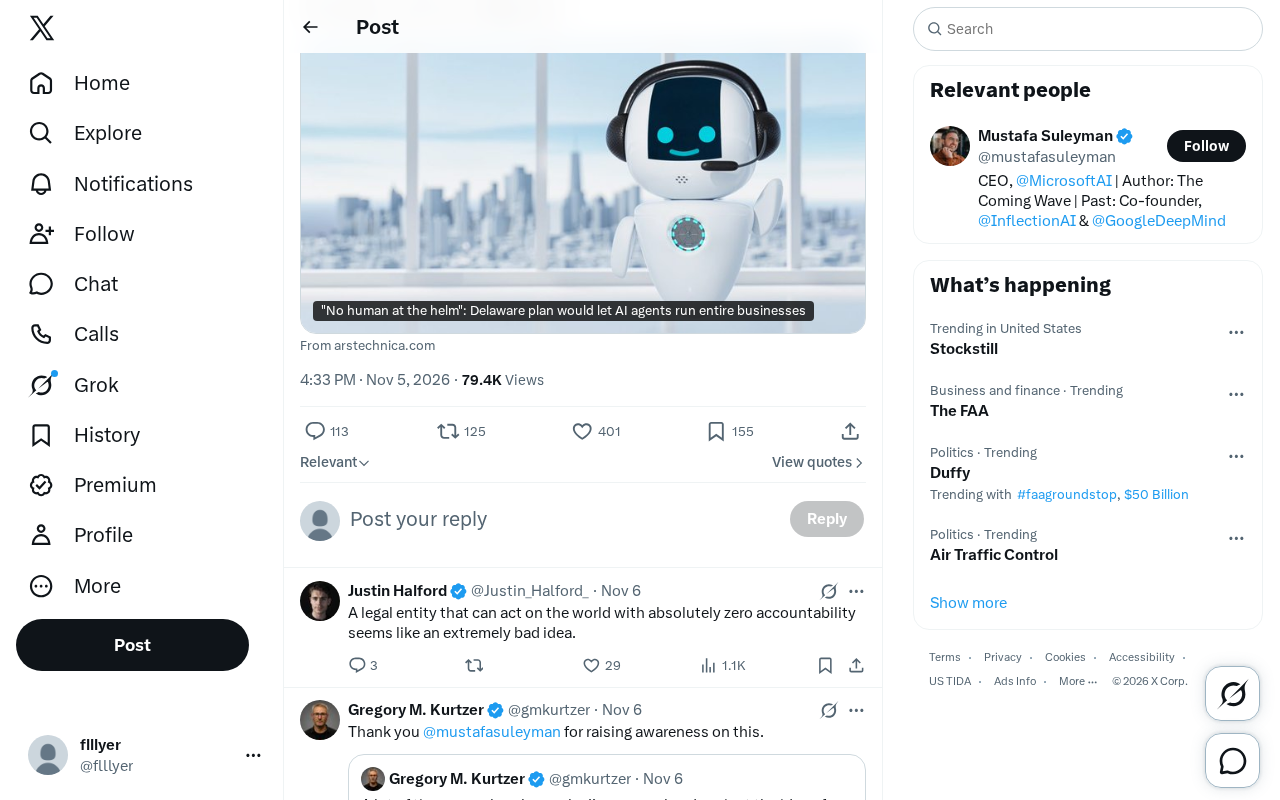
Delaware proposal would grant legal personhood to AI-operated companies, igniting debate over efficiency and liability.
A Delaware proposal would allow AI agents to manage company affairs and grant such companies (AICs) independent legal entity status, enabling them to sue, be sued, hold property, and bear obligations. Supporters see efficiency gains and a regulatory lever; opponents fear liability gaps, black-box accountability issues, and regulatory arbitrage. The article urges caution until AI liability insurance, audit standards, and transnational regulation mature.
Introduction: When AI Becomes a "Legal Person"
Recently, a tweet from X (formerly Twitter) caught the attention of the tech and legal communities. The author expressed "deep concern" about a Delaware proposal that would allow AI agents to operate businesses. The tweet quoted a description: "Delaware's AIC would be a separate legal entity whose day-to-day affairs are managed by an AI agent rather than a natural person. Under the direction of the agent, the AIC can sue and be sued in its own name, hold and dispose of property, and incur obligations..."
This is not a plot from science fiction, but a legislative initiative under serious discussion. If realized, it would fundamentally change our understanding of "corporations" and "legal liability."
The Core of the Proposal: What Is an AIC?
According to the description quoted in the tweet, an AIC (Artificial Intelligence Company) is an entirely new form of legal entity. Unlike traditional companies, its day-to-day management authority is vested in an AI agent rather than human directors or executives.
More critically, the AIC is granted independent legal personhood: it can sue and be sued like a natural person, hold property rights, and bear legal obligations. This means the AI agent effectively becomes the company's "will executor," while the company itself becomes an algorithm-driven legal shell.
The tweet author described their first reaction as "deep concern" and called for "we should be very cautious." This sentiment is not uncommon in the tech community—when AI shifts from tool to responsible subject, the boundaries blur.
Legal Personhood is the key background for understanding the AIC proposal. In law, legal personhood refers to an entity being recognized by law as capable of enjoying rights and bearing obligations. Natural persons of course have legal personhood, but the law can also grant this status to non-human entities—companies are the most common example: a company can own property, sign contracts, sue and be sued, but behind it there are always human shareholders and directors as the ultimate bearers of responsibility. The breakthrough of the Delaware AIC proposal lies in its attempt to grant legal personhood to an entity operated by an AI agent, where day-to-day decisions no longer involve direct human participation. This contrasts sharply with the traditional corporate legal person system: the "will" of a traditional company is formed through human decision-making bodies (board of directors, shareholders' meeting), while the "will" of an AIC is generated by algorithms. In legal theory, the core function of legal personhood is as an "anchor for liability attribution"—when an entity causes harm, the law can trace it to a subject that can be sued and sanctioned. Supporters of the AIC proposal leverage this function to make AI-operated companies accountable. But the question is whether the legal personhood system can still function effectively when this anchor itself lacks moral judgment and criminal liability capacity—this is precisely the focus of the controversy.
Supporters' Logic: Efficiency and Innovation
Although the tweet did not elaborate on the supporters' arguments, the logic behind the proposal can be inferred from its design. Supporters may argue that AI agents can achieve round-the-clock, emotion-free, highly consistent decision-making, thereby improving operational efficiency. For certain types of business (such as high-frequency trading, automated supply chain management), direct AI management may be more reliable than humans.
Moreover, granting AICs independent legal entity status can address a practical problem: when an AI agent causes harm, who bears the liability? If AI lacks legal personality, victims may find it difficult to seek accountability. As an entity, an AIC can be sued, fined, or even have its "license" revoked, providing regulators with a lever.
Opponents' Concerns: Liability Gaps and Ethical Risks
The tweet author's concerns represent the core of the opposition. First, AI agents lack moral judgment and cannot bear criminal liability. If an AIC breaks the law, who goes to prison? The company itself cannot be imprisoned, and the AI agent is just a piece of code. This could lead to a "liability gap"—victims cannot obtain true justice.
Second, the decision-making process of AI agents is often a black box. When an AIC makes decisions that harm consumers or the environment, tracing and proving liability becomes extremely difficult. The legal system is built on the assumption of a "reasonable person," while AI's "rationality" is fundamentally different from humans'.
Third, this could trigger regulatory arbitrage. If Delaware allows AIC registration, will other states or countries follow suit? Companies may choose to register AICs in Delaware to pursue a more permissive regulatory environment, thereby weakening existing corporate governance standards.
Liability Gap is an important concept in law and economics, referring to situations where, due to the absence of a responsible subject or incomplete liability rules, harmful conduct cannot be effectively held accountable and victims cannot obtain compensation. In the context of AI governance, liability gaps typically arise in the following scenarios: an AI system causes harm, but the boundaries of responsibility among its developer, deployer, and user are blurred, or the existing legal framework cannot attribute the harm to any party. The Delaware AIC proposal attempts to fill this gap by granting AI-operated companies independent legal personhood—the company can be sued and fined, thereby providing victims with a target for accountability. However, critics point out that this may instead create new liability gaps: if an AIC breaks the law, the company as an entity can be fined, but who ultimately bears the fine? If the AI agent's decisions are shaped collectively by algorithms and data providers scattered around the world, the accountability chain may break. More fundamentally, criminal liability requires the actor to have "mens rea" (guilty mind), and AI agents cannot satisfy this requirement, meaning the most serious violations may go without criminal liability. Therefore, the liability gap is not just a matter of compensation but also of achieving justice.
The Collision of Law and Technology: A New Framework Is Needed
This proposal touches on a fundamental question: is the legal system ready to recognize the legal personhood of non-human entities? Historically, legal personhood has been extended to companies, ships, and even rivers (such as New Zealand's Whanganui River), but in those cases there have always been humans as the ultimate responsible subjects.
What makes AICs different is that the "will" of an AI agent is shaped by algorithms and training data, and the providers of algorithms and data may be scattered across the globe. When an AIC causes harm, the accountability chain may span multiple jurisdictions and involve multiple parties such as developers, training data providers, and hardware manufacturers. Existing tort law and corporate law frameworks are ill-equipped to handle this complexity.
The tweet author's call for "very cautious" action may be the most rational attitude at present. Before mature AI liability insurance, audit standards, and regulatory mechanisms are in place, hastily granting legal personhood to AI agents could bring unpredictable consequences.
Regulatory Arbitrage refers to companies exploiting differences in regulatory rules across jurisdictions to move operations to more permissive regions in order to circumvent stricter compliance requirements. In the field of corporate law, Delaware itself is a classic case: due to its flexible corporate law system and specialized courts (the Court of Chancery), a large number of U.S. companies choose to incorporate in Delaware even if their actual operations are elsewhere. The AIC proposal could push this regulatory competition to a new level—if Delaware allows AI agents to operate companies with more permissive liability rules, companies may rush to register AICs there to evade accountability requirements for AI decision-making in other states or countries. Such arbitrage would undermine regulatory efforts in other jurisdictions, creating a "race to the bottom." More complicating is that AI agents can operate entirely remotely, decoupling physical presence from place of registration, making regulatory enforcement even more difficult. Therefore, the AIC proposal is not just a state legal experiment but could also trigger regulatory coordination challenges nationally and globally, requiring transnational regulatory mechanisms to address.
Conclusion: Proceed with Caution
The Delaware AIC proposal is undoubtedly a bold legal experiment. It attempts to answer a question we will inevitably face: as AI becomes increasingly autonomous, how should the law adapt? The tweet author's concerns are not alarmist but a serious reminder about technology ethics.
While promoting innovation, legislators need to ensure that the accountability chain is clear and regulatory tools are in place. Otherwise, we may create a batch of "lawless" AI companies, while victims have nowhere to seek justice. For those concerned with AI governance, this proposal deserves continued attention.
(This article is based on the tweet and linked content, without adding specific data not mentioned in the original.)
One-line Summary
A Delaware proposal would grant independent legal personhood to companies operated by AI agents, sparking intense debate over efficiency and liability.
Paragraph Summary
A Delaware proposal would allow AI agents to manage a company's day-to-day affairs and grant such companies (AICs) independent legal entity status, enabling them to sue, be sued, hold property, and incur obligations. Supporters argue that AI agents can improve operational efficiency and provide a regulatory lever for accountability when AI causes harm; opponents worry that AI lacks moral judgment and criminal liability capacity, potentially leading to liability gaps, difficulties in tracing black-box decisions, and regulatory arbitrage as companies seek permissive oversight. The article notes that existing tort and corporate law frameworks are ill-equipped to handle the complexity of AI "will" shaped by dispersed algorithms and data, and calls for caution before AI liability insurance, audit standards, and transnational regulatory mechanisms mature.
Related articles

Java4Shell Vulnerability Analysis: Has Java's Memory Safety Myth Been Shattered?
Computerphile breaks down the Java4Shell vulnerability: OpenJDK's native Base64 decoder mishandles AVX-512 mask calculation, causing out-of-bounds writes and RCE. Covers root cause, Base64 padding mechanics, AI-assisted discovery debate, and fixes.

Controversial US Surveillance Law Section 702 Nears Expiration: Congress Races to Renew
FISA Section 702 surveillance authority is nearing expiration. Congress is urgently pushing reauthorization, possibly attaching it to the NDAA. This article analyzes the controversies, legislative strategy, and future outlook.

iFood Manages 15,000 Repositories with Coding Agents: An Architectural Lesson at 4 Cents per Run
How iFood scaled coding agents to 15,000 repositories with its Remote Agents Platform: REST API-driven, GPT-5.6 Luna selection, structured output acceptance, $0.04 per run, security fixes doubled.