AI Engineering Hub: A Collection of Hands-On LLM and RAG Tutorials
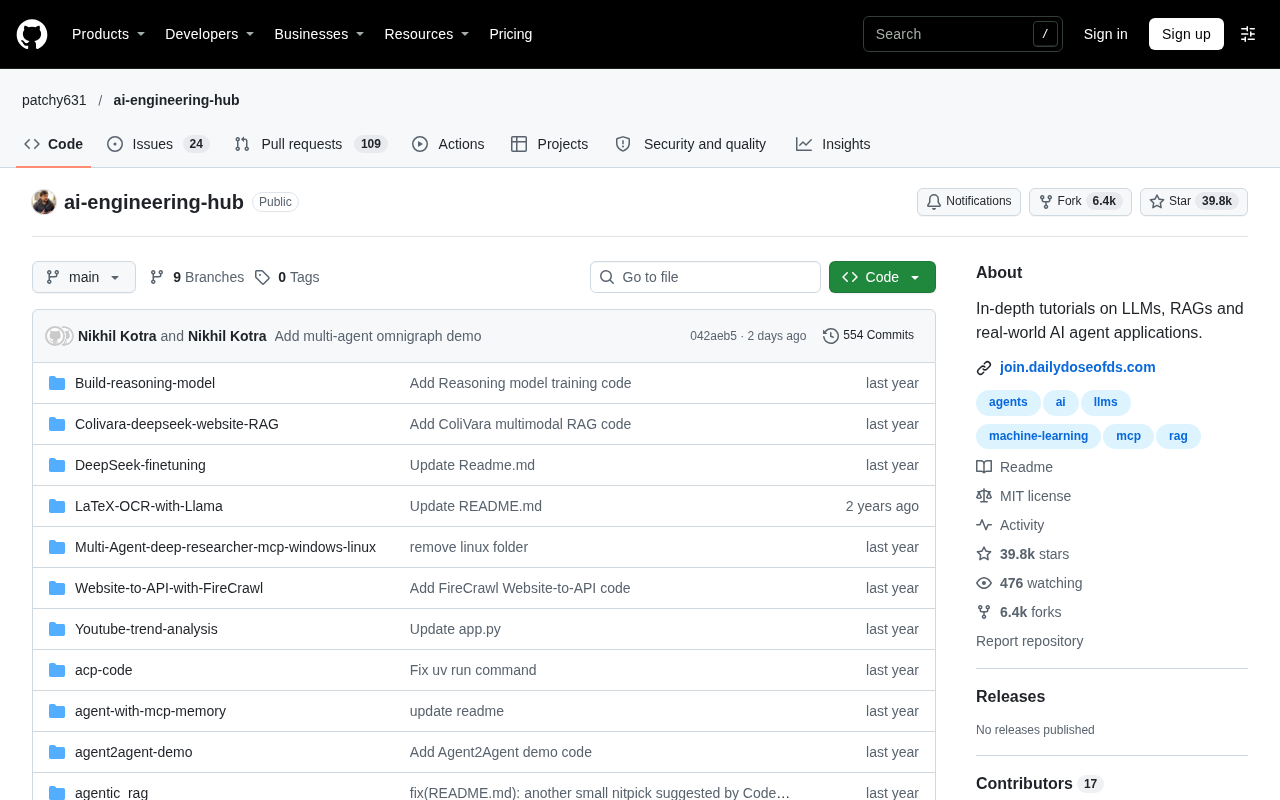
ai-engineering-hub is a deep tutorial repo on LLMs, RAG, and Agents, with runnable Jupyter Notebooks and nearly 40k stars.
ai-engineering-hub is a GitHub deep tutorial project focused on the engineering practice of LLMs, RAG, and real-world AI Agent applications. Organized as Jupyter Notebooks, all tutorials are interactively runnable. It covers LLM invocation and fine-tuning, RAG pipeline tuning (chunking, retrieval, reranking), and Agent engineering (tool definition, state management, error recovery). With nearly 40,000 stars and over 6,000 forks, plus 573 new stars in one day, it suits developers with Python basics to use on demand and deepen understanding through hands-on parameter changes.
In the field of AI application development, the gap between theoretical knowledge and engineering practice is often larger than one might imagine. A GitHub project called ai-engineering-hub is trying to bridge this gap with in-depth tutorials. The project focuses on LLMs, RAG, and real-world AI Agent applications, and has already garnered nearly 40,000 stars, with over 500 new stars in a single day—clear evidence of developers' hunger for this kind of hands-on content.
Project Positioning: From Concepts to Runnable Code
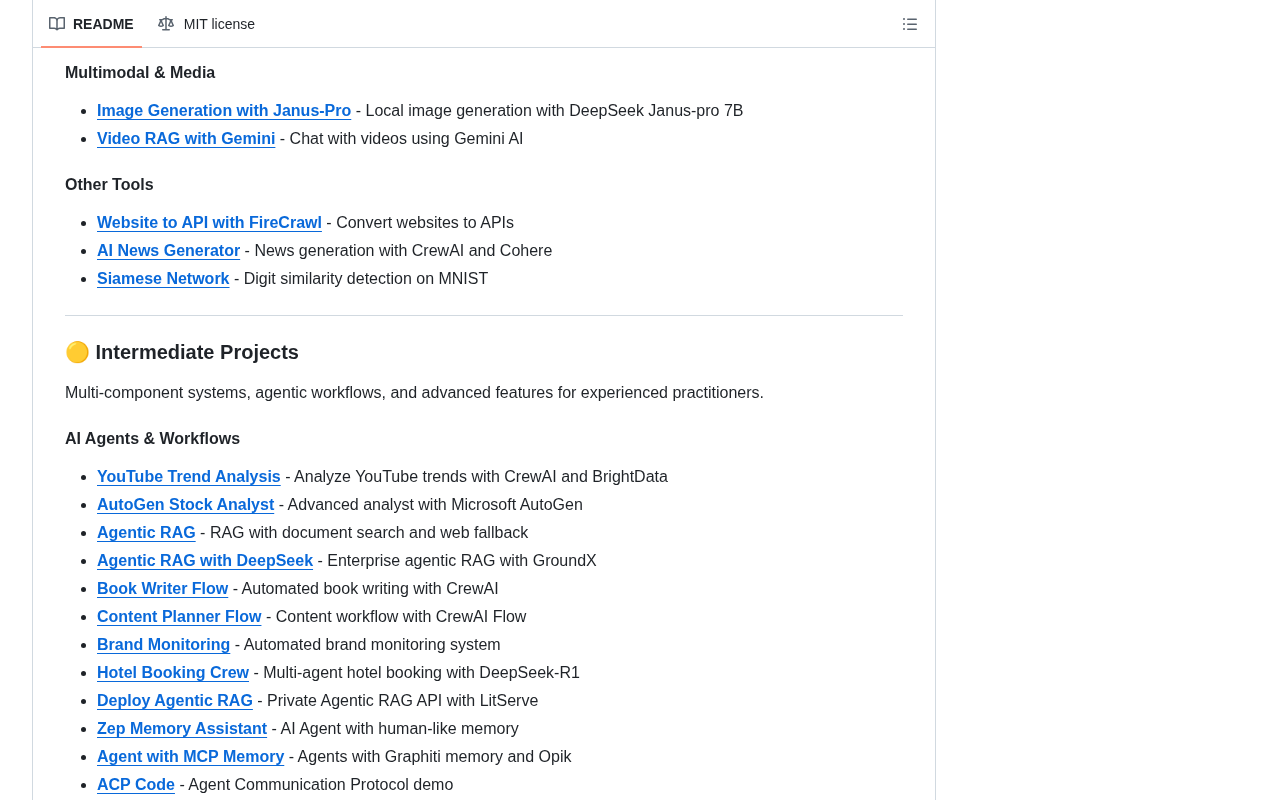
The self-description of ai-engineering-hub is very straightforward: in-depth tutorials on LLMs, RAG, and real-world AI Agent applications. It is not content with explaining Transformer architectures or attention mechanisms; instead, it focuses on how to turn large model capabilities into usable applications. All content is organized as Jupyter Notebooks, which means every tutorial is an interactive, reproducible experimental environment where readers can directly run code, adjust parameters, and observe changes in output.
This format is especially friendly to AI engineering learners. Compared with text-only blogs or video courses, Notebooks place explanations, code, and results on the same page, lowering the barrier from reading to hands-on experimentation. The project language is Jupyter Notebook, which also suggests that its content leans toward data science and rapid prototyping workflows.
Jupyter Notebook is a web-based interactive computing environment that supports mixing code writing, code execution, output display (including text, images, tables, etc.), and explanatory text within the same document. It was originally designed for data science and scientific computing and supports more than 40 programming languages, with Python being the most commonly used. Notebook files (.ipynb) are stored in JSON format and contain code cells and Markdown cells, making them easy to share and version-control. In AI engineering, Notebooks are often used for rapid prototyping, model debugging, and tutorial writing because they allow developers to execute code step by step and observe results immediately, greatly lowering the barrier to experimentation.
Content Landscape: LLM, RAG, and Agent Advancing on Three Fronts
As the project title suggests, there are three core sections. The LLM section most likely covers engineering topics such as model invocation, prompt engineering, fine-tuning, and evaluation; the RAG section focuses on retrieval-augmented generation, involving vector databases, document chunking, retrieval strategies, and generation quality optimization; the Agent section focuses on application patterns that let models plan autonomously, call tools, and complete multi-step tasks.
These three lines correspond exactly to the mainstream technology stack in current AI application development. LLM is the capability foundation, RAG addresses knowledge timeliness and hallucination issues, and Agent upgrades the model from a Q&A tool to a task executor. By placing all three in the same tutorial collection, the project helps developers build a complete understanding from basic invocation to complex systems.
Why RAG and Agent Tutorials Are So Scarce
There is no shortage of introductory LLM materials on the market, but content that goes deep into RAG pipeline tuning and Agent engineering practice is relatively scarce. RAG seems simple—retrieval plus generation—but in practice it encounters many engineering details such as chunk granularity, recall rate, reranking, and context window limitations. Agents involve system design issues such as tool definition, state management, and error recovery. The value of ai-engineering-hub lies in breaking down and thoroughly explaining these easily overlooked steps.
Retrieval-augmented generation (RAG) is a technical architecture that combines information retrieval with text generation. Its core workflow is: first convert the user query into a vector through an embedding model, retrieve relevant document chunks from a vector database, then feed these chunks as context together with the original question into a large language model to generate a more accurate and more timely answer. RAG can effectively mitigate the hallucination problem of large models and allow systems to leverage external knowledge bases without retraining the model. A typical RAG pipeline includes document chunking, vectorization, index construction, retrieval, reranking, and generation, and each stage has substantial room for engineering tuning—for example, chunk granularity affects recall completeness, and reranking can improve context relevance.
An AI Agent is an intelligent system capable of perceiving its environment, making autonomous decisions, and executing actions to accomplish specific goals. In the LLM context, an Agent usually refers to a program that uses a large language model as its reasoning engine and completes complex tasks through tool calling (such as search, computation, and API access), memory management, and multi-step planning. The core components of an Agent include: tool definitions (letting the model know the available external functions and their parameters), state management (tracking conversation history and task progress), planning and reflection (decomposing tasks into substeps and evaluating results), and error recovery (handling tool call failures or logical errors). In engineering practice, Agent design faces challenges such as loop control, context length limits, and tool selection accuracy—exactly the content that in-depth tutorials need to cover.
Signals Behind Community Popularity
Nearly 40,000 stars and more than 6,000 forks indicate that the project has entered a stage where it is widely bookmarked, reproduced, and further developed by developers. The 573 new stars in a single day is a noteworthy signal: the project is still spreading, possibly due to recent content updates or community recommendations. For technical tutorial repositories, a high fork count usually means readers are not just liking the project but actually pulling down the code and running it.
From a technology choice perspective, using Jupyter Notebook as the medium lowers the environment barrier, but it also requires readers to have some Python and data science fundamentals. The project is better suited to developers with some programming experience who want to quickly validate AI application ideas, rather than complete beginners.
How to Efficiently Use Tutorial Repositories Like This
When facing a large tutorial collection, it is advisable to use it on demand rather than reading it linearly from start to finish. First browse the table of contents, identify the Notebook most relevant to your current project, get a minimal example running, and then go back to understand the design tradeoffs behind it. The RAG and Agent sections are especially suitable for reading with specific questions in mind—such as "Why are my retrieval results inaccurate?" or "Why does the Agent get stuck in a loop?" Reading tutorials with questions in mind is far more efficient than passive browsing.
In addition, the interactive nature of Jupyter Notebooks is worth making full use of. Modify prompts, change retrieval parameters, swap model interfaces, and observe differences in output. The depth of understanding gained from this kind of hands-on experimentation cannot be replaced by static reading.
A vector database is a database system specifically designed to store and retrieve high-dimensional vector data, and it plays a central role in the RAG pipeline. It converts unstructured data such as text and images into vectors through embedding models and builds efficient indexes (such as HNSW and IVF) to support approximate nearest neighbor search. Common vector databases include Pinecone, Weaviate, Milvus, Chroma, and FAISS. When choosing a vector database, consider index type, query latency, scalability, filtering capabilities, and whether it supports hybrid search. In RAG applications, the retrieval quality of the vector database directly affects the accuracy of generated answers, so understanding its indexing mechanisms and similarity metrics is crucial for tuning.
Who It Is For
ai-engineering-hub is aimed at engineers, data scientists, and technical leads who want to turn LLM capabilities into products. It does not provide theoretical proofs; it provides runnable engineering paths. For teams building RAG systems or designing Agent workflows, this kind of tutorial collection can serve as a quick reference and source of inspiration. The project's high community popularity also means that when problems arise, it is easier to find discussions and derivative resources.
In an era of rapid AI technology iteration, the timeliness of tutorials is always a challenge. Readers are advised to follow the project's update status, prioritize recently maintained content, and cross-check key implementation details against official documentation.
One-line Summary
ai-engineering-hub is a deep tutorial repository focused on LLMs, RAG, and Agents, offering runnable code via Jupyter Notebooks and boasting nearly 40,000 stars.
Paragraph Summary
ai-engineering-hub is a GitHub deep tutorial project focused on the engineering practice of LLMs, RAG, and real-world AI Agent applications. Organized as Jupyter Notebooks, all tutorials are interactively runnable, lowering the barrier from reading to hands-on work. The content covers LLM invocation and fine-tuning, RAG pipeline tuning (chunking, retrieval, reranking), and Agent engineering (tool definition, state management, error recovery), filling the tutorial gap in implementation stages. The project has earned nearly 40,000 stars and more than 6,000 forks, with 573 new stars in a single day and continued community momentum. It is suitable for developers with Python fundamentals to use on demand, deepening understanding by modifying parameters and observing differences in output.
Related articles
Is Anthropic Unbeatable? A Deep Dive into Fable 5.2
A deep dive into Anthropic Fable 5.2 and Mythos 5.2: benchmark dominance and a leap in the sciences, but self-built tests expose weaknesses. Why real competitiveness comes from task division between models, not a single strongest one.

Why Rockets Don't Land Horizontally Like Airplanes: A Physics and Engineering Trade-off
Why don't rockets land horizontally like airplanes with wings? This article explains the engineering trade-offs behind Shuttle-style landings and Falcon 9 vertical landings from three angles: wing lift conditions, orbital velocity costs, and reusable booster structural reuse.

Can AI Governance Tools Block Agent and API Calls?
A Reddit developer questions whether AI governance tools only flag Agent calls rather than block them. We analyze the flagging vs. real-time blocking capability gap, vendor demo mismatches, and key questions to ask when buying.