@ai-sdk/svelte 3.0.267 Patch Update Explained

@ai-sdk/svelte 3.0.267 patch syncs with ai@5.0.267 core — low risk, safe to upgrade.
Vercel AI SDK's official Svelte adapter `@ai-sdk/svelte` has released version 3.0.267, a patch update that syncs with the latest fixes from the underlying `ai@5.0.267` core package. With no breaking changes, developers can follow this update with minimal risk after testing. The article also introduces the broader context of Vercel AI SDK — a popular open-source library with ~27k GitHub stars — and explains how its high-frequency release cadence (reflected in version 5.0.267) mirrors the rapid pace of change in the LLM ecosystem.
Vercel's open-source AI SDK has shipped another iteration: @ai-sdk/svelte version 3.0.267. This is a patch-level update that primarily syncs with the core package ai@5.0.267. For developers building AI applications with the Svelte framework, understanding the significance of these version bumps helps you track the evolution of the AI SDK ecosystem.
What's in This Update
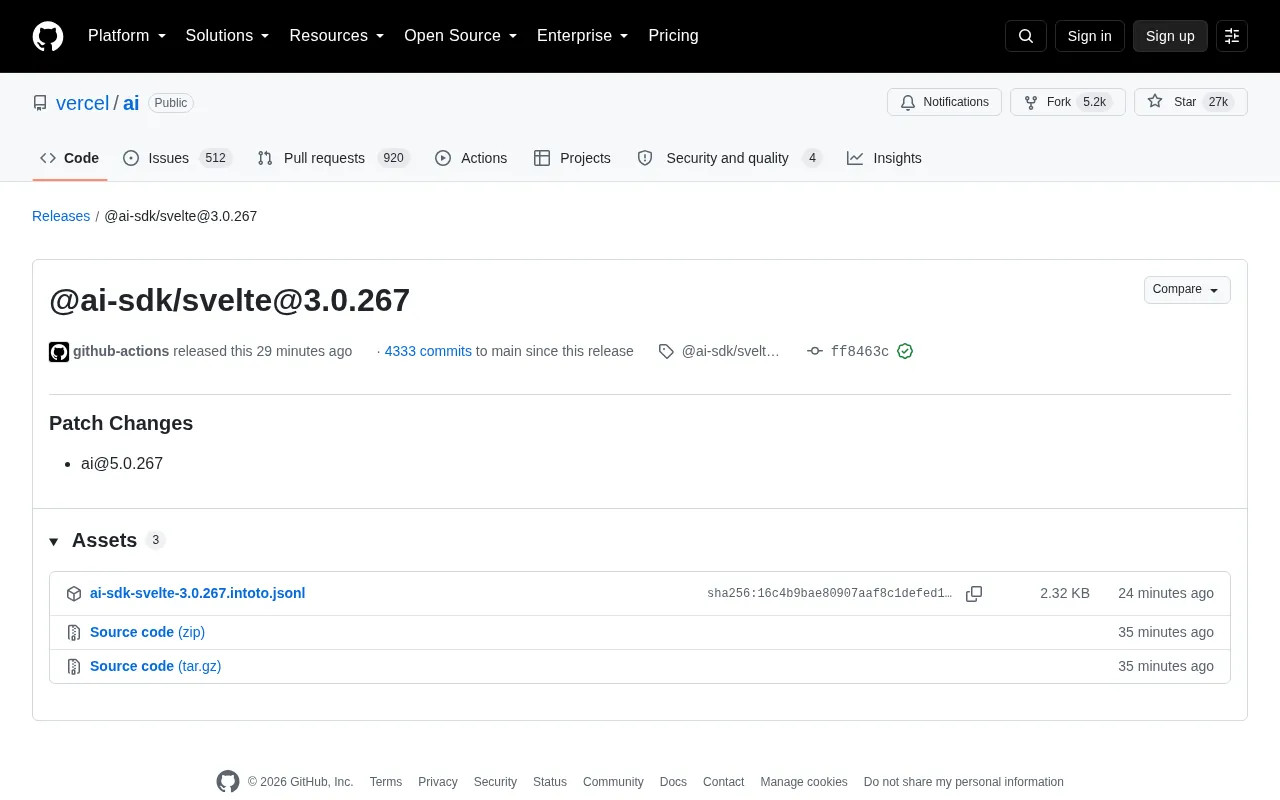
According to the GitHub Releases page, this release was automated via github-actions, with commits signed using a verified GitHub GPG key (ID: B5690EEEBB952194). The core change log contains a single Patch Changes entry:
ai@5.0.267
This means @ai-sdk/svelte itself introduces no independent new features — it simply aligns with the latest patch version of the underlying ai core package. Patch updates typically include bug fixes, internal dependency upgrades, or minor stability improvements, and involve no breaking changes, making the upgrade risk low.
What Is the AI SDK's Svelte Integration?
Vercel AI SDK is a popular open-source library (with approximately 27k stars and 5.2k forks on GitHub) designed to help developers rapidly build AI applications with capabilities like streaming responses and tool calling. It follows a modular design, providing adapter packages for major frontend frameworks. @ai-sdk/svelte is the official binding for the Svelte / SvelteKit ecosystem.
With this package, Svelte developers can tap into LLM interaction patterns — such as chat and text completion — through reactive stores or the runes mechanism, without having to handle low-level streaming data parsing or state management themselves.
It's worth briefly explaining how Svelte's reactivity model integrates with the AI SDK. Svelte 4 and earlier versions use the $store syntax to subscribe to Writable Stores for state management; Svelte 5 introduced the new Runes system (e.g., $state, $derived, $effect), shifting reactivity from compile-time magic to more explicit primitives. @ai-sdk/svelte needs to support both reactive paradigms, exposing hook-style utilities such as useChat and useCompletion. Internally, it converts streaming SSE data frames into reactive state, allowing chat message lists, loading indicators, and error messages to automatically drive UI updates — no need for developers to manually write fetch + ReadableStream parsing logic.
What Does Frequent Minor Versioning Tell Us?
The version number 5.0.267 makes it clear that the AI SDK iterates at a very high cadence. This pattern of dense patch releases is common among actively maintained open-source projects and reflects several characteristics:
Tight Synchronization with the Core Package
Framework adapter packages (such as those for Svelte, React, and Vue) tend to track the core ai package closely. This synchronization strategy ensures that users of all supported frameworks receive upstream fixes as soon as they land, preventing compatibility issues caused by version mismatches.
Vercel AI SDK uses a Monorepo + Semantic Versioning (SemVer) release strategy, managing version numbers across multiple sub-packages with the Changesets tooling. When the core ai package ships a patch, the CI/CD pipeline automatically triggers a synchronized patch-level release for all dependent framework adapters (@ai-sdk/react, @ai-sdk/svelte, @ai-sdk/vue, etc.) — even if those adapters themselves have no code changes. This "cascading release" mechanism ensures that declared peerDependencies version ranges remain valid at all times, preventing dependency conflict warnings during installation. The side effect is that version numbers grow very quickly: a version like 5.0.267 implies the core package has gone through at least 267 patch releases since 5.0.0.
Rapid Response to Ecosystem Changes
LLM model interfaces and protocols evolve frequently, and SDKs must continuously keep pace. A high patch frequency signals that the maintenance team can quickly fix issues and adapt to upstream changes — a positive sign for teams using the SDK in production.
How Should Developers Respond?
For teams already using @ai-sdk/svelte in their projects, a pragmatic approach works well for patch updates like this one: patch versions are generally backward-compatible, so the recommended approach is to validate in a test environment before upgrading to pick up the latest stability improvements. If you use an automated dependency management tool, locking to a minor version range will automatically pull in patches.
One thing to note: this release does not disclose the specific issues that were fixed. Developers who need a detailed breakdown of the changes should consult the changelog for the ai@5.0.267 core package separately. Overall, this is a routine maintenance update with low risk — safe to follow without hesitation.
Related articles

GitHub Daily · October 30: Skills Ecosystem Explodes, Agents Start Provisioning Their Own Computers
GitHub Daily Oct 30: Skills ecosystem hits three layers (official, personal, vertical), agents get their own computers, and cross-session memory becomes essential.
AWS AgentCore Gateway: Connecting AI A…
AWS AgentCore Gateway: Connecting AI Agents to Enterprise Backends with MCP
How AWS AgentCore Gateway acts as a primary MCP server to aggregate REST APIs, Lambda, and existing MCP services? Analyzing its AST real-time mapping, zero cold start, semantic search for tool overload, session isolation, and key injection security design, plus the architectural approach to decoupling enterprise AI agents from backends.

One Link Gives Figma AI a New Skill: Hands-On with MCP Connectors
Paste one MCP server link and the AI Agent in Figma gains new tool capabilities. We break down the setup flow, 20+ one-click apps, read/write permissions and execution policies, and the public HTTPS requirement.