AI SDK Svelte Package Updated to 4.0.318: Dependencies Synchronized

@ai-sdk/svelte releases 4.0.318 patch, only synchronizing ai and provider-utils dependencies.
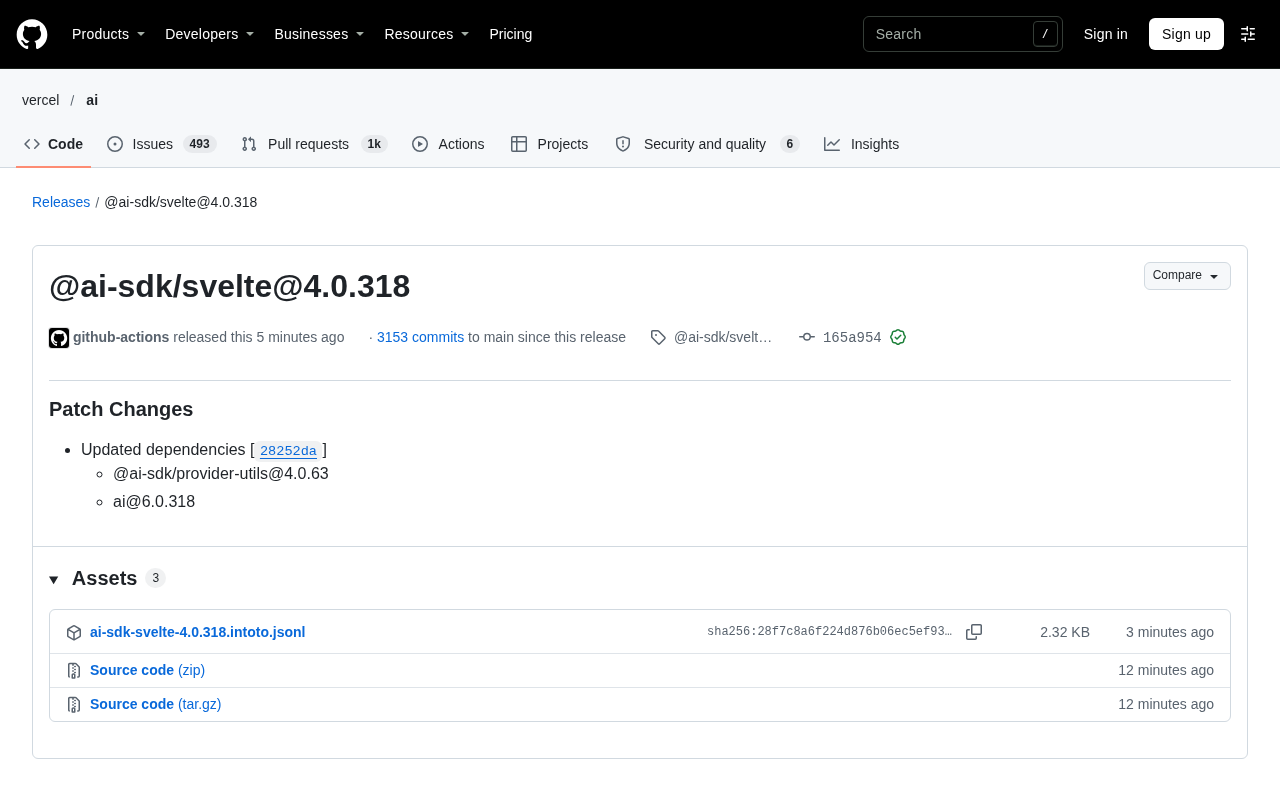
`@ai-sdk/svelte` released patch version 4.0.318 with only one change: synchronizing underlying dependencies—`@ai-sdk/provider-utils` to 4.0.63 and the core `ai` package to 6.0.318. This is a typical dependency-alignment patch with no new APIs, feature changes, or breaking changes, classified as patch level under SemVer. For Svelte/SvelteKit developers using the AI SDK, upgrade risk is low, but keeping the adapter and core packages version-synchronized is important to avoid type mismatches or dependency conflicts. The release was automated via GitHub Actions, with 3153 commits on the main branch, reflecting the repo's high-frequency iteration and parallel multi-package release cadence.
The Svelte adapter package in the AI SDK ecosystem has received a patch version update. @ai-sdk/svelte has released version 4.0.318, with the core change being the synchronized upgrade of two underlying dependencies: @ai-sdk/provider-utils to 4.0.63 and the core package ai to 6.0.318. This update itself introduces no new APIs or feature changes—it's a typical dependency-alignment patch.
Update Overview
Dependency Version Synchronization
According to the release notes, version 4.0.318 is a Patch Change with only one item: updating dependencies. Specifically, @ai-sdk/provider-utils was upgraded to 4.0.63 and the core ai package to 6.0.318. These two dependencies serve different roles—provider-utils provides low-level utility functions for interacting with model providers, while the ai package is the core runtime of the entire AI SDK.
Nature of the Patch Version
Under semantic versioning conventions, patch versions are typically used for backward-compatible bug fixes. This release contains no feature descriptions, bug fix notes, or behavior change records, suggesting it's more likely intended to keep the Svelte adapter layer's version numbers aligned with upstream packages. For developers building Svelte applications with the AI SDK, upgrading will not involve any breaking API-level changes.
Semantic Versioning (SemVer) is a widely adopted versioning convention with the format MAJOR.MINOR.PATCH. The major version increments on incompatible API changes; the minor version increments on backward-compatible feature additions; the patch number is for backward-compatible bug fixes. By this convention, 4.0.317 → 4.0.318 is a patch upgrade that callers can safely substitute without modifying code. In practice, however, many maintainers also classify "dependency-only" changes that don't touch their own code logic as patch versions to minimize upgrade overhead. Understanding this helps interpret releases: when the notes only say "update dependencies," the real behavior changes actually happened in the upgraded upstream packages.
Practical Impact on Developers
Who Should Pay Attention
If you're integrating LLM capabilities into a Svelte or SvelteKit project via @ai-sdk/svelte, this update is worth following. Although the change is just a dependency upgrade, keeping the adapter package version in sync with the core package helps avoid type mismatches or runtime exceptions caused by version skew. Especially given the fast iteration pace of the AI SDK, an adapter layer lagging behind the core package often leads to hidden compatibility issues.
AI SDK is an open-source TypeScript toolkit maintained by Vercel for building AI applications, designed with a layered architecture: the core ai package provides runtime capabilities like streaming text generation, tool calling, and message management; @ai-sdk/provider-utils encapsulates the shared low-level request and parsing logic for various model providers (such as OpenAI and Anthropic); and adapter packages like @ai-sdk/svelte, @ai-sdk/react, and @ai-sdk/vue bridge core capabilities into specific frontend frameworks' reactivity systems. This separation keeps the framework adapter layer thin—responsible only for connecting state and framework lifecycles—so when upstream changes, the adapter often just needs a version bump.
Upgrade Recommendations
For most projects, a standard dependency update suffices. Since it's a patch version with no breaking changes, upgrade risk is low. It's recommended to run existing test cases after upgrading to confirm that Svelte-specific integration points—such as streaming responses and message state management—behave correctly. If your project pins the ai core package version, adjust it in sync to avoid dependency conflicts.
Version skew refers to inconsistent version requirements for a shared dependency across multiple packages in the same dependency tree. In the npm ecosystem, if the adapter package declares a dependency on ai@6.0.318 while the project lockfile is still pinned to an earlier ai version, the package manager may install two copies, leading to inconsistent type definitions or duplicate instance issues at runtime (e.g., instanceof checks failing). Therefore, when upgrading the adapter package, also verify that the version ranges of ai and @ai-sdk/provider-utils can converge to the same version, updating the lockfile if necessary and checking the output of npm ls ai.
Release Background and Version Cadence
This release was automated via GitHub Actions, with commit records showing 3153 commits accumulated on the main branch since the last release. This number reflects the high-frequency iteration state of the AI SDK repository as a whole, where parallel releases of multiple packages are the norm. The automated release process also means patch versions often closely follow upstream dependency changes rather than independent feature planning.
For developers following the AI SDK ecosystem, understanding this "adapter follows core" release pattern helps plan upgrade cadence sensibly: you don't need to chase every patch immediately, but you should align versions periodically to avoid accumulating compatibility debt by staying on old versions for too long.
Summary
@ai-sdk/svelte@4.0.318 is a patch update aimed at dependency synchronization, with the core ai package and provider-utils upgraded to new versions in sync, involving no feature or API changes. Teams using the AI SDK with Svelte can upgrade through the standard process, paying attention to version alignment with the core package.
One-line Summary
@ai-sdk/svelte releases 4.0.318 patch, only synchronizing ai and provider-utils dependencies.
Paragraph Summary
@ai-sdk/svelte released patch version 4.0.318, with only one change: synchronously upgrading underlying dependencies, with @ai-sdk/provider-utils to 4.0.63 and core package ai to 6.0.318. The article explains this is a typical dependency-alignment patch containing no new APIs, feature changes, or breaking changes, thus classified as a patch level under semantic versioning. For developers using the AI SDK in Svelte/SvelteKit, the upgrade risk is low, but the adapter and core packages should stay version-synchronized to avoid type mismatches or dependency conflicts. The release was automated via GitHub Actions, with 3153 commits accumulated on the main branch, reflecting the repository's high-frequency iteration and parallel multi-package release cadence.
Related articles

Will GitHub Die? Open Source Maintainer Burnout and the Collaboration Crisis in the AI Era
Lex Fridman podcast discussion on open source maintainer burnout and GitHub's predicament: massive pull requests overwhelm core maintainers, and AI worsens code bloat. Using math journal peer review and Poincaré conjecture verification as analogies, the article analyzes why verification in knowledge production must be deliberately slow, and how open source communities can avoid the failure mode of maintainers exiting.

Stop Building Cookie-Cutter AI Websites: 3 Tools That Transform Your Coding Agent
Three tools that boost AI coding agents: FFmpeg skill for local video editing in Claude Code and Cursor, Hallmark's 50 design themes to fix cookie-cutter AI sites, and Jailbreaks' 25+ model prompts.

How America's Gerontocracy Squeezes the Younger Generation
Americans over 55 hold nearly three-quarters of national wealth, alongside an 80-year-old president and elderly congressional leaders. The Atlantic's Idrees Kahloon explains how gerontocracy drives up housing costs, squeezes opportunities for the young, and explores zoning reform and child poverty reduction as practical fixes.