@ai-sdk/workflow 2.0.76 Patch Update: AI SDK Dependency Chain Upgraded in Sync

@ai-sdk/workflow 2.0.76 is a pure patch update that synchronously upgrades three upstream dependencies to align the dependency chain.
Vercel's @ai-sdk/workflow has released version 2.0.76, a Patch Changes type release with no new features or API changes. Its core action is synchronously upgrading three upstream dependencies: @ai-sdk/provider 4.0.30, ai 7.0.144, and @ai-sdk/provider-utils 5.0.63. The article uses this to outline the AI SDK's layered package structure: ai is the main entry package, provider defines unified model interfaces, provider-utils provides reusable utilities, and workflow handles workflow orchestration. Since patch updates to underlying packages can affect upper-layer behavior through dependency propagation, the workflow package following the upgrade is a necessary action to maintain ecosystem consistency. The article advises developers to run workflow integration tests after performing routine dependency updates and to develop the habit of regularly checking dependency versions to cope with the high-frequency, small-step release cadence.
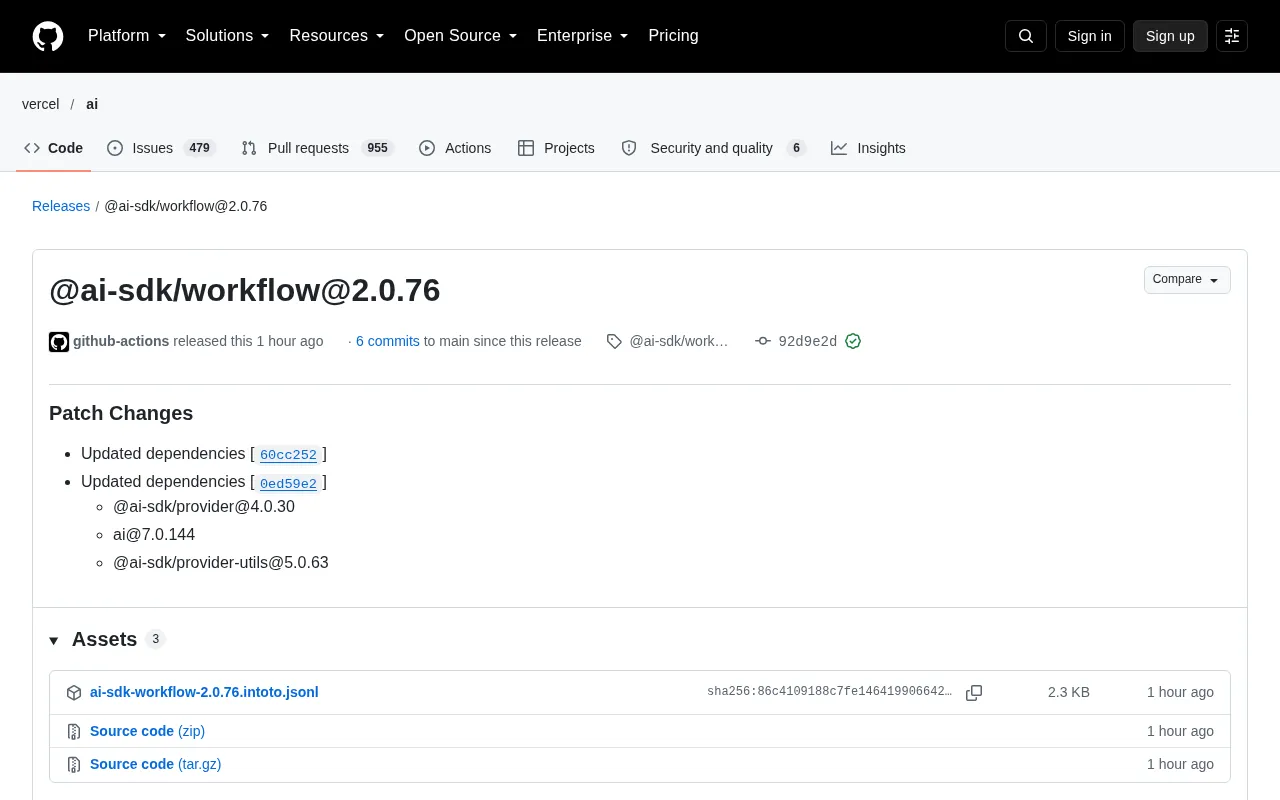
Vercel's AI SDK ecosystem has rolled out another routine patch iteration. @ai-sdk/workflow has released version 2.0.76, and this update introduces no new features—its core action is synchronously upgrading upstream dependency packages. For developers relying on the AI SDK to build workflow applications, such patch updates are often easy to overlook, but what they reflect is the coordinated evolution of the entire SDK dependency chain.
What Exactly Changed in This Update
According to the release notes on GitHub, 2.0.76 is a Patch Changes type release, with changes focused on dependency updates. The commit history shows a total of 6 commits merged into the main branch. The specific dependency packages involved include:
@ai-sdk/providerupgraded to 4.0.30aiupgraded to 7.0.144@ai-sdk/provider-utilsupgraded to 5.0.63
These three packages respectively correspond to the core abstraction layer, the main entry package, and the Provider utilities within the AI SDK ecosystem. The Workflow package itself serves as a high-level wrapper for workflow orchestration, and its stability is directly built upon the compatibility of the underlying packages mentioned above.
Why Patch Releases Still Deserve Attention
Many developers take an "automatic upgrade is fine" attitude toward patch versions, but in a multi-package monorepo ecosystem, dependency alignment is often the key to fixing hidden bugs. If there is a version mismatch between the ai main package and @ai-sdk/provider, it can lead to inconsistent type definitions, abnormal Provider adaptation, and other hard-to-diagnose issues. This update synchronously upgrading all three dependencies is essentially a dependency chain alignment operation.
The Meaning of Patch in Semantic Versioning (SemVer): In the semantic versioning specification, version numbers follow the form MAJOR.MINOR.PATCH. An increment in the PATCH position indicates backward-compatible bug fixes that introduce no new features and do not break existing APIs. Therefore, 2.0.76 relative to 2.0.75 is expected to have unchanged behavior, only fixing defects or updating dependencies. However, note that this promise applies only to the package's own public API; when a patch involves dependency upgrades, behavioral changes in transitive dependencies may still indirectly affect consumers—this is precisely why the "dependency alignment" discussed in this article deserves attention.
Breaking Down the AI SDK Package Structure
To understand the significance of this update, one must first grasp the layered architecture of the AI SDK. ai is the main package for developers, providing core APIs such as generateText, streamText, and generateObject; @ai-sdk/provider defines the unified interface specification for model providers; and @ai-sdk/provider-utils encapsulates utility functions reused across various Provider implementations. @ai-sdk/workflow takes on the responsibility of workflow orchestration within this system, connecting multi-step model calls and tool executions into manageable processes.
The direct consequence of this layered design is that any patch update to an underlying package can affect the behavior of upper-layer packages through dependency propagation. The Workflow package following the upgrade is a necessary action to maintain ecosystem consistency.
What the Version Numbers Reveal
Looking at the version numbers, @ai-sdk/provider has reached 4.x, the ai main package has reached 7.x, and provider-utils has reached 5.x, indicating that the AI SDK has gone through multiple major version evolutions. Each package's version number increments independently but stays coordinated through the release process, which requires consumers to use compatible version ranges in package.json rather than locking to exact versions.
The Role of the Provider Abstraction Layer: @ai-sdk/provider defines a set of interface specifications independent of specific vendors, including call contracts for language models (LanguageModelV1), embedding models, image models, and more. Various model services (such as OpenAI, Anthropic, Google) integrate with the AI SDK by implementing these interfaces, and the main package ai depends only on the abstract interfaces rather than specific vendors. This design allows developers to switch model providers without changing business code. Meanwhile, @ai-sdk/provider-utils houses utilities that repeatedly appear across Provider implementations—such as streaming response parsing, JSON schema validation, and error wrapping—avoiding the need for each Provider package to reinvent the wheel.
Practical Advice for Developers
If you use @ai-sdk/workflow in your project, the operational cost of this upgrade is very low: simply run the usual dependency update command. However, it is recommended to run your workflow-related integration tests after upgrading to confirm that the multi-step call chain has not exhibited behavioral differences due to changes in underlying dependencies.
For developers who have not yet adopted the workflow package but have already integrated the AI SDK main package, this release also offers an observation window—check whether ai@7.0.144 and @ai-sdk/provider@4.0.30 appear together in your dependency tree, to avoid version drift.
Where This Type of Update Fits in the Release Cadence
Judging from release frequency, the AI SDK ecosystem maintains a high-frequency patch iteration cadence, with each update typically having a very small change surface. This "small steps, fast pace" strategy reduces the risk of any single upgrade, but it also means developers need to develop the habit of regularly checking dependency versions, rather than waiting for major version upgrades to address everything at once.
Trade-offs Between Version Ranges and Lock Files: Using ^ in package.json (e.g., ^2.0.76) allows automatic receipt of patches and minor version updates within the same major version, while ~ allows only patch updates, and exact versions completely lock things down. Combined with lock files such as package-lock.json and pnpm-lock.yaml, you can ensure that your team and CI environments install exactly the same dependency tree. The recommended approach is: use ^ in daily dependency declarations to stay flexible, commit lock files to the repository to ensure reproducibility, and then use tools like Dependabot or Renovate to periodically raise upgrade PRs and run integration tests before merging—balancing timeliness and stability.
Summary Observations
@ai-sdk/workflow@2.0.76 is a typical ecosystem-synchronization patch release with no API changes and no behavioral adjustments; its value lies in maintaining dependency chain consistency. Viewed as a slice of AI SDK version management: in the rapidly evolving AI development toolchain, underlying stability maintenance is equally part of product capability.
Related articles

WorkBuddy in Action: How a Desktop Agent Automates Your Work
WorkBuddy is a desktop-level AI agent workbench that drives computers via command line, connects external tools, and automates file processing, data organization, and document generation. This article analyzes its working principles, complex task processing flow, and a practical path from getting started to taking orders.

Turning AI Intruders Against Themselves: A Hands-On Look at AgentCapture
AgentCapture is an AI countermeasure honeypot platform that integrates with existing networks and reverse proxies, using lossless deployment, AI agent identification, attacker profiling, and session replay to turn automated intruders against themselves.

WorkBuddy In-Depth: The Leap from Conversational AI to Office Automation
What is WorkBuddy? Tencent's AI agent desktop tool understands Chinese commands and directly operates computer files, handling office automation from resume sorting to scheduled reports. This article analyzes its fundamental differences from conversational AI like ChatGPT, its core capabilities, and applicable scenarios.