AI SDK Workflow Harness 1.0.168 Update Analysis

@ai-sdk/workflow-harness releases 1.0.168 patch update, syncing dependencies and harness version.
@ai-sdk/workflow-harness released version 1.0.168, a patch update focused on dependency updates, containing 2 commits and four dependency commit hashes (033f8d9, e7a8988, 2c12e25, 6eab0f7). Meanwhile, @ai-sdk/harness was also updated to 1.0.168 in sync, indicating a tight version linkage between the two packages. The article notes that such dependency updates typically mean synchronized improvements in underlying capabilities or security fixes; although the release notes do not detail specific changes, frequent updates reflect active iteration in the upstream ecosystem. For teams using this toolkit, it is recommended to check synchronized versions, verify workflow execution in a test environment, and monitor subsequent feature changes. Overall, this is a routine maintenance update suitable for teams already using the toolkit to follow up with the upgrade.
Version Update Overview
Recently, @ai-sdk/workflow-harness released version 1.0.168. According to the GitHub release records, this is a patch version update (Patch Changes) focused primarily on dependency updates, containing 2 commits and updating multiple underlying dependencies.
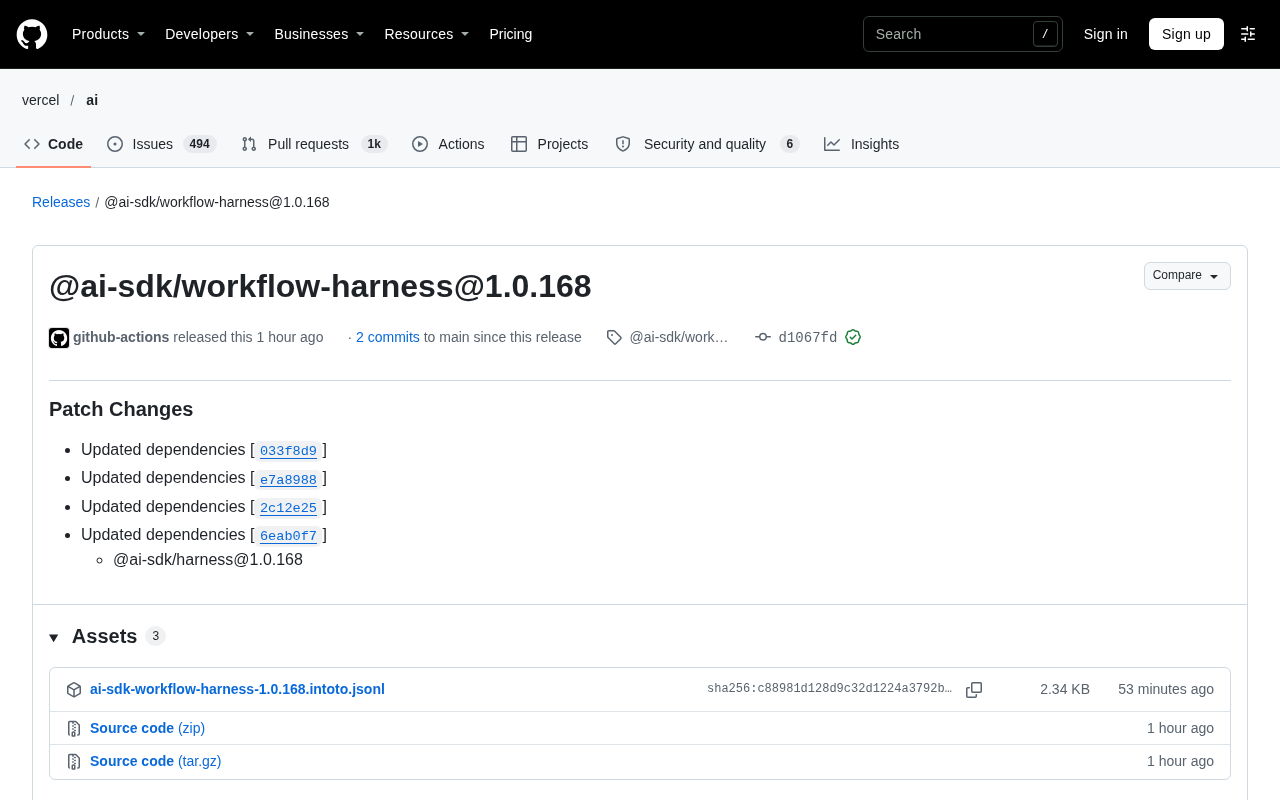
The core changes in this version center on dependency management, involving four commit hashes: 033f8d9, e7a8988, 2c12e25, and 6eab0f7. Meanwhile, @ai-sdk/harness was also updated to version 1.0.168 in sync, indicating a tight version linkage between these two packages.
Patch Changes are a category of version increment rules in Semantic Versioning (SemVer). SemVer divides version numbers into major.minor.patch (e.g., 1.0.168), where a change in the patch number indicates a backward-compatible bug fix, without new features or breaking changes. In the npm ecosystem, many projects use tools like changesets to automatically generate release notes; when a release contains only dependency upgrades or minor fixes, it is marked as Patch Changes. Therefore, when developers see a patch version update, they can generally expect low upgrade risk, but should still be mindful of indirect effects that transitive dependencies may introduce.
The Significance of Dependency Updates
For toolkits like this, dependency updates often mean synchronized improvements in underlying capabilities or security fixes. Although the release notes do not detail the specific changes, frequent dependency updates usually reflect active iteration in the upstream ecosystem.
As a workflow orchestration tool in the AI SDK ecosystem, the stability of @ai-sdk/workflow-harness directly affects the reliability of applications built on top of it. Although this update appears to be merely a version number change, for production environments that depend on this package, keeping in sync with updates remains necessary maintenance work.
How to Understand This Type of Patch Release
When developers encounter patch versions like this without detailed change descriptions, it is recommended to pay attention to the following points:
- Check the synchronized version of
@ai-sdk/harnessto ensure there are no version conflicts in the dependency tree; - Verify in a test environment that workflow execution works properly, especially in scenarios involving multi-step orchestration;
- Keep an eye on whether subsequent versions bring functional changes; the current update is more maintenance-oriented.
Ecosystem Linkage and Version Synchronization
Interestingly, @ai-sdk/workflow-harness and @ai-sdk/harness maintain the same version number (both 1.0.168). This synchronized release strategy helps reduce confusion for developers in dependency management.
For teams building AI workflows, the value of such toolkits lies in providing standardized orchestration capabilities. Although this update itself does not introduce new features, it maintains ecosystem consistency and lays the groundwork for possible future feature iterations.
Dependency Tree is the hierarchical structure built by a package manager when installing dependencies, recording each package and all its transitive dependency versions. When two packages (such as @ai-sdk/workflow-harness and @ai-sdk/harness) are released in sync with the same version number, it helps reduce the occurrence of multiple incompatible versions of the same package in the dependency tree. Tools like npm may install multiple copies when encountering version conflicts, leading to package bloat or inconsistent singleton state. A synchronized version strategy makes it easier for upper-level applications to resolve to the same version when parsing dependencies, thereby improving the flatness and predictability of the dependency tree.
Summary
@ai-sdk/workflow-harness@1.0.168 is a routine dependency maintenance update, suitable for teams already using this toolkit to follow up with the upgrade. For developers who have not yet adopted it, it can serve as an entry point to learn about the AI SDK workflow ecosystem.
Related articles

WorkBuddy in Action: How a Desktop Agent Automates Your Work
WorkBuddy is a desktop-level AI agent workbench that drives computers via command line, connects external tools, and automates file processing, data organization, and document generation. This article analyzes its working principles, complex task processing flow, and a practical path from getting started to taking orders.

Turning AI Intruders Against Themselves: A Hands-On Look at AgentCapture
AgentCapture is an AI countermeasure honeypot platform that integrates with existing networks and reverse proxies, using lossless deployment, AI agent identification, attacker profiling, and session replay to turn automated intruders against themselves.

WorkBuddy In-Depth: The Leap from Conversational AI to Office Automation
What is WorkBuddy? Tencent's AI agent desktop tool understands Chinese commands and directly operates computer files, handling office automation from resume sorting to scheduled reports. This article analyzes its fundamental differences from conversational AI like ChatGPT, its core capabilities, and applicable scenarios.