@ai-sdk/xai 3.0.142 Released: Dependency Chain Upgraded in Sync

Vercel's @ai-sdk/xai releases 3.0.142 patch, synchronously upgrading three underlying dependency packages — a routine maintenance update.
Vercel-maintained @ai-sdk/xai released patch version 3.0.142, automatically published via GitHub Actions, with the main change being synchronized upgrades to three underlying dependencies: @ai-sdk/provider to 3.0.19, @ai-sdk/openai-compatible to 2.0.84, and @ai-sdk/provider-utils to 4.0.60. This update introduces no new features or behavior changes — a typical dependency sync patch — but its underlying packages serve as shared infrastructure across multiple providers, and their iterations may include compatibility fixes or security patches. The article recommends developers focus on the specific diffs of @ai-sdk/provider and @ai-sdk/provider-utils, and keep underlying versions consistent when multiple providers coexist to avoid type conflicts.
Updates in the AI SDK ecosystem are often overlooked, yet they're deeply relevant to developers' day-to-day work. Recently, the @ai-sdk/xai package maintained by Vercel released version 3.0.142. Though it's a patch update, the changelog shows it touched several underlying dependency packages.
Patch Changes
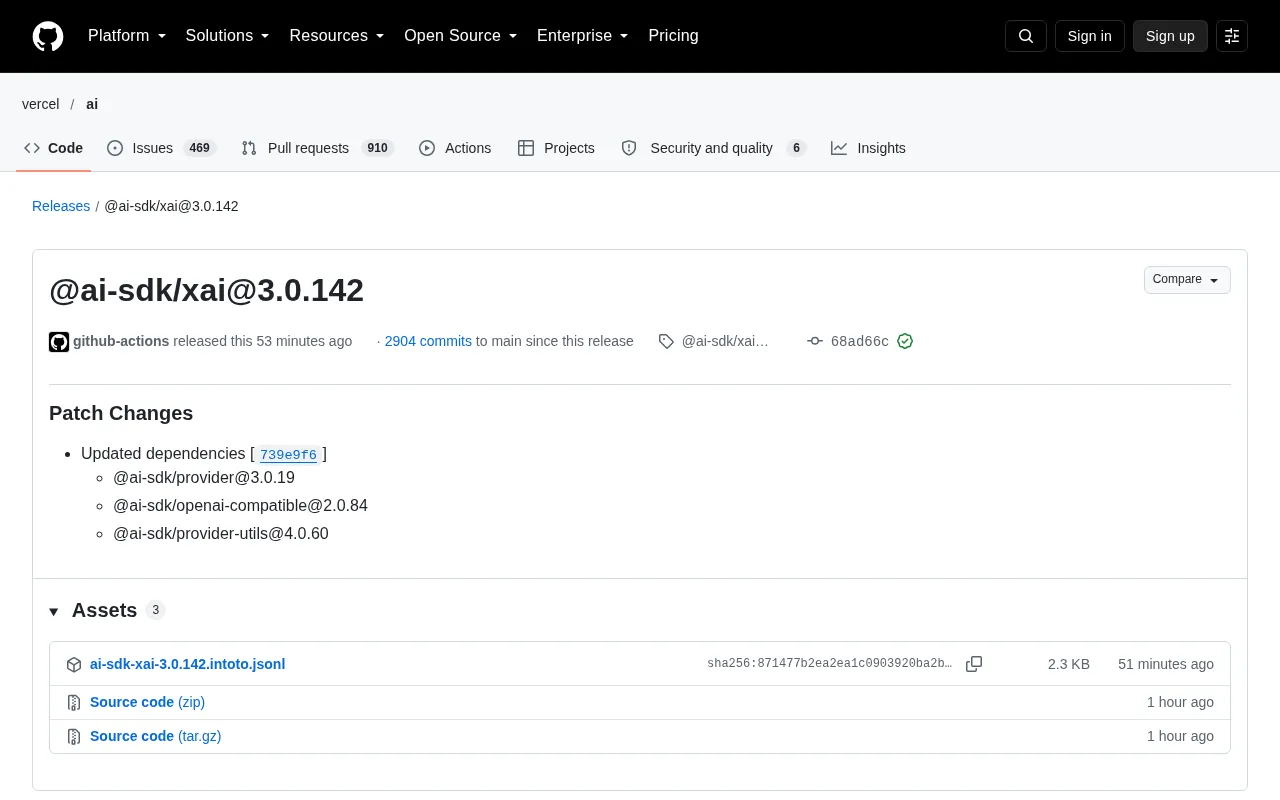
According to the GitHub Releases page, the patch changes in @ai-sdk/xai@3.0.142 primarily consist of dependency updates, specifically involving three packages:
@ai-sdk/providerupgraded to 3.0.19@ai-sdk/openai-compatibleupgraded to 2.0.84@ai-sdk/provider-utilsupgraded to 4.0.60
These dependency updates were triggered by a commit (commit 739e9f6), automatically published to the main branch by the github-actions bot. From this release to the main branch, there have been a cumulative 2904 commits. The commit was verified with a GitHub signature (GPG key ID: B5690EEEBB952194).
@ai-sdk/provider is the abstraction layer in the Vercel AI SDK that faces underlying model providers, defining specification types like LanguageModelV1, EmbeddingModelV1, as well as the shapes of core protocols such as streaming responses, tool calls, and multimodal inputs. All concrete provider packages (like @ai-sdk/openai, @ai-sdk/anthropic, @ai-sdk/xai) must implement the interfaces it declares, so any enum extension, field addition or removal, or type narrowing in this package propagates down to all downstream providers.
@ai-sdk/provider-utils is the toolkit reused when implementing those interfaces, containing stream parsers (parseStreamPart), event source transforms, JSON schema validation helpers, error normalization functions, and more. It's usually released in pairs with provider packages: the provider defines "what", and provider-utils provides "how". When the two versions are mismatched, runtime parsing discrepancies or TypeScript type mismatches can easily occur.
@ai-sdk/openai-compatible is the generic adapter layer that the AI SDK abstracts for "OpenAI Chat Completions compatible endpoints". Any third-party service claiming OpenAI compatibility (xAI, Groq, DeepSeekAd, local Ollama, etc.) can quickly integrate based on it. This package encapsulates logic such as message format conversion, streaming chunk parsing, and error code mapping, so its updates often mean the compatibility layer has been aligned with newly emerging API behavior differences.
What This Update Actually Means
For developers using @ai-sdk/xai, 3.0.142 itself introduces no new features or behavior changes — it's a typical dependency sync patch. But these updates aren't without value — @ai-sdk/provider and @ai-sdk/provider-utils are shared infrastructure across multiple provider packages in the AI SDK ecosystem, and their version iterations often fix underlying compatibility issues or security vulnerabilities.
The synchronized upgrade of @ai-sdk/openai-compatible is also worth attention, because xAI's API overlaps in design with OpenAI-compatible interfaces, and this package's update may mean the compatibility layer's behavior alignment has improved.
However, since AI SDK provider packages iterate frequently, version numbers themselves don't directly reflect feature importance. Developers should focus more on the specific diffs of the two core packages @ai-sdk/provider and @ai-sdk/provider-utils in the corresponding versions, to determine whether there are changes affecting their own projects.
A dependency sync patch refers to a version number increase triggered solely by raising the dependency version range in package.json, without any change to the package's own source code. Under Semantic Versioning (SemVer), if the underlying dependency only made bug fixes (patch level) or backward-compatible additions (minor level), the upper-level package can just release a patch number. The AI SDK ecosystem achieves automation through toolchains like changesets: when a base package is merged, CI detects all packages depending on it, generates corresponding patch versions in batch, and publishes them.
This also explains why @ai-sdk/xai's version number grows so frequently — it reflects more of the dependency graph's "heartbeat" than iteration of xAI-specific capabilities. To judge whether an update is worth acting on, the key isn't the xAI package's version number, but whether the two "root nodes" @ai-sdk/provider and @ai-sdk/provider-utils underwent substantive changes in the same time window.
How to Handle These High-Frequency Small Version Updates
The AI SDK uses an automated release process, and dependency sync updates frequently trigger patch version number increases. If your project pins a specific version, it's recommended to evaluate whether to upgrade via the following:
- Check the changelog of the corresponding versions of
@ai-sdk/providerand@ai-sdk/provider-utilsto confirm whether there are breaking changes or bug fixes - If your project's dependency chain uses multiple AI SDK provider packages simultaneously, ensure they reference consistent underlying provider versions to avoid type conflicts
- For purely dependency-sync patches, you can merge them after CI passes, without excessive manual review
Overall, @ai-sdk/xai@3.0.142 is a routine ecosystem maintenance update, reflecting how automated dependency management operates under the AI SDK's multi-package architecture.
One-line Summary
Vercel's @ai-sdk/xai releases 3.0.142 patch, synchronously upgrading three underlying dependency packages — a routine maintenance update.
Paragraph Summary
Vercel-maintained @ai-sdk/xai released patch version 3.0.142, automatically published via GitHub Actions, with the main change being synchronized upgrades to three underlying dependencies: @ai-sdk/provider to 3.0.19, @ai-sdk/openai-compatible to 2.0.84, and @ai-sdk/provider-utils to 4.0.60. This update introduces no new features or behavior changes — a typical dependency sync patch — but its underlying packages serve as shared infrastructure across multiple providers, and their iterations may include compatibility fixes or security patches. The article recommends developers focus on the specific diffs of @ai-sdk/provider and @ai-sdk/provider-utils, and keep underlying versions consistent when multiple providers coexist to avoid type conflicts.
Related articles

Anthropic Files S-1: $16.3B Revenue, $80.7B Net Loss in Half a Year — Who Controls the Company?
Anthropic files S-1 for a Nasdaq IPO: H1 2026 revenue of $16.3B, an $80.7B net loss from valuation remeasurement rather than cash burn, founders' Class F shares holding 50.1% voting power, and no price or date yet.

Anthropic Files S-1: The Truth Behind $16.3B Revenue and $80.7B Loss
Anthropic's S-1 reveals $16.3B revenue and $80.7B net loss in H1 2026, with $72.4B from accounting effects. The filing also discloses $265.6B compute commitments, cloud deal details, and a 50.1% founder voting control structure, while IPO pricing remains blank.

Anthropic Financials Leaked: Revenue Far Exceeds Compute Costs, Claude Inference Gross Margin Hits 68%
Leaked Anthropic financials show revenue roughly twice total compute costs, Claude inference gross margin at 68%, while frontier training burns $2.8B per quarter. This article breaks down the two accounts and analyzes shifts in AI company valuation logic.