AI + SRC Automated Vulnerability Hunting: Rebuilding the Three-Step Method with AI Agents

AI Agents rebuild the SRC bug-hunting workflow, slashing barriers and boosting annual output by 100x.
This article starts from the traditional SRC "three-step" vulnerability hunting method and highlights its core problem: every stage depends on human experience, making it slow and inaccessible to beginners. With AI Agents (like Codex and Claude) integrated into the workflow, each step transforms — AI auto-generates structured asset inventories, filters false positives to surface real high-severity risks, executes security tools, and drafts reports for human review. The key insight is that effective AI-assisted hunting requires an action-capable Agent, not a chatbot, shifting the human role from hands-on operator to decision-maker and validator.
The Traditional Struggle: High Barriers, Low Efficiency, Experience-Dependent
In the SRC (Security Response Center) vulnerability hunting space, there's a time-tested "universal three-step method." Step one: thoroughly browse the target site to understand its functional structure, underlying tech stack, and data interfaces — covering every business flow from registration and login to payment and refunds. Step two: capture and analyze traffic, map out request paths and parameters, identify potential risk points, then tamper with parameters to verify whether vulnerabilities exist. Step three: validate findings and write a report following the "four essentials" — URL, reproduction steps, impact assessment, and remediation recommendations.
The core problem with this workflow is that every step is driven by a human. Information gathering means manually clicking through websites. Tool usage (Nmap, Telnet, NC, Burp Suite, etc.) requires hands-on operation. And the results still need experienced eyes to validate. For example, if a scan reveals that ports 22 or 3306 are open, it takes human judgment to determine whether that's a real vulnerability, a false positive, or simply an intentionally exposed but poorly protected service.
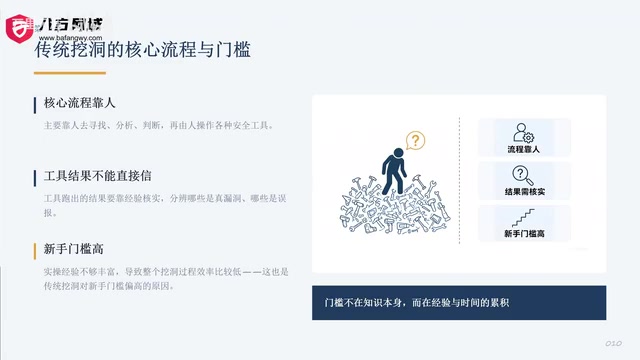
This makes traditional vulnerability hunting extremely challenging for newcomers. The real barrier isn't the knowledge itself — it's the depth of accumulated experience and the sheer time investment required. Prolific bug hunters typically spend years building the intuition needed to make reliable judgments. Many beginners, even after completing courses, still struggle to get into an effective hunting rhythm.
How AI Rebuilds the Three-Step Method
Introducing AI into the vulnerability hunting workflow transforms each step in a meaningful way.
Step One: Let AI "Sweep the Board" First
In the past, understanding a target meant visiting it page by page on your own. Now you can have AI do a first-pass sweep. Whether it's the backend architecture, frontend structure, authentication mechanisms, database choices, or access patterns — AI can map out functional modules and routing entry points, annotating what each entry point handles and what parameters it accepts. The output is a structured asset inventory: which functions map to which endpoints, and how to test them — all at a glance. Humans only need to review and verify, not build from scratch.
Step Two: Intelligent Analysis and False Positive Filtering
During traffic capture, parameter tampering, and submission testing, AI can suggest testing strategies, explain unfamiliar code, and filter out false positives. Vulnerability hunting generates enormous volumes of results and noise; AI can cut through most of it and focus attention on critical, high-severity, and medium-severity risks that actually matter. Low-severity findings are plentiful but less urgent, while critical vulnerabilities demand immediate attention. This lets humans concentrate deep testing effort only where it's genuinely valuable.
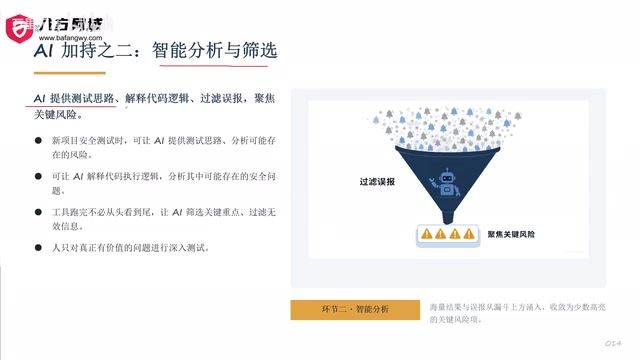
False positives are a persistent problem with automated security scanning tools. Take port scanning as an example: a tool may flag port 3306 (MySQL's default port) as a risk, but that port might already have strict access control whitelists in place and simply can't be reached from the internet. Similarly, WAF (Web Application Firewall) rules or cloud provider security groups can render an "open port" finding meaningless in terms of actual attack surface. In the traditional approach, filtering this kind of noise relies entirely on the security professional's experience — sometimes requiring manual verification of dozens or even hundreds of alerts. An AI agent can combine the target's tech stack information and collected asset context to prioritize alerts, keeping focus on findings that are both technically feasible and carry real potential for harm.
Step Three: Tool Execution and Report Generation
Security tools on systems like Kali are numerous, and expecting any one person to master all of them is unrealistic. With AI handling tool invocation, command execution, and report drafting, the path from tool usage to result analysis becomes far more manageable. For the reporting phase, AI can generate an initial draft following the four essentials.
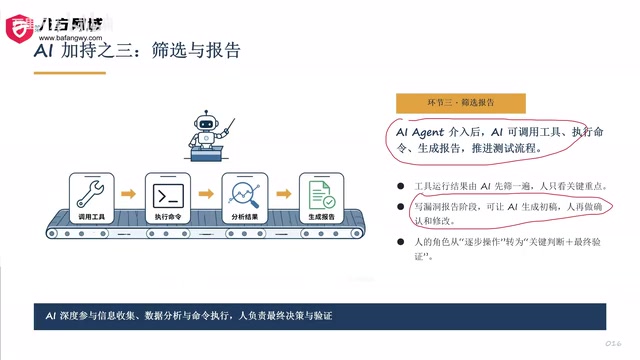
One critical caveat: what AI produces is only a draft. Any report you actually submit must go through careful human review — verifying whether the URL is truly vulnerable, whether the reproduction steps are accurate, and whether the stated impact holds up. Submitting AI-generated reports without proper review is a fast track to getting blacklisted.
The Key Distinction: You're Deploying an AI Agent, Not a Chatbot
This is the most important insight in the entire discussion: what actually makes vulnerability hunting effective is not a web-based question-and-answer chat tool. The capability to execute tools, make sequential decisions, identify exploitation paths, and carry them out belongs to AI Agents.
Commonly used agents for this purpose include Codex, Claude (Code), and earlier tools like OpenCode and Amos Agent. These agents can read project files, analyze code logic to identify security issues, execute reconnaissance or testing commands, and invoke security tools to conduct penetration testing against targets.
In other words, AI doesn't bring a Q&A function to the table — it brings an intelligent execution entity capable of deeply participating in the actual hunting workflow. That's the fundamental reason it can take high-barrier work and make it accessible.
The essential difference between an AI Agent and a standard conversational AI lies in the ability to act. Ordinary chat tools can only generate text responses within a conversation window, with each interaction being stateless. An AI Agent, by contrast, can perceive its environment, plan tasks, invoke external tools, and iterate continuously based on feedback. In a vulnerability hunting context, this means an Agent can autonomously open a terminal to run an Nmap scan, parse the returned results, and then decide whether to invoke Burp Suite for traffic capture — all without a human manually passing information between steps. This "perceive-decide-execute" loop is what distinguishes an Agent from a chatbot, and it's the technical foundation that allows it to replace large volumes of repetitive reconnaissance work. Leading Agent frameworks today — such as OpenAI's function calling mechanism and Anthropic's tool use interface — provide standardized support for exactly this kind of tool invocation, dramatically lowering the integration cost for security tooling.
The Core Value of AI-Assisted Hunting: Lower Barriers, Higher Efficiency
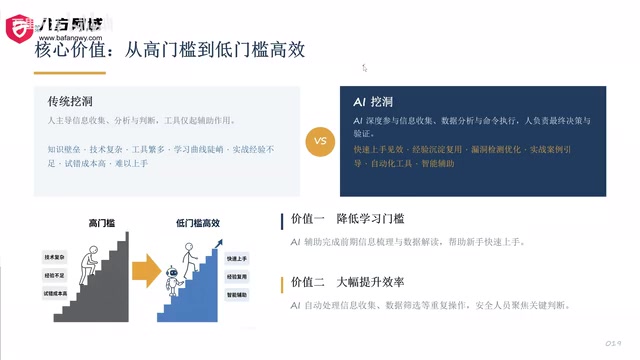
Cybersecurity is a highly interdisciplinary field with a vast toolset and a steep learning curve. The cost of trial and error without hands-on experience is enormous, and the traditional path to competence typically takes three to six months just to get started.
Once an AI Agent is deeply involved in information gathering, data analysis, and command execution, the human's role shifts to decision-making and validation — judging whether a vulnerability is real and writing the report for submission. The value concentrates around two points: dramatically lowering the learning barrier, and significantly boosting hunting efficiency.
As mentioned in the original source material, under traditional methods a single researcher might submit a few dozen or perhaps a hundred vulnerabilities per year. With AI-assisted hunting, some researchers have submitted over 14,000 vulnerabilities in a single year. That contrast directly reflects the efficiency leap that AI Agents enable.
That said, a clear-eyed view is essential: AI-assisted hunting doesn't mean letting an agent fully replace the human hunter. It means using AI to lower the barrier and raise the throughput — turning what was once a high-expertise, time-intensive endeavor into something that can be systematically scaled. Human judgment and validation remain irreplaceable throughout.
SRC (Security Response Center) platforms are vulnerability reward programs maintained by domestic internet companies, where researchers who discover and report vulnerabilities receive points or cash rewards from the vendor. Vulnerabilities are typically tiered into four severity levels — critical, high, medium, and low — each corresponding to different reward amounts. From an economic standpoint, bug hunting is fundamentally a "scale economics" business: the more vulnerabilities you submit at higher quality, the greater the returns. Under traditional approaches, individual researchers are constrained by the speed of information gathering and the depth of their experience, keeping annual submission counts relatively low. With AI Agents handling information collection, initial scanning, and false positive filtering, the time cost of those phases drops sharply — allowing researchers to concentrate limited energy on deep validation of high-value findings. That structural shift is the real reason behind numbers like "14,000+ vulnerabilities in a year."
Conclusion
AI's transformation of SRC vulnerability hunting operates at the process level: from the "board sweep" of information gathering, to noise reduction in risk triage, to tool invocation and report generation — AI Agents are shouldering the heavy lifting of execution. But no matter how capable AI becomes, final vulnerability validation and report sign-off must remain in human hands. Understanding that "an agent is not a chatbot" is the prerequisite for using AI effectively in vulnerability hunting.
Related articles

Will GitHub Die? Open Source Maintainer Burnout and the Collaboration Crisis in the AI Era
Lex Fridman podcast discussion on open source maintainer burnout and GitHub's predicament: massive pull requests overwhelm core maintainers, and AI worsens code bloat. Using math journal peer review and Poincaré conjecture verification as analogies, the article analyzes why verification in knowledge production must be deliberately slow, and how open source communities can avoid the failure mode of maintainers exiting.

Stop Building Cookie-Cutter AI Websites: 3 Tools That Transform Your Coding Agent
Three tools that boost AI coding agents: FFmpeg skill for local video editing in Claude Code and Cursor, Hallmark's 50 design themes to fix cookie-cutter AI sites, and Jailbreaks' 25+ model prompts.

How America's Gerontocracy Squeezes the Younger Generation
Americans over 55 hold nearly three-quarters of national wealth, alongside an 80-year-old president and elderly congressional leaders. The Atlantic's Idrees Kahloon explains how gerontocracy drives up housing costs, squeezes opportunities for the young, and explores zoning reform and child poverty reduction as practical fixes.