AI Torture Chamber Controversy: A GitHub Project That Tests AI's Limits

Reddit debates a GitHub "AI Torture Chamber" project, highlighting tensions in adversarial AI testing and model safety.
A Reddit thread about the GitHub project "AI Torture Chamber" has sparked a multi-layered debate in the developer community. Technically, stress-testing LLMs through jailbreak attempts and adversarial inputs is central to red teaming and alignment research. But the anthropomorphic name blurs the line between serious safety work and ethical theater, and may invite pointless debates about AI sentience. The article argues that evaluating such projects should focus on testing methodology, reproducibility, and engineering quality — not the name — while acknowledging the inherent tension between transparency and security risk in open-source AI tools.
A GitHub Project That's Sparking Debate
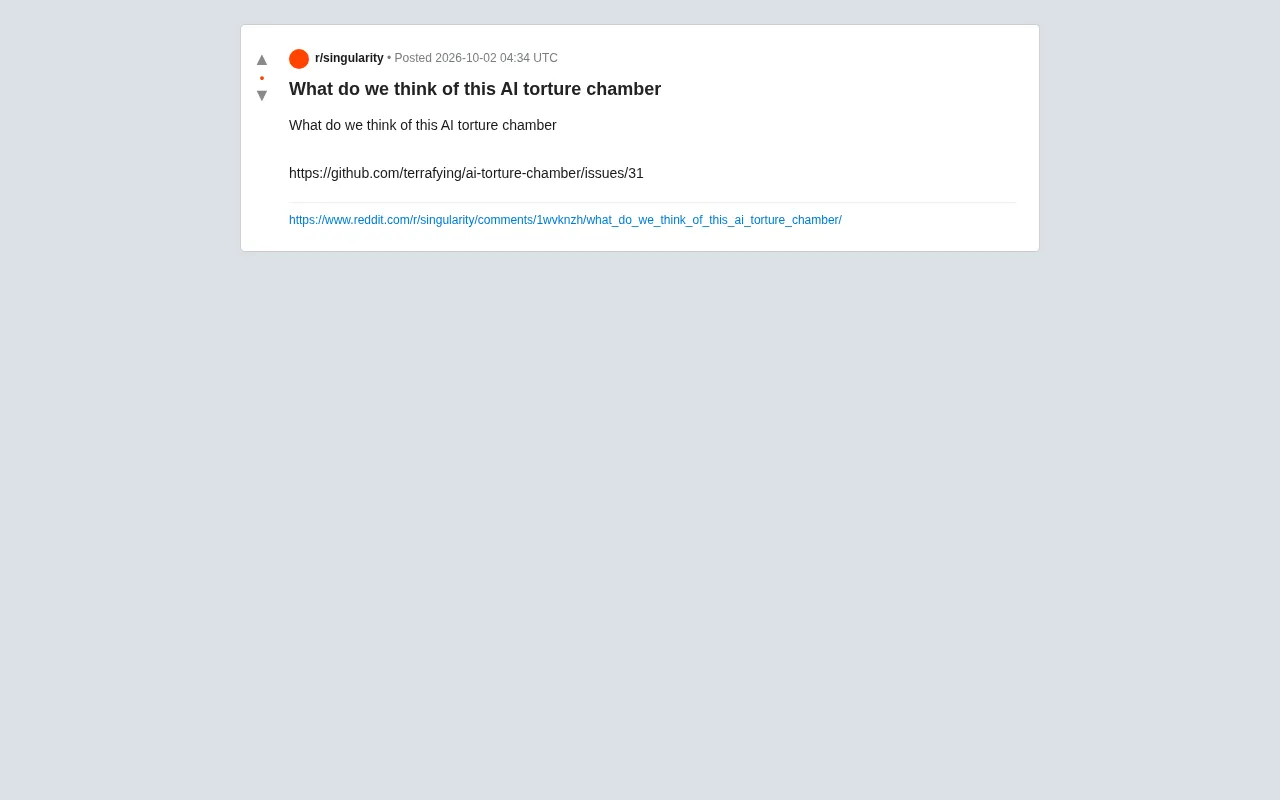
A discussion thread recently appeared on Reddit asking a blunt question: "What do we think of this AI torture chamber?" The post links to an issue page on the GitHub repository terrafying/ai-torture-chamber.
Based on the project name alone, this appears to be an experimental tool that tests large language model behavior using extreme or adversarial scenarios. Projects like this aren't uncommon in the AI developer community — they typically explore, with a touch of dark humor, how models perform under stress tests, jailbreak attempts, or unusual inputs.
Why Projects Like This Stir Controversy
The anthropomorphic framing of "torture" itself touches on a long-running debate: when we subject AI models to adversarial testing, are we conducting serious safety research, or performing some kind of ethically charged "anthropomorphic theater"?
From a technical standpoint, stress-testing AI models is a crucial part of red teaming and model alignment research. Developers need to understand how models fail when repeatedly prompted, given contradictory instructions, or subjected to extreme inputs — insights that have real value for improving model robustness.
But naming something a "torture chamber" blurs the line between technical testing and ethical imagination. It reflects a strain of dark humor common in developer culture, while potentially inviting pointless debates about whether AI can "feel" anything. In terms of current technical reality, large language models don't have subjective experiences — "torture" is simply a dramatic way of describing input-output behavior.
Red Teaming originated in military adversarial exercises. In AI, it refers to a dedicated team playing the role of "attacker" to systematically identify security vulnerabilities, biased outputs, or harmful behaviors in a model. Major AI labs like OpenAI, Anthropic, and Google DeepMind all conduct internal red teaming before releasing large models, and some also invite external researchers to participate. Model Alignment research focuses on ensuring model behavior aligns with human intentions and values — adversarial testing is a key component, since only by fully exposing failure modes under extreme conditions can training objectives and safety guardrails be improved in a targeted way. Jailbreaking is the most commonly discussed attack method in this space: using carefully crafted prompts to bypass a model's safety filters and elicit otherwise-prohibited outputs. Public jailbreak research has a dual nature — it helps developers patch vulnerabilities, but it can also hand ready-made tools to malicious users.
The Value and Limits of Community Discussion
It's worth noting that a Reddit post title and a GitHub issue link alone are far from enough to make a comprehensive judgment about a project's actual functionality, code quality, or research value. The source material provides no details about the project's implementation, the author's stated design intent, or the substance of community discussion.
The typical value of threads like this lies in their role as informal exchanges about AI safety testing methodology within developer communities. Debates around such projects often circle back to a few core questions:
Where Should the Line Be for Adversarial Testing?
Stress testing is critical for model security, but whether the methods and framing are appropriate remains an open question. Overly anthropomorphic frameworks can distract from genuine safety concerns.
The Double-Edged Sword of Open-Source Testing Tools
Publishing tools like this promotes research transparency, but it may also enable malicious jailbreaking. How to balance openness with security is a persistent challenge for the open-source AI community.
This tension is known in security circles as the Vulnerability Disclosure Dilemma — the same tension that exists in traditional cybersecurity around CVE disclosure. Two dominant practices exist: Responsible Disclosure requires researchers to notify vendors before going public, giving them time to patch the issue; Full Disclosure advocates for immediate publication to pressure vendors into rapid response. For AI jailbreak tools, the risk is harder to contain than with traditional software vulnerabilities — effective attack methods often transfer across models because similar architectures are shared across the industry, and model update cycles are long. Some AI security researchers have called for review mechanisms similar to the Dual-Use Research of Concern (DURC) frameworks used in biosecurity.
A Rational Take on AI Testing Projects
For developers and researchers, evaluating projects like this should come back to technical substance: What model behaviors are being tested? What methods are used? Are the findings reproducible? These questions matter far more than whether the name is attention-grabbing.
If you're interested in AI security testing, the better approach is to go directly to the project repository's README, code implementation, and issue discussions — rather than forming judgments based on a title alone. Serious AI red teaming tools and pure novelty projects are usually distinguishable by their engineering quality and methodological rigor.
Given the limited information available, this article can only offer an analytical framework at the surface level. A deeper evaluation of the project would require readers to consult the full contents of its GitHub repository.
Related articles

A New Paradigm for Text Editing in Compose: TextFieldState Replaces the Old API
Jetpack Compose introduces the TextFieldState API to fix dropped characters and cursor jumps from async input. The old value/onValueChange callbacks will be deprecated in 1.13. This article covers InputTransformation, OutputTransformation, four state hoisting patterns, and new formatted text editing capabilities.

Remote Compose: A New Document-Driven Paradigm for Cross-Platform UI on Android
Remote Compose transmits compact binary documents instead of screen pixels, enabling efficient UI rendering on remote surfaces like Wear OS and widgets. This article covers its document creation API, expression animations, size optimization techniques, and Wear OS progress.

How Crashlytics Eliminates Android Memory and Responsiveness Issues
Through the Chroma Clip case study, this article explains how Firebase Crashlytics uses Application Exit Info, Profiling Manager, GWP ASAN, and ARM MTE to pinpoint ANRs, OOMs, memory limit terminations, and native memory corruption—solving the challenge of stack traces that don't point to the real culprit.