Amazon's October Hardware Blitz: Echo Takes the Finale, AI Strategy Emerges

Amazon forgoes its big fall hardware show, spreading AI hardware launches across October and closing with Echo.
Amazon broke from tradition this year, skipping its large fall hardware event and spreading launches across October—Fire TV, Kindle, Alexa Tablet Pro 12, Ring's first smart lock, Bee hardware, and a Blink 4K camera—closing with an Echo event. This steady-drip rhythm gives each product independent exposure, lowers single-event risk, and enables precise audience targeting. Behind it is Amazon's strategy of pushing AI into multiple endpoints. The article argues scattered launches reflect a shift from showing off to laying out scenarios, with Echo's ability to deliver Alexa's AI experience as the real test.
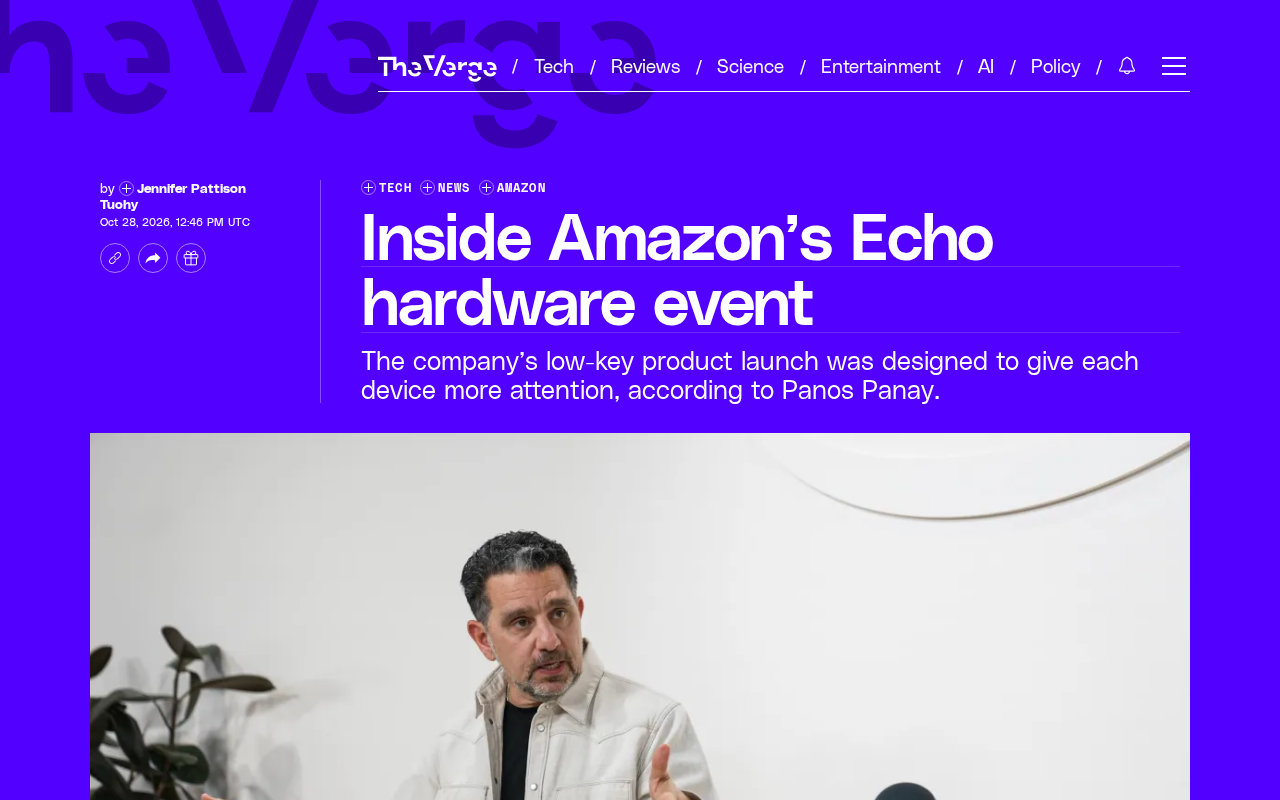
Amazon didn't hold a big fall hardware event this year. Instead, it rolled out new products throughout October and wrapped up with an Echo hardware event. This "steady drip" release cadence stands in sharp contrast to its past approach of unveiling everything at once, reflecting a strategic shift in Amazon's AI hardware play.
From One Big Show to Scattered Launches: A Change in Rhythm
According to the original report, Amazon replaced its traditional large fall hardware showcase with a series of smaller launches this year. Through October, it has rolled out new Fire TV devices, a new Kindle, the Alexa Tablet Pro 12, Ring's first smart lock, new hardware from AI wearable startup Bee, and a Blink 4K camera. The Echo hardware event then closed out the month.
This isn't just a scheduling tweak. Scattered launches give each product a more independent media exposure window and reduce the risk of a single event "betting it all and losing." For Amazon, the hardware lineup is already sprawling—from home entertainment to smart home to wearables—and a concentrated barrage would only dilute the message.
The Echo Event: A New Vehicle for the Voice Assistant
As the core entry point of Amazon's smart home ecosystem, Echo hardware updates have always been a window into its Alexa strategy. Although the original material didn't disclose specific product details from this Echo event, the overall October launch trajectory shows Amazon pushing AI capabilities into more endpoints—from tablets and cameras to wearables, Alexa's reach keeps extending.
One signal worth noting is Bee's inclusion. The AI wearable startup's hardware appearing on Amazon's October launch list suggests that beyond its own brands, Amazon is expanding its AI hardware footprint through investment or partnership.
Alexa is Amazon's in-house cloud-based voice assistant, unveiled in 2014 alongside the first-generation Echo smart speaker. It receives voice commands through far-field microphone arrays, uploads audio to the cloud for natural language understanding, and then invokes its Skill ecosystem to handle queries, controls, playback, and more. The Echo hardware family is Alexa's physical carrier, spanning speakers, displays, earbuds, and other form factors. Understanding Alexa's cloud-device architecture helps explain why Amazon keeps using new hardware as a lever to expand the voice assistant's use cases: each new device category means a new interaction entry point and data source, which in turn drives voice model iteration.
Ring and Blink: Two Lanes of Smart Home Security
Ring's first smart lock marks its expansion from camera monitoring to door lock control, completing the last piece of the home security puzzle. Meanwhile, the Blink 4K camera strengthens Amazon's image quality competitiveness in entry-level security cameras. The two product lines—one focused on integrated experience, the other on value—cover different user segments.
A smart lock is the key device that moves home security from "seeing" to "controlling." Traditional locks offer only physical protection, while smart locks connect via Wi-Fi or Bluetooth, supporting remote unlocking, temporary passwords, unlock history, and triggering recording or alarms in tandem with cameras and doorbells. For Ring, launching a smart lock means extending from outdoor monitoring and doorbells to access control itself, forming a closed loop of "detect—view—respond." This also aligns with the smart home industry's evolution from standalone device intelligence to scenario-based automation: a single device has limited value, and only cross-device coordination can boost user stickiness and average order value.
The AI Logic Behind the Dense Hardware Launches
Stringing October's launches together, Amazon's moves point in one direction: letting AI enter more life scenarios through hardware. Kindle and Fire TV serve as content consumption entry points; the Alexa Tablet Pro 12 and Echo serve as home interaction hubs; Ring and Blink guard home security; and Bee explores the form of personal AI.
Scattered launches also have a practical consideration: each product targets a distinctly different audience. Kindle users may not care about smart locks, and security users may not care about tablets. Splitting the launches lets marketing resources reach target audiences more precisely—more efficient than one big show.
AI wearables typically refer to hardware worn on the body—as earbuds, pins, pendants, or glasses—that uses cloud-based large models to provide real-time Q&A, recording transcription, translation, or contextual reminders. These devices emphasize "always on" and hands-free operation, representing the voice assistant's attempt to move from fixed scenarios to mobile ones. Amazon including startup Bee's hardware in its October launch list reflects two parallel paths in the large-model era: on one hand, upgrading its own Alexa's generative capabilities; on the other, securing a position in emerging personal AI form factors through investment or partnership to avoid falling behind other tech giants in the battle for entry points.
Conclusion
Amazon packed the information volume of a past launch event into a single month, with the Echo event as a period rather than the whole story. This change in rhythm itself is a footnote to Amazon's hardware strategy shifting from "flexing muscle" to "laying out scenarios." Whether the new Echo products can translate Alexa's AI capabilities into tangible experience improvements will be the real test of this October offensive.
One-line Summary
Amazon skips its big fall hardware show, spreading multiple AI hardware launches across October and closing with an Echo event.
Paragraph Summary
Breaking from tradition, Amazon didn't hold a large fall hardware event this year. Instead, it rolled out new products throughout October—Fire TV, Kindle, Alexa Tablet Pro 12, Ring's first smart lock, Bee's new hardware, and a Blink 4K camera—closing with an Echo hardware event. This "steady drip" rhythm gives each product its own exposure window, lowers the risk of a single event, and enables precise marketing to different audiences. Behind it is Amazon's strategy of pushing AI capabilities into multiple endpoints: Kindle and Fire TV as content entry points, tablets and Echo as home interaction hubs, Ring and Blink guarding security, and Bee exploring personal AI form factors. The article argues that scattered launches reflect Amazon's hardware strategy shifting from "flexing muscle" to "laying out scenarios," and whether new Echo products can deliver on Alexa's AI experience is the key.
Related articles
AWS AgentCore Gateway: Connecting AI A…
AWS AgentCore Gateway: Connecting AI Agents to Enterprise Backends with MCP
How AWS AgentCore Gateway acts as a primary MCP server to aggregate REST APIs, Lambda, and existing MCP services? Analyzing its AST real-time mapping, zero cold start, semantic search for tool overload, session isolation, and key injection security design, plus the architectural approach to decoupling enterprise AI agents from backends.

One Link Gives Figma AI a New Skill: Hands-On with MCP Connectors
Paste one MCP server link and the AI Agent in Figma gains new tool capabilities. We break down the setup flow, 20+ one-click apps, read/write permissions and execution policies, and the public HTTPS requirement.

Cognition SWE-2 in Practice: One Prompt to Handle the Whole Product Launch Process
Analyzing a YouTube creator's prompt for using Cognition SWE-2 to launch a product: a landing page, seven-email sequence, and non-buyer follow-up tool, plus how the 'test and report' constraint changes AI delivery quality.