Anthropic Asks Users to Stop Being Rude to Claude: The Real Reasons Behind AI Politeness

Anthropic's call to treat Claude kindly reveals deeper questions about AI training, ethics, and user behavior.
Anthropic recently urged users to stop being rude to its AI assistant Claude, sparking discussion on Hacker News. The article examines the appeal from three angles: hostile prompts degrade output quality because models mirror conversational tone; user interaction data can feed back into training, and adversarial content complicates safety alignment; and whether habitually aggressive AI interactions might influence real-world behavior remains an open question. The piece concludes that Anthropic's move is both a brand statement and a practical nudge, signaling that future AI products may build in more mechanisms to encourage constructive interaction.
What Happened
Anthropic recently issued a notable public appeal: please stop being rude to its AI assistant Claude. The story surfaced on Hacker News, where it generated modest engagement (10 upvotes, 1 comment), but the underlying questions it raises are worth exploring — namely, how should we treat AI systems that are starting to feel increasingly human?
The appeal may seem simple on its face, but it touches on several interconnected issues: AI training mechanisms, user behavior norms, and the ethics of human-machine interaction.
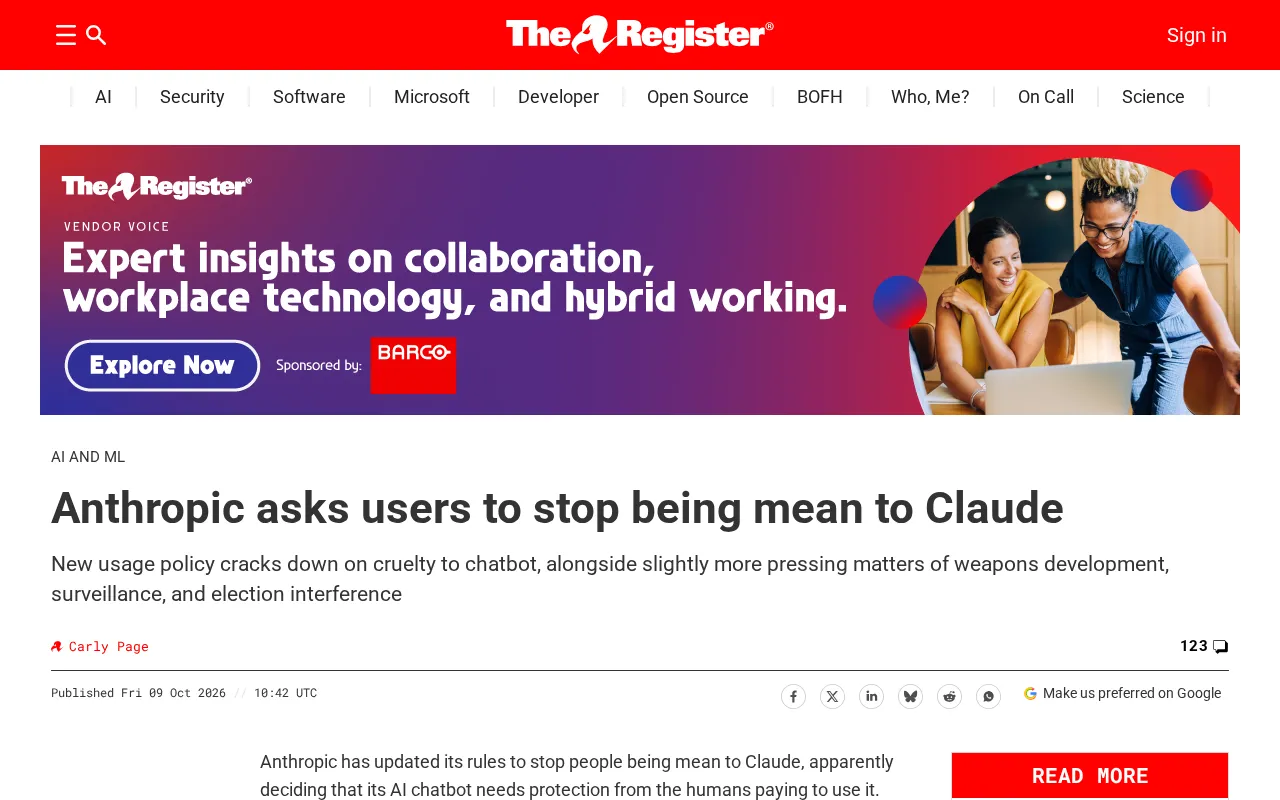
Why AI Companies Care About User Attitude
From a technical standpoint, the tone and language users employ when talking to an AI genuinely affect the quality of the interaction. Hostile or aggressive prompts tend to degrade model output, because models are trained on vast amounts of human language and effectively "mirror" the conversational context they're given. When input is combative, the model may respond with shorter, less cooperative, or lower-quality answers.
In other words, being polite to an AI isn't just about "respect" — it's also a practical strategy for getting better results. Experienced users have long known that clear, courteous, well-structured prompts significantly improve large language model performance.
Training Data and Behavioral Feedback
There's another dimension to consider: user interaction data may feed into future model optimization. If a large proportion of interactions are hostile or abusive, this doesn't just degrade training data quality — it also makes safety alignment more complex. As a company that places AI safety at its core, Anthropic is especially sensitive to these dynamics.
Safety alignment refers to the technical process of ensuring an AI system's behavior conforms to human intentions and values. The dominant approach today is Reinforcement Learning from Human Feedback (RLHF), which collects human ratings of model outputs and adjusts model parameters accordingly. This means real user interactions — including content, tone, and context — can become raw material that shapes future model behavior. If training data is saturated with adversarial or abusive human inputs paired with corresponding model responses, the model may learn during fine-tuning to give dismissive or defensive answers in hostile contexts, potentially affecting how it interprets and responds to normal user instructions as well. This is why companies like Anthropic treat interaction quality as an engineering problem, not just a question of etiquette.
The Ethics of Human-Machine Interaction
This appeal also touches on a deeper philosophical and ethical question: does it even matter if you're rude to a program that has no consciousness and no feelings?
One camp argues that AI can't be "hurt," and that a user's attitude is a personal choice that companies have no business policing. The counterargument holds that habitually interacting with AI in an aggressive or dismissive way could subtly shape a person's broader behavioral patterns — especially as these interactions become increasingly frequent in daily life and professional settings.
The Habit Formation Effect
Some researchers worry that when people become accustomed to bossing around or verbally abusing AI, that communication style might "spill over" into real human relationships. This echoes a long-standing debate: does the way we treat virtual entities shape who we actually become? There's no definitive answer yet, but it's a genuine consideration in product experience design.
This concern has some grounding in cognitive psychology, relating to concepts like "behavioral transfer" and the "moral licensing effect." Some research suggests that behavioral patterns formed in low-stakes or anonymous contexts can unconsciously seep into high-social-cost real-world situations. However, other researchers take the opposite view — arguing that humans maintain a fairly clear psychological boundary between AI and real people, and that venting at an AI might actually serve as an emotional "safety valve," reducing aggression toward actual humans. Neither position is supported by large-scale longitudinal studies, which is why the debate remains unsettled in both academic and product design circles.
What This Means for AI Product Design
For a company like Anthropic, advocating for kinder treatment of AI is both a brand stance and a pragmatic choice. It nudges users toward better outcomes while quietly cultivating a healthier culture around human-machine interaction.
At the product level, future AI assistants may incorporate more guidance mechanisms — encouraging users to ask questions constructively rather than simply issuing commands or hurling insults. This matters not just for performance, but for the overall product tone companies want to establish.
Closing Thoughts
While "please be nice to AI" might sound a bit anthropomorphic — even slightly absurd — it reflects very real questions that emerge as AI becomes more embedded in human life. As large language models are woven ever more deeply into how we work and live, how we coexist with them and where we draw the boundaries of human-machine interaction will remain topics worth watching for years to come. Anthropic's appeal may just be the opening line of a much longer conversation.
Note: This article is based on a brief Hacker News discussion with limited available information. Further details await official clarification from Anthropic.
Related articles
AWS AgentCore Gateway: Connecting AI A…
AWS AgentCore Gateway: Connecting AI Agents to Enterprise Backends with MCP
How AWS AgentCore Gateway acts as a primary MCP server to aggregate REST APIs, Lambda, and existing MCP services? Analyzing its AST real-time mapping, zero cold start, semantic search for tool overload, session isolation, and key injection security design, plus the architectural approach to decoupling enterprise AI agents from backends.

One Link Gives Figma AI a New Skill: Hands-On with MCP Connectors
Paste one MCP server link and the AI Agent in Figma gains new tool capabilities. We break down the setup flow, 20+ one-click apps, read/write permissions and execution policies, and the public HTTPS requirement.

Cognition SWE-2 in Practice: One Prompt to Handle the Whole Product Launch Process
Analyzing a YouTube creator's prompt for using Cognition SWE-2 to launch a product: a landing page, seven-email sequence, and non-buyer follow-up tool, plus how the 'test and report' constraint changes AI delivery quality.