Anthropic Donates Agent Skills Standard to AAIF
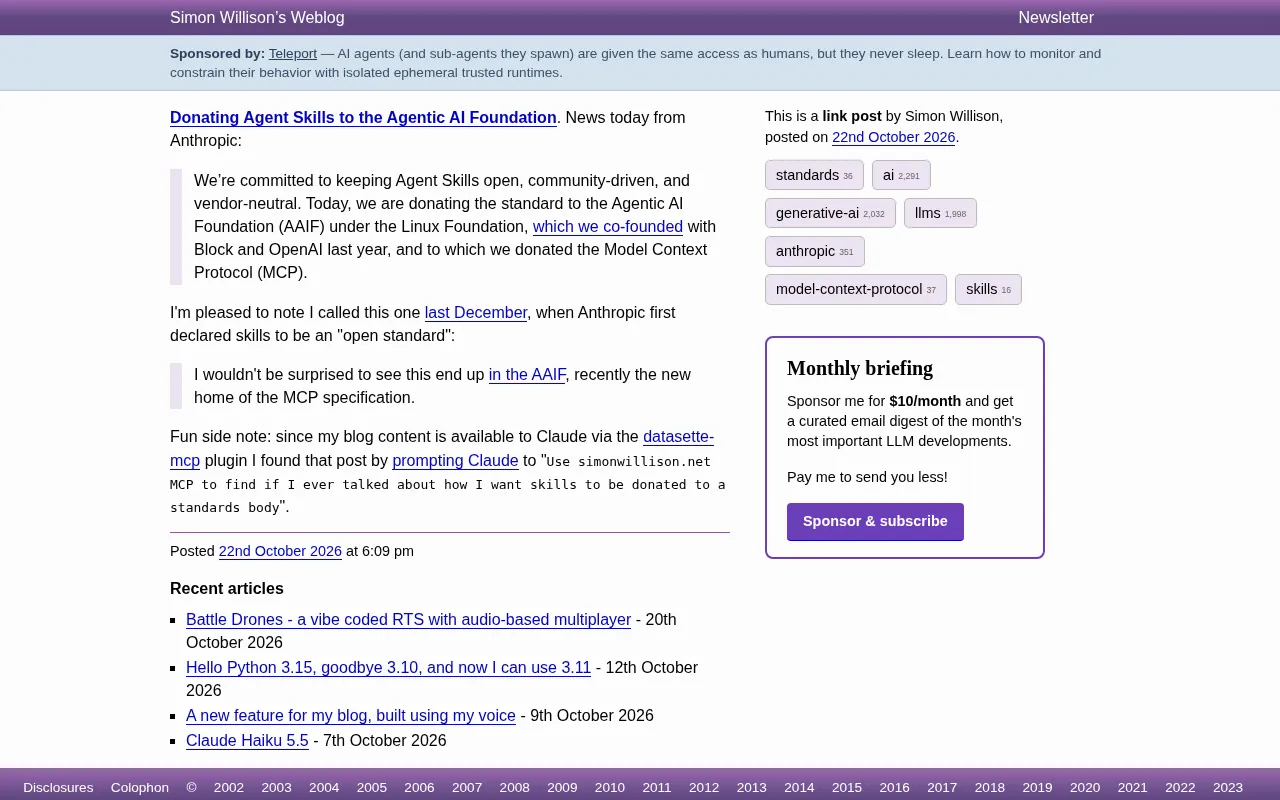
Anthropic donates Agent Skills to the Linux Foundation's AAIF, further advancing AI Agent standards neutralization after MCP.
Anthropic announced that it is donating the Agent Skills standard to the Agentic AI Foundation (AAIF) under the Linux Foundation, the second core AI Agent standard it has donated to the foundation after the Model Context Protocol (MCP). AAIF was co-founded by Anthropic, Block, and OpenAI. The addition of Agent Skills means that the two major infrastructure standards—the context protocol and skill definition—are unified under a neutral governance framework. The article analyzes the need for neutral governance—avoiding single-vendor lock-in risk, attracting broader platform adoption, and promoting skill marketplaces and cross-platform interoperability—and records an aside in which Simon Willison used an MCP plugin to let Claude search his own blog and validate his earlier prediction. It concludes that how AAIF coordinates multi-party interests and how governance details are implemented remain key points to watch.
Anthropic has announced that it is donating the Agent Skills standard to the Agentic AI Foundation (AAIF) under the Linux Foundation, marking the formal transition of this open standard toward vendor neutrality and community-driven governance. This is the second major standard Anthropic has donated to AAIF, following the Model Context Protocol (MCP).
From MCP to Agent Skills: Anthropic's Standard Donation Path
In its announcement, Anthropic stated clearly: "We are committed to keeping Agent Skills open, community-driven, and vendor-neutral." AAIF was co-founded by Anthropic, Block, and OpenAI, and had previously received the donation of the MCP specification. The addition of Agent Skills means that two key infrastructure standards in the AI Agent space—the context protocol and skill definition—are now unified under the same neutral governance framework.
Industry observers see this move as a signal of accelerating AI standardization. Well-known developer Simon Willison predicted this direction as early as last December, writing at the time: "I wouldn't be surprised if this eventually ends up in AAIF—the new home of the MCP specification." Willison's prediction was based on a simple logic: when Anthropic first defined skills as an "open standard," the question of where it would be governed became inevitable.
Model Context Protocol (MCP) is an open protocol launched by Anthropic in late 2024 to standardize how AI applications (such as Claude) connect to external data sources, tools, and services. MCP uses a client-server architecture: developers only need to implement an MCP server according to the specification, and any MCP-compatible AI client can access that data source or tool without adapting separately for each model. This design philosophy is similar to the Language Server Protocol (LSP), with the goal of shifting integration between AI applications and external capabilities from "point-to-point customization" to "implement once, reuse everywhere." After the MCP specification was donated to AAIF, it became the first core standard received by the foundation and serves as an important reference for understanding the governance path of Agent Skills.
Why Agent Skills Needs Neutral Governance
Agent Skills is essentially a specification that enables AI Agents to discover, invoke, and compose external capabilities. If this standard were controlled by a single vendor, other companies would inevitably worry about lock-in risk when adopting it. After donation to AAIF, the evolution of the standard will be shaped by multiple parties, which helps attract support from more platforms and toolchains.
Looking at the precedent of MCP, the specification gained broader ecosystem adoption after donation. Agent Skills following the same path could drive the development of scenarios such as skill marketplaces and cross-platform Agent interoperability. For developers, this means that skill definitions written in the future may be reusable across more Agent runtimes rather than tied to a specific vendor.
Agent Skills is a specification proposed by Anthropic for describing external capabilities that AI Agents can discover, invoke, and compose. Technically, a Skill typically includes metadata such as name, description, input/output schema, and invocation method, enabling an Agent to dynamically identify available skills at runtime and orchestrate them as needed. Unlike the earlier function calling mechanism, Agent Skills emphasizes the discoverability and reusability of skills—skill definitions are independent of a specific Agent runtime and can theoretically be migrated between platforms. This "skill as description" approach makes it possible to distribute, register, and compose skills, and for this very reason, the governance ownership of the standard directly affects whether cross-platform interoperability can be achieved.
An Interesting Validation: Using MCP to Find His Own Blog
Willison recorded a detail in his blog post: he used the datasette-mcp plugin to let Claude search his blog content, with the prompt "Use simonwillison.net MCP to find if I ever talked about how I want skills to be donated to a standards body." Claude successfully found his earlier prediction article. This aside itself demonstrates the practical value of combining MCP with Agent Skills—an Agent can access a personal knowledge base on demand and complete semantic retrieval.
datasette-mcp is an MCP server plugin built by Simon Willison based on Datasette (a lightweight data publishing tool he developed). Its purpose is to expose SQLite datasets such as personal blogs to AI clients through the MCP protocol. After users configure the plugin, Claude can perform structured queries and semantic retrieval on blog content through the MCP interface without embedding the full dataset into the prompt in advance. This example demonstrates the practical use of MCP as a "context protocol": an AI client pulls external knowledge on demand through a standard interface, then combines it with the invocation logic defined in Agent Skills to complete retrieval tasks, with the two forming a complementary relationship.
Potential Impact on the AI Agent Ecosystem
Neutralization of standards usually means a lower barrier to collaboration. After Agent Skills enters AAIF, possible developments include: more vendors reaching agreement on skill formats, maturation of toolchains around skill registration and distribution, and skill reuse across Agent platforms becoming the norm. Anthropic emphasized "community-driven" in its announcement, implying that future evolution of the specification will rely more on external contributions rather than unilateral decisions.
At present, the specific governance details of Agent Skills have not yet been published. How AAIF will balance the interests of founding members such as Anthropic, OpenAI, and Block with those of other participants will be key to observing whether this standard can truly be implemented.
One-line Summary
Anthropic donates the Agent Skills standard to AAIF under the Linux Foundation, further advancing neutralization of AI Agent standards after MCP.
Paragraph Summary
Anthropic announced that it is donating the Agent Skills standard to the Agentic AI Foundation (AAIF) under the Linux Foundation. This is the second core AI Agent standard Anthropic has donated to the foundation, following the Model Context Protocol (MCP). AAIF was co-founded by Anthropic, Block, and OpenAI. The addition of Agent Skills means that the two major infrastructure standards—the context protocol and skill definition—are unified under a neutral governance framework. The article analyzes the necessity of neutral governance—avoiding single-vendor lock-in risk, attracting adoption by more platforms, and promoting skill marketplaces and cross-platform interoperability. It also records an aside in which Simon Willison used an MCP plugin to let Claude search his own blog and validate his earlier prediction. Finally, it points out that how AAIF coordinates the interests of multiple parties and how the governance details are implemented remain key points to watch.
Related articles

Anthropic Files S-1: $16.3B Revenue, $80.7B Net Loss in Half a Year — Who Controls the Company?
Anthropic files S-1 for a Nasdaq IPO: H1 2026 revenue of $16.3B, an $80.7B net loss from valuation remeasurement rather than cash burn, founders' Class F shares holding 50.1% voting power, and no price or date yet.

Anthropic Files S-1: The Truth Behind $16.3B Revenue and $80.7B Loss
Anthropic's S-1 reveals $16.3B revenue and $80.7B net loss in H1 2026, with $72.4B from accounting effects. The filing also discloses $265.6B compute commitments, cloud deal details, and a 50.1% founder voting control structure, while IPO pricing remains blank.

Anthropic Financials Leaked: Revenue Far Exceeds Compute Costs, Claude Inference Gross Margin Hits 68%
Leaked Anthropic financials show revenue roughly twice total compute costs, Claude inference gross margin at 68%, while frontier training burns $2.8B per quarter. This article breaks down the two accounts and analyzes shifts in AI company valuation logic.