Anthropic SDK Releases v2.0.0: API Version Upgrade and Enhanced Quota Management

Anthropic SDK v2.0.0 released, supporting a new API version and enhancing quota management.
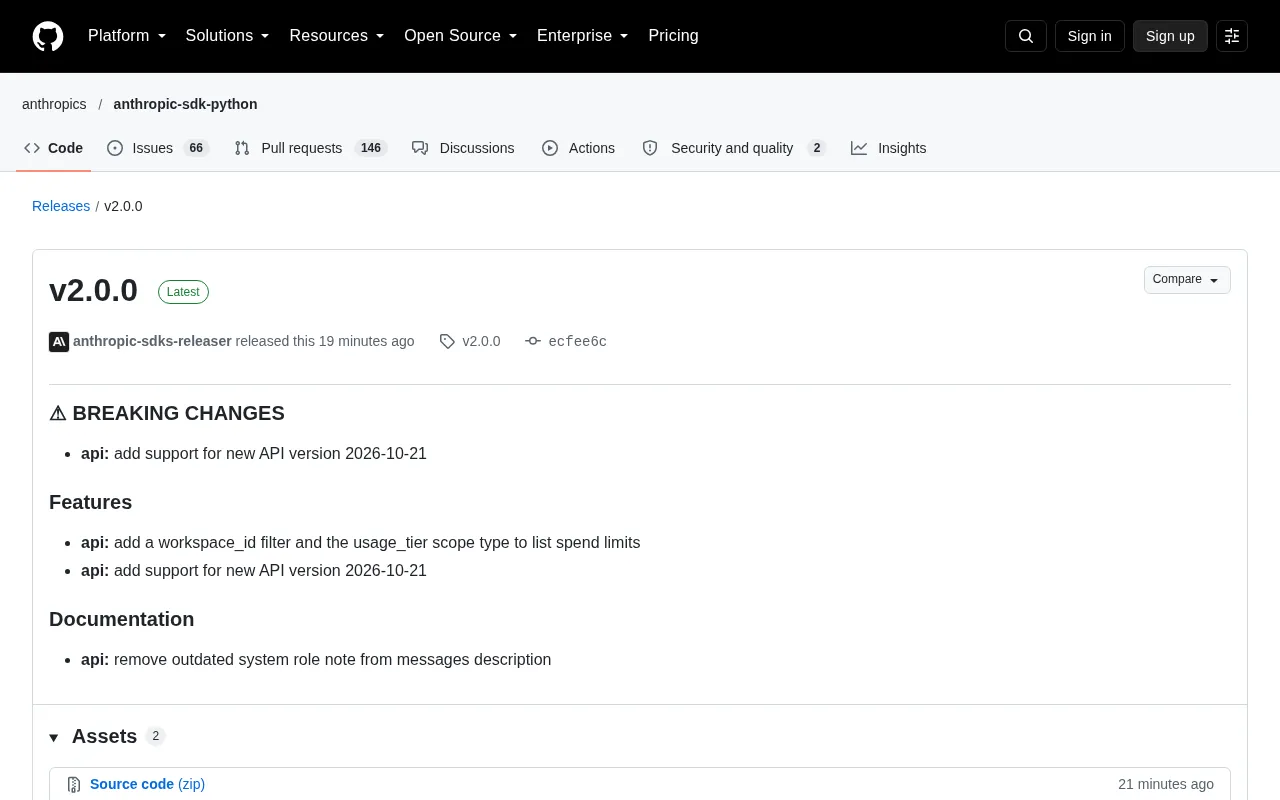
Anthropic SDK has released v2.0.0, centered on adding support for API version 2026-10-21, a breaking change requiring developers to check compatibility of existing integrations. The list spend limits endpoint adds a workspace_id filter parameter and introduces a usage_tier range type for more granular quota control by workspace and tier—valuable for multi-workspace and tiered-billing scenarios. An outdated system role note was removed from the docs as a maintenance fix. The article advises testing compatibility first, checking affected endpoints and parameters, evaluating the new quota features, and following official migration docs for a clear upgrade path.
Anthropic SDK v2.0.0 has been released. This update brings support for a new API version and introduces more granular quota management capabilities. For developers building applications on the Anthropic API, this is an important release worth paying attention to.
Breaking Change: Support for API Version 2026-10-21
The core change in v2.0.0 is the addition of support for API version 2026-10-21. This is a breaking change, meaning developers need to check whether their existing integrations are compatible with the new version. Typically, an API version update involves adjustments to request/response formats, endpoint behavior, or authentication methods, so it's advisable to carefully read the migration guide for the corresponding version before upgrading.
What Is an Anthropic API Version
Anthropic's API uses date-based version numbers (such as 2026-10-21), specified explicitly via a request header (usually anthropic-version). Unlike most REST APIs that use semantic versioning to indicate compatibility, this "date version" freezes each incompatible semantic or structural change into a date snapshot, and the server decides which format to return based on the version number you declare. Therefore, once the SDK is upgraded to v2.0.0, if the default or only supported version number becomes the new date, any logic in old code that depends on the old version's request/response structure may fail—which is exactly why it's marked as a breaking change. The safest approach when upgrading is to pin the version number in code or environment variables, then check each item against the migration guide.
New Features: workspace_id Filtering and usage_tier Range Type
At the feature level, this update adds a workspace_id filter parameter to the list spend limits endpoint and introduces a usage_tier range type. This allows teams to query spend limits by workspace dimension and perform more granular quota control based on usage tier. For multi-workspace or tiered-billing enterprise scenarios, this improvement directly enhances management efficiency.
Workspaces and Quota Range Types
A workspace is an organizational unit in the Anthropic console used to isolate team members, API keys, usage, and billing; an organization can have multiple workspaces. The list spend limits endpoint previously returned limits at the organization or key level; with the workspace_id parameter, you can now query only the spend limits of a specific workspace, making it easier to account separately when multiple teams share an account. usage_tier is a field describing the usage level; a "range type" typically means the parameter supports range queries—for example, expressing min..max with start and end values rather than matching a single value—so you can filter out in one go the limit records that fall within a certain tier range. Combined, the two move quota queries from "full dump" to precise retrieval "by dimension and by range."
Documentation Fix: Removal of Outdated System Role Description
On the documentation side, this release removes an outdated note about system role in the messages description. This is a maintenance update, but it helps reduce confusion for developers reading the docs and prevents incorrect implementations based on old information.
Impact on Developers and Recommendations
Since v2.0.0 contains breaking changes, developers are advised to:
- First verify compatibility of the new API version with existing code in a test environment;
- Check whether affected endpoints or parameters are in use;
- If your project has quota management needs, evaluate the practical value of
workspace_idfiltering andusage_tier; - Follow the official migration documentation to ensure a clear upgrade path.
Overall, v2.0.0 is a release centered on an API version upgrade and enhanced quota management, and is best evaluated first by teams that need finer resource control or plan to follow the latest API version.
Common Triggers of Breaking Changes
In major SDK releases centered on API version upgrades like this, breaking changes often hide in the details: request fields renamed or made required, types of certain response fields changed from string to object, pagination parameters or defaults adjusted, error codes and retry semantics changed, and new additions to SDK method signatures and enum types. It's recommended to run all unit tests and contract tests first when upgrading, then do a round of real-call regression in a test environment; also check whether the old version number is hardcoded and whether serialization logic depends on field order or structure. If migration isn't feasible in the short term, consider locking the SDK version to the v1.x branch and switching over all at once after migration is complete.
One-line Summary
Anthropic SDK v2.0.0 released, supporting a new API version and enhancing quota management capabilities.
Paragraph Summary
Anthropic SDK has released v2.0.0, centered on adding support for API version 2026-10-21—a breaking change, so developers need to check the compatibility of existing integrations. At the feature level, the list spend limits endpoint adds a workspace_id filter parameter and introduces a usage_tier range type, enabling teams to query spend limits by workspace dimension and achieve more granular quota control based on usage tier—clearly valuable for multi-workspace and tiered-billing scenarios. On the documentation side, an outdated system role note in the messages description was removed as a maintenance fix. The article recommends first verifying compatibility in a test environment, checking affected endpoints and parameters, evaluating the practical value of the new quota capabilities, and following the official migration documentation to ensure a clear upgrade path.
Related articles
AWS AgentCore Gateway: Connecting AI A…
AWS AgentCore Gateway: Connecting AI Agents to Enterprise Backends with MCP
How AWS AgentCore Gateway acts as a primary MCP server to aggregate REST APIs, Lambda, and existing MCP services? Analyzing its AST real-time mapping, zero cold start, semantic search for tool overload, session isolation, and key injection security design, plus the architectural approach to decoupling enterprise AI agents from backends.

One Link Gives Figma AI a New Skill: Hands-On with MCP Connectors
Paste one MCP server link and the AI Agent in Figma gains new tool capabilities. We break down the setup flow, 20+ one-click apps, read/write permissions and execution policies, and the public HTTPS requirement.

Cognition SWE-2 in Practice: One Prompt to Handle the Whole Product Launch Process
Analyzing a YouTube creator's prompt for using Cognition SWE-2 to launch a product: a landing page, seven-email sequence, and non-buyer follow-up tool, plus how the 'test and report' constraint changes AI delivery quality.