Anthropic Wanted to Replace Engineers—But Shot Its Own Customers First

Anthropic used "replacing engineers" as its selling point, but ended up hurting its paying developer customers first.
Drawing on a low-traffic Hacker News discussion, this article analyzes the structural contradiction in Anthropic's "replace engineers" narrative. Paying customers are engineers themselves; when vendors position "making engineers redundant" as value, customers feel diminished rather than augmented. The article notes that shifting resources toward end-to-end automation sacrifices everyday experiences like context understanding, codebase adaptation, and review integration—and when the lofty "replacement" promise falls short, the contrast spreads faster in developer communities than positive reviews. Three takeaways: focus on augmentation not replacement, prioritize paying customer experience over demos, and treat community sentiment as a product signal.
An ambition to "replace engineers"—why did it hurt customers first?
Recently, a rather provocative discussion caught attention on Hacker News: "Anthropic wanted to replace engineers, but ended up shooting its own customers first." The post itself only had 13 points and 6 comments—hardly a hot topic—but the contradiction it highlights is worth every AI company's attention: when a model vendor makes "replacing human engineers" its selling point, the first casualties are often not the people being replaced, but the developers who pay for it.
This is not an isolated product complaint, but a structural problem about how AI companies position themselves and how they treat their customers.
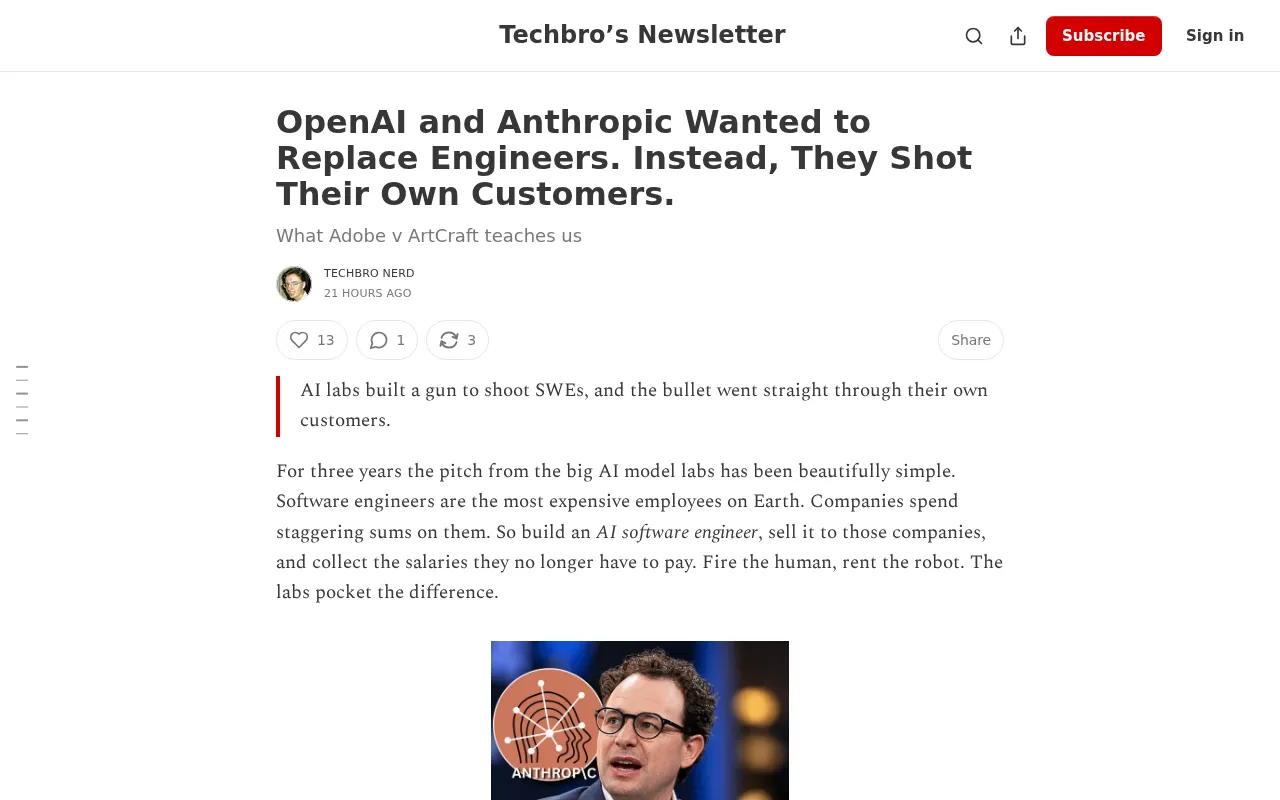
The core contradiction: selling "replacement" or "augmentation"?
In Anthropic's recent external narrative, coding capability has been placed front and center. From Claude's coding assistance to various agentic tools, "AI writing code" is essentially the main thread of its business story. The problem is that the more the narrative emphasizes "replacing engineers," the easier it is to inadvertently push the developers who buy APIs and tools into opposition—they are both customers and the very people being claimed as replaceable.
The core dissatisfaction revealed in the Hacker News discussion is not that the model's capabilities are insufficient, but rather a misalignment in positioning: if a product's marketing message is "make engineers redundant," then the engineering teams actually paying the bills will instinctively wonder whether this company is helping them become more productive or undermining them. This psychological gap is harder to repair than any feature deficiency.
A product principle worth remembering: when selling tools to developers, make them look stronger, not deletable.
Why the "replace engineers" narrative tends to backfire
Customers and the "replaced" overlap in identity
The primary paying users of AI coding tools are precisely engineers and teams that depend on engineers. When vendors make "reducing headcount of engineers" their value proposition, they are essentially telling customers: your core value is being diminished. In the short term this generates buzz, but in the long run it erodes trust.
Anthropic's coding product line is the key context for understanding this contradiction. Anthropic centers on the Claude series of models and enters developer workflows through APIs and agentic tools like Claude Code, with commercial revenue highly dependent on enterprise engineering teams' subscriptions and call volumes. This means its customer profile overlaps heavily with the engineer group it claims to "replace"—the same people are both purchasing decision-makers and end users. This structure of "customers being the target of replacement" is rare in SaaS history; traditional developer tool vendors typically amplify user productivity rather than reduce headcount. Therefore, when marketing narratives lean toward "reducing engineer headcount," they directly trigger customers' anxiety about their own value, rather than mere feature skepticism.
Friction in the toolchain gets amplified
Another layer implicit in the discussion is that when vendors shift resources toward "end-to-end automation," the small everyday development experiences that matter most—context understanding, codebase adaptation, integration with review workflows—tend to be neglected. What customers feel is not "augmented" but "asked to adapt to a tool that wants to replace them."
Agentic coding tools refer to AI systems capable of autonomously planning multi-step tasks, invoking terminals and file systems, and completing feature development end-to-end—distinct from early line-level code completion. These tools pursue "deliver a feature with one sentence," but their capability boundaries depend heavily on context windows, codebase indexing quality, and coordination with human review. When vendor resources shift toward end-to-end automation, it often means relatively reduced investment in IDE plugins, code review integration, incremental completion, and other "small experiences." The real pain points in developers' daily work are concentrated precisely in these areas: understanding large legacy codebases, following team conventions, and integrating with control flow and testing processes. The grander the automation narrative, the more these friction points are exposed and amplified.
Imbalanced expectation management
"Replacing engineers" is an extremely high promise. Once obvious shortcomings appear in actual use, the contrast gets amplified into disappointment—and disappointment spreads through developer communities far faster than positive reviews. Platforms like Hacker News are especially good at condensing this contrast into a sharp headline.
Hacker News's voting and commenting mechanisms determine how it provides feedback on product narratives: a low-point post doesn't necessarily mean a weak voice—it may simply mean the topic hasn't spread yet—but the comment section often precisely captures a widespread sentiment. HN users are primarily senior engineers, founders, and technical decision-makers—exactly the core paying audience for AI coding tools. They have low tolerance for marketing speak and are especially sensitive to "the gap between promise and delivery." When a post with only a dozen points gets repeatedly cited, it usually means it has articulated a judgment many people already held but hadn't expressed. Therefore, equating low heat with low representativeness is a common misjudgment in vendor community management.
Three takeaways for AI tool vendors
First, the narrative should focus on augmentation, not replacement. Even when emphasizing coding capability, saying "let engineers spend time on more valuable work" versus "engineers are no longer needed" produces vastly different levels of customer acceptance.
Second, the experience of paying customers must take priority over demo results. If stunning automation in a demo falls flat on real codebases, the first to leave are precisely the people most willing to pay.
Third, community sentiment is a product signal. This HN post had only 13 points, yet it precisely captured a widespread sentiment. If vendors treat it as mere noise, they may miss an early warning about positioning.
Conclusion
This discussion doesn't carry much information, but the question it raises is very real: as AI capabilities rapidly approach programming tasks, the biggest risk for model vendors may not be insufficient technical strength, but rather accidentally ending up on the opposite side of their customers while telling a growth story. The ambition to replace engineers can exist, but don't let the people paying the bills feel like they've become the target first.
One-line Summary
Anthropic used "replacing engineers" as its selling point, but ended up hurting its paying developer customers first.
Paragraph Summary
Drawing on a low-traffic discussion on Hacker News, this article analyzes the structural contradiction arising from Anthropic's core narrative of "replacing engineers." The primary paying users are engineers themselves; when vendors make "making engineers redundant" their value proposition, customers feel diminished and invalidated rather than augmented. The article further points out that shifting resources toward end-to-end automation sacrifices everyday small experiences like context understanding, codebase adaptation, and review workflow integration—and once the excessive promise of "replacement" falls short, the contrast spreads through developer communities far faster than positive reviews. The author offers three takeaways: narratives should focus on augmentation rather than replacement, paying customer experience should take priority over demo results, and community sentiment should be treated as a product signal rather than noise.
Related articles

Anthropic Files S-1: $16.3B Revenue, $80.7B Net Loss in Half a Year — Who Controls the Company?
Anthropic files S-1 for a Nasdaq IPO: H1 2026 revenue of $16.3B, an $80.7B net loss from valuation remeasurement rather than cash burn, founders' Class F shares holding 50.1% voting power, and no price or date yet.

Anthropic Files S-1: The Truth Behind $16.3B Revenue and $80.7B Loss
Anthropic's S-1 reveals $16.3B revenue and $80.7B net loss in H1 2026, with $72.4B from accounting effects. The filing also discloses $265.6B compute commitments, cloud deal details, and a 50.1% founder voting control structure, while IPO pricing remains blank.

Anthropic Financials Leaked: Revenue Far Exceeds Compute Costs, Claude Inference Gross Margin Hits 68%
Leaked Anthropic financials show revenue roughly twice total compute costs, Claude inference gross margin at 68%, while frontier training burns $2.8B per quarter. This article breaks down the two accounts and analyzes shifts in AI company valuation logic.