Apple Emergency Security Update: iOS 26 Vulnerability Under Active Targeted Attacks — Update Now

Apple urgently patches an actively exploited iOS 26 vulnerability — update your device now.
Apple has issued an emergency security update to fix a vulnerability in iOS 26 that has already been exploited in real-world attacks. Apple's advisory references "specific targeted individuals," language typically associated with commercial spyware or nation-state actors. While initial victims are limited, iOS 26 remains the dominant system version, making the overall risk exposure significant. iPhone, iPad, and Mac users are urged to update immediately via system settings, and enterprise IT teams should prioritize patching high-value targets.
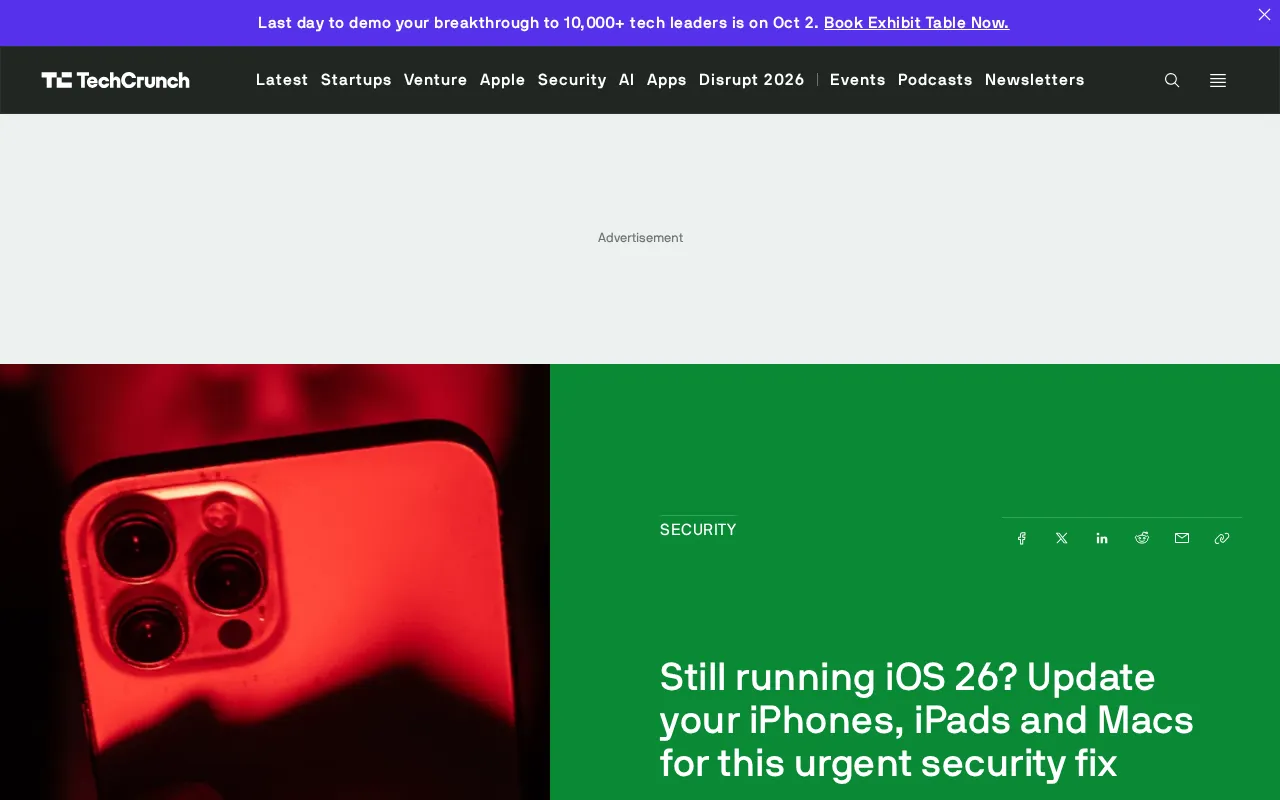
Apple has issued an emergency security update urging iPhone, iPad, and Mac users still running iOS 26 to upgrade immediately. According to Apple's official advisory, the vulnerability has already been exploited in real-world attacks against "specific targeted individuals" — and the majority of Apple users are still running the affected iOS 26.
Vulnerability Being Exploited in Targeted Attacks
Apple's security advisory makes clear that this is not a theoretical risk — the vulnerability has already appeared in active attack scenarios. Apple's language describes it as being used against "specific targeted individuals," a characterization that typically signals highly targeted attacks, often associated with commercial spyware or nation-state threat actors rather than broad, indiscriminate campaigns.
While the number of direct victims in a targeted attack may be limited, that's no reason for everyday users to let their guard down. Once a vulnerability is publicly disclosed, its technical details can be leveraged by a much wider pool of attackers — creating a "vulnerability weaponization" cascade effect. This is precisely why Apple has characterized this update as "urgent."
Zero-click attacks represent one of the most dangerous forms of targeted intrusion: the attacker doesn't need the victim to click any link or open any file. Simply receiving a specially crafted message — via iMessage or email, for instance — can trigger the vulnerability and install malicious code. Pegasus spyware, developed by Israeli firm NSO Group and used to surveil journalists, dissidents, and government officials, is the most well-known example of this kind of attack. Apple previously introduced Lockdown Mode specifically for high-risk users, dramatically reducing the device's attack surface by restricting functionality — though it's not a practical option for most people. Apple's phrasing of "specific targeted individuals" closely mirrors the disclosure patterns associated with commercial surveillance tools, suggesting the vulnerability was likely discovered by security researchers who specialize in tracking such software.
Why the Exposure Is So Widespread
A key aspect of this incident worth noting: iOS 26 remains the version most Apple users are currently running. That means the potential attack surface is enormous. When a security vulnerability is combined with an extremely high installation base, the overall risk exposure is significantly amplified — even if the initial attacks were narrowly targeted.
For individual users, this is a reminder that system updates shouldn't be put off indefinitely. Many people habitually delay upgrades out of concerns about compatibility issues or battery life changes. But when a vulnerability is already being actively exploited, patching promptly is the most direct and effective line of defense.
What Users Should Do
All users still running iOS 26 are advised to update their devices as soon as possible. Here's how:
iPhone and iPad
Go to Settings → General → Software Update, then check for and install the latest available version. It's recommended to do this while your device is charging and connected to Wi-Fi to ensure a smooth update process.
Mac
Open System Settings → General → Software Update, then follow the prompts to download and install Apple's security fix.
For enterprise and institutional IT administrators, the priority should be reviewing device management policies and pushing this update to managed devices as quickly as possible — particularly for high-value individuals who may be likely targets of directed attacks.
What This Incident Reveals About Mobile Security Trends
In recent years, targeted attacks against high-value individuals have become increasingly common, with spyware exploiting zero-click vulnerabilities or high-risk flaws to compromise devices at an alarming rate. Apple invests heavily in system security, but no platform is completely immune. This incident reaffirms a fundamental principle: security is a continuous process, not a one-time achievement.
The most practical advice for everyday users remains as simple as ever — keep your system updated, enable automatic updates, and stay cautious about suspicious links and messages. Completing an upgrade before a vulnerability is widely exploited is often the single most critical line between safety and risk.
Apple operates a dedicated Apple Security Bounty program, offering up to $1 million to researchers who discover zero-click remote code execution vulnerabilities — a figure that reflects just how rare and dangerous such flaws are. Meanwhile, the Rapid Security Response mechanism introduced in iOS 16 allows Apple to push targeted security patches without requiring a full version upgrade, dramatically shrinking the window between vulnerability discovery and user protection. This emergency update is a demonstration of that security infrastructure working as intended — from vulnerability confirmation to pushing a fix to hundreds of millions of devices, the speed of that entire response chain directly determines the ceiling on potential victims.
Related articles

Will GitHub Die? Open Source Maintainer Burnout and the Collaboration Crisis in the AI Era
Lex Fridman podcast discussion on open source maintainer burnout and GitHub's predicament: massive pull requests overwhelm core maintainers, and AI worsens code bloat. Using math journal peer review and Poincaré conjecture verification as analogies, the article analyzes why verification in knowledge production must be deliberately slow, and how open source communities can avoid the failure mode of maintainers exiting.

Stop Building Cookie-Cutter AI Websites: 3 Tools That Transform Your Coding Agent
Three tools that boost AI coding agents: FFmpeg skill for local video editing in Claude Code and Cursor, Hallmark's 50 design themes to fix cookie-cutter AI sites, and Jailbreaks' 25+ model prompts.

How America's Gerontocracy Squeezes the Younger Generation
Americans over 55 hold nearly three-quarters of national wealth, alongside an 80-year-old president and elderly congressional leaders. The Atlantic's Idrees Kahloon explains how gerontocracy drives up housing costs, squeezes opportunities for the young, and explores zoning reform and child poverty reduction as practical fixes.