Apple's HomeView Smart Display Gets a $10 Discount on Amazon

Apple's first smart display HomeView launches Nov 13, with Amazon offering a $10 pre-order discount at $289.99.
Apple has unveiled its first smart display, the HomeView, launching November 13. Amazon is taking pre-orders with a $10 discount, pricing it at $289.99. Available in Gray and creamy white Starlight, both colors carry the same early discount. HomeView enters a market dominated by Amazon Echo Show and Google Nest Hub, with Apple's edge expected to be deep HomeKit and Siri integration. The $10 discount is largely symbolic, and HomeView's success will hinge on real-world experience and ecosystem integration.
Apple has just unveiled its first smart display, the HomeView, which will officially launch on November 13. However, consumers can already pre-order it on Amazon for $289.99 — $10 less than the official price.
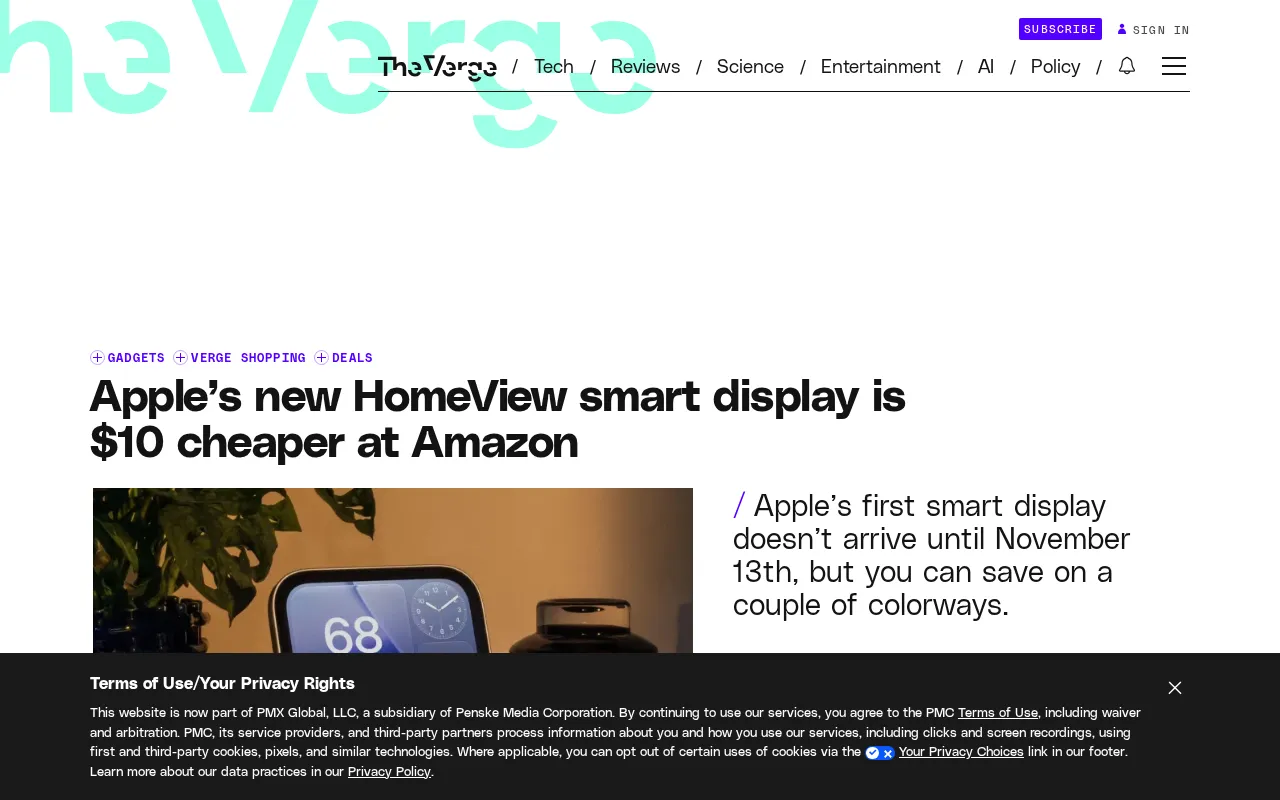
Design and Color Options
The HomeView comes in two colorways: Gray and a creamy white "Starlight" finish. Both colors are currently available on Amazon with the $10 discount. Although the savings are modest, it's a solid early deal for a product that was just announced.
"Starlight" is a warm-toned silver-white that Apple has adopted in recent years across its Apple Watch and MacBook lines, sitting somewhere between traditional silver and gold. Unlike pure white or Space Gray, it takes on a soft, creamy quality under different lighting conditions, and it's aimed primarily at users who want their devices to blend into home decor rather than stand out as tech. The gray version leans closer to Space Gray and has a more understated feel. Both colorways emphasize HomeView's positioning as a home furnishing piece rather than a pure electronic device — a departure from Amazon's more functionally oriented design language for the Echo Show, and a continuation of Apple's long-standing practice of making industrial design a key selling point.
Market Positioning and Competition
Apple is entering the smart display market relatively late, a space currently dominated by products like the Amazon Echo Show and Google Nest Hub. The launch of HomeView marks Apple's further expansion of its smart home ecosystem and is expected to integrate deeply with HomeKit and Siri.
A smart display is a home device that sits between a smart speaker and a tablet, typically featuring a touchscreen and serving as a smart home hub, video calling terminal, and information panel. This category was pioneered by Amazon in 2017 with the Echo Show, followed by Google's Nest Hub. The core logic behind both is to use a voice assistant (Alexa, Google Assistant) as the entry point and the screen as a home control center. Apple's delay in releasing a comparable product stems partly from long-standing questions about Siri's capabilities in smart home scenarios, and partly from the fact that the HomeKit ecosystem has far fewer third-party devices than the Alexa and Google Assistant ecosystems. The launch of HomeView is seen as a key step in completing Apple's smart home hardware puzzle, but whether it can catch up from behind will depend on the scale of Siri's upgrades and the openness of the HomeKit ecosystem.
It's worth noting that HomeKit is Apple's smart home framework introduced in 2014, built around end-to-end encryption and privacy protection. However, this security-first strategy has led to high barriers to device integration and lengthy certification cycles, limiting third-party manufacturers' willingness to participate. If HomeView is to genuinely compete with the Echo Show and Nest Hub, Apple needs to lower the barriers to ecosystem integration while maintaining its privacy advantage — otherwise, the screen alone won't be enough to close the gap in content and services.
Key Takeaways
For consumers already invested in the Apple ecosystem, the HomeView could be an appealing choice, especially if it can seamlessly connect with iPhone, Apple Watch, and other HomeKit devices. However, the $10 discount is likely to have limited impact on driving sales — it's more symbolic than anything.
Summary
Apple's HomeView smart display is about to hit the market, and Amazon is offering a modest discount. While the savings aren't significant, they provide early buyers with an opportunity to save. As competition in the smart home market intensifies, whether Apple can stand out with the HomeView will depend on its real-world experience and ecosystem integration capabilities.
One-line Summary
Apple's first smart display, the HomeView, launches November 13, with Amazon offering a $10 discount at a $289.99 pre-order price.
Paragraph Summary
Apple has announced its first smart display, the HomeView, set to officially launch on November 13. Amazon has opened pre-orders with a $10 discount, bringing the price to $289.99. The device comes in two colorways — Gray and creamy white Starlight — both with the same early discount. HomeView is entering a mature market dominated by Amazon's Echo Show and Google's Nest Hub, and Apple's differentiation is expected to come from deep integration with HomeKit and Siri, as well as its appeal to Apple ecosystem users. However, the $10 discount is unlikely to significantly boost sales and is more of a symbolic early promotion. Whether HomeView can stand out in the competition will depend on its actual user experience and ecosystem integration capabilities.
Related articles

Will GitHub Die? Open Source Maintainer Burnout and the Collaboration Crisis in the AI Era
Lex Fridman podcast discussion on open source maintainer burnout and GitHub's predicament: massive pull requests overwhelm core maintainers, and AI worsens code bloat. Using math journal peer review and Poincaré conjecture verification as analogies, the article analyzes why verification in knowledge production must be deliberately slow, and how open source communities can avoid the failure mode of maintainers exiting.

Stop Building Cookie-Cutter AI Websites: 3 Tools That Transform Your Coding Agent
Three tools that boost AI coding agents: FFmpeg skill for local video editing in Claude Code and Cursor, Hallmark's 50 design themes to fix cookie-cutter AI sites, and Jailbreaks' 25+ model prompts.

How America's Gerontocracy Squeezes the Younger Generation
Americans over 55 hold nearly three-quarters of national wealth, alongside an 80-year-old president and elderly congressional leaders. The Atlantic's Idrees Kahloon explains how gerontocracy drives up housing costs, squeezes opportunities for the young, and explores zoning reform and child poverty reduction as practical fixes.