AutoScaffold: Dynamic Scaffolding with AI Tutors for More Efficient RL Training
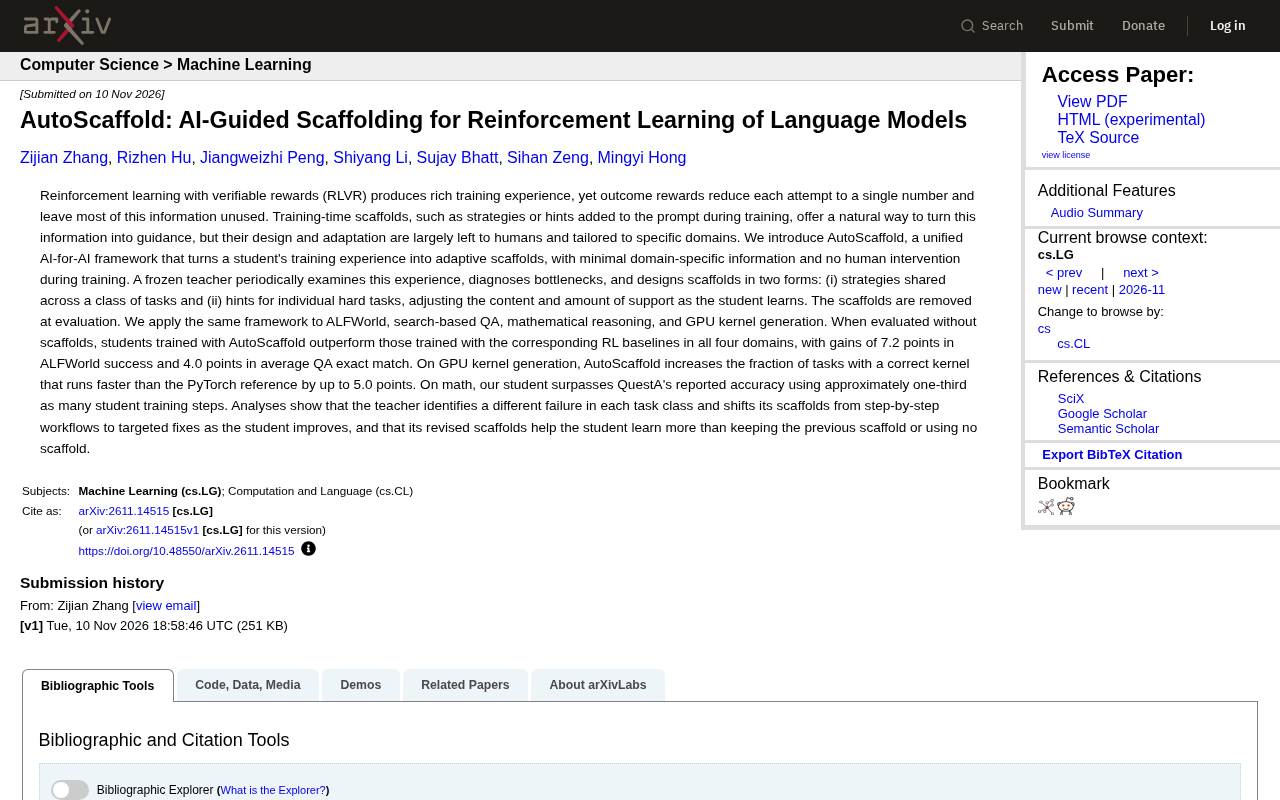
AutoScaffold uses a frozen teacher to auto-diagnose student bottlenecks and design dynamic scaffolding, beating RL baselines in four domains.
The article introduces AutoScaffold, an AI-for-AI framework that tackles sparse outcome rewards and wasted training experience in RLVR. A frozen teacher periodically reviews student training experience, identifies repeated failure categories, and automatically designs two types of scaffolding—cross-task strategies and task-specific hints—adjusting them dynamically as the student improves. In ALFWorld, search QA, math reasoning, and GPU kernel generation, scaffold-free evaluation shows gains of 4-7 points over RL baselines, with math reasoning surpassing QuestA-reported accuracy in about one-third of the training steps. Ablations confirm dynamically revised scaffolding is more effective than static scaffolding. The method relies on a strong teacher, and scaffolding acts only as a training accelerator, not an inference add-on.
Title
AutoScaffold: Dynamic Scaffolding with AI Tutors for More Efficient RL Training
Meta Description
AutoScaffold proposes an AI-for-AI framework in which a frozen teacher model automatically designs dynamic scaffolding based on student training experience. Across four domains—ALFWorld, search QA, math reasoning, and GPU kernel generation—it outperforms RL baselines under scaffold-free evaluation, with ALFWorld success rate improving by 7.2 points.
Article Content
Reinforcement learning (RL) has shown strong potential in language model training, especially reinforcement learning with verifiable rewards (RLVR). But a fundamental contradiction has long persisted: each attempt yields only a scalar outcome reward, and the rich information implicit in the training process is wasted. Recently, a study on AutoScaffold proposed a unified "AI-for-AI" framework that lets a frozen teacher model periodically review the student's training experience, automatically diagnose bottlenecks, and design scaffolding, thereby significantly improving training efficiency across multiple domains.

Why Do We Need Training-Time Scaffolding?
The advantage of RLVR lies in its verifiable reward signal that requires no human preference annotation, but the outcome reward compresses each attempt into a single number, and information such as specific failure modes and success paths generated during training is almost entirely discarded. Training-time scaffolding—for example, adding strategies or hints to the prompt—can in theory convert this information into guiding signals. However, existing approaches usually rely on manual design and are customized for specific domains, making them difficult to generalize across tasks and unable to adapt dynamically as the student's ability changes.
The core insight of AutoScaffold is that training experience itself is a resource that AI can leverage. Rather than having human experts manually design prompts, it is better to let a stronger model automatically perform diagnosis and design.
RLVR (reinforcement learning with verifiable rewards) is an important paradigm for post-training language models in recent years. Its core is to replace human preference annotation with programmatic, automatically determinable reward signals (such as whether the final answer to a math problem matches, whether code passes unit tests, the exact match rate of QA, etc.). Unlike RLHF, which relies on a reward model for scoring, RLVR's rewards come from deterministic verifiers, so the signal is more objective, less susceptible to reward hacking, and lower in cost. Representative works include the DeepSeekAd-R1 series methods that use reinforcement learning to improve math reasoning, QuestA, and others. But the inherent limitation of RLVR is that rewards are outcome-level, sparse, and scalarized: a complete generation yields only a single number, and the model cannot directly learn from a failed trajectory "which step went wrong and why," which is one of the root causes of the training efficiency bottleneck.
Training-time scaffolding refers to auxiliary context injected into the student model during the training phase, such as solution strategies in the prompt, step templates, format constraints, or correction suggestions for specific problems. Its key difference from inference-time prompt engineering is that scaffolding exists only during training to shape the model's policy distribution, and is completely removed during evaluation and deployment, so the model's final capability must be internalized in its parameters. This is in line with the idea of "gradually withdrawing auxiliary information" in curriculum learning and teacher distillation, but AutoScaffold's innovation is to have the teacher model automatically generate and iterate these scaffolds rather than presetting them manually.
How AutoScaffold Works: Teacher Diagnosis, Student Evolution
The framework involves two roles: a frozen teacher model and a student model being trained. The teacher model does not participate directly in training; instead, it periodically inspects the student's training experience data, identifies the task categories on which the student repeatedly fails, and designs two types of scaffolding accordingly:
- Strategies: general guidance for a class of tasks, shared across tasks of the same kind;
- Hints: specific correction suggestions for individual difficult tasks.
The key design is that the content and amount of scaffolding are dynamically adjusted as the student progresses. When the student is weak early on, the teacher may provide more detailed step-by-step workflows; as the student improves, the scaffolding shifts toward more precise targeted fixes. During evaluation, all scaffolding is removed to ensure the final model does not depend on external support.
A frozen teacher model refers to a strong model whose parameters are not updated throughout training and is invoked only as an inference service. This design draws on the "teacher–student" paradigm in knowledge distillation, but its purpose differs: distillation transfers per-token output distributions, whereas here the teacher transfers diagnostic conclusions and structured suggestions about the training experience. Freezing brings two benefits: first, it avoids training instability and mode collapse caused by co-updating the teacher and student; second, the teacher's capability constitutes a de facto upper bound on the student's capability, making scaffold quality controllable. The cost is that the teacher's capability ceiling becomes the ceiling of the entire framework, and periodically invoking a strong model incurs additional inference costs.
The dichotomy between "strategies" and "hints" corresponds to shared representations and individual corrections in transfer learning: strategies target task categories and amount to reusable priors or meta-knowledge that can be amortized across samples of the same kind; hints target individual difficult samples and amount to targeted error correction. This hierarchical structure makes scaffolding both generalizable and precise, while keeping the quantity controllable to avoid context bloat. The dynamic addition and removal of scaffolding as training progresses is essentially an automatic curriculum driven by the model's own performance, which is more adaptive than curriculum learning with manually set difficulty curves.
Multi-Domain Validation: Performance Gains on Four Tasks
The research team applied the same framework to four clearly different domains: ALFWorld household environment tasks, search-based QA, math reasoning, and GPU kernel generation. According to the paper, under evaluation without scaffolding, the student models trained with AutoScaffold outperform the corresponding RL baselines in all four domains:
- ALFWorld: success rate improves by 7.2 points;
- Search QA: average exact match improves by 4.0 points;
- GPU kernel generation: the proportion of tasks that are correct and run faster than the PyTorch reference implementation improves by up to 5.0 points;
- Math reasoning: the student model surpasses the accuracy reported by QuestA using about one-third of the student training steps.
These results show that the gains from scaffolding are not limited to a single task type but are transferable across domains.
Analysis Reveals: The Teacher Identifies Different Failure Modes for Different Tasks
The paper further analyzes the behavior of the teacher model. The results show that the teacher identifies different failure causes in different task categories and adjusts the form of scaffolding as the student progresses: transitioning from early step-by-step workflows to later targeted fixes. Ablation experiments show that the teacher's revised scaffolding helps the student improve more than retaining old scaffolding or using no scaffolding at all. In other words, the value of scaffolding lies not only in "having it" but in "dynamic adaptation."
Significance and Limitations
AutoScaffold offers an idea: turn the training process itself into a signal that AI can understand and exploit, reducing reliance on human domain knowledge and manual design. It does not require a large amount of domain-specific information, nor does it require human intervention during training, which makes it attractive in multi-task scenarios.
One additional point: the method relies on a sufficiently capable frozen teacher model, and the quality of the teacher's diagnosis directly affects scaffold effectiveness; meanwhile, all evaluations in the paper are conducted after removing scaffolding, which ensures fairness but also means that scaffolding acts as a "training accelerator" rather than an inference-time add-on. How to extend this framework to more open tasks with sparser rewards remains a direction worth exploring.
One-line Summary
AutoScaffold uses a frozen teacher model to automatically diagnose student training bottlenecks and design dynamic scaffolding, outperforming RL baselines in all four domains.
Paragraph Summary
The article introduces a study called AutoScaffold, which addresses the problem of sparse outcome-reward information and wasted training experience in reinforcement learning with verifiable rewards (RLVR) by proposing a unified AI-for-AI framework. In this framework, a frozen teacher model periodically reviews the student's training experience, identifies task categories of repeated failure, and automatically designs two types of scaffolding: strategies shared across tasks and hints for difficult tasks, adjusting their form dynamically as the student progresses. In four domains—ALFWorld, search QA, math reasoning, and GPU kernel generation—evaluation after removing scaffolding shows that the student models outperform the corresponding RL baselines, with metrics such as success rate and exact match improving by 4 to 7 points, and math reasoning surpassing the accuracy reported by QuestA using only about one-third of the training steps. Analysis shows that the teacher identifies different failure modes for different tasks, and ablation experiments confirm that dynamically revised scaffolding is more effective than retaining old scaffolding. The article also notes that the method relies on a strong teacher model and that scaffolding serves only as a training accelerator rather than an inference-time add-on.
Related articles

Anker SOLIX X1 Three-Month Test: Seamless Outage Switching and How Home Energy Storage Cuts Electricity Bills
Three-month real-world test of Anker SOLIX X1 and PowerDock Pro: millisecond seamless outage switching, September usage of 735 kWh with only 16 kWh bought from the grid, solar plus battery covering about 98% of demand, 358 kWh battery discharge, and 495 kWh surplus exported to the grid.
Ollama Beginner's Guide: Zero-Basics Local Deployment of AI Large Models
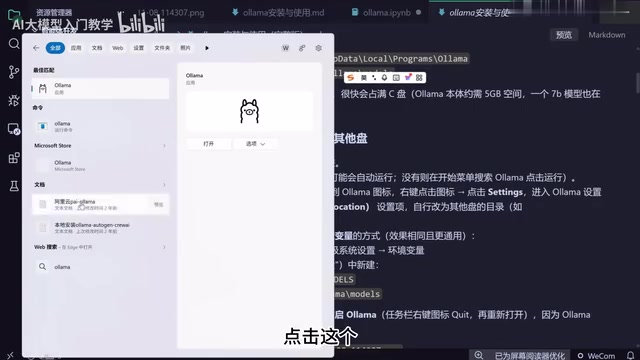
Zero-basics Ollama installation and deployment tutorial: three installation methods with software and models stored separately, how to change the model directory, how to run models with commands after installation, plus VRAM-based model selection advice and tips for turning off thinking mode.
Nvidia's Governance Crisis: Why Corporate Governance Experts Are Watching en Masse
Nvidia faces a crisis that corporate governance experts call unprecedented, with many saying they've never seen anything like it. This analysis explores why the governance crisis has drawn professional attention and its potential impact on the AI chip industry.