Backend to Agent Development: Salary Gains and Skill Roadmap Explained

Agent job demand is surging with salaries higher than traditional backend; backend engineers can transition at low cost with engineering advantages.
Based on a Bilibili creator's sample analysis of 2,500+ Agent development positions on BOSS Zhipin, this article outlines the market landscape and transition path. Agent demand is growing at 107% CAGR; entry-level salaries start at 12K, 1-3 years experience earns 18-40K, and tech leads typically earn 500K annually. The skill path emphasizes "change direction, not stack": using Java and Spring AI, learn LLM principles, prompt engineering, and function calling in month one; ReAct, tool calling, memory, and RAG in month two; then multi-Agent collaboration and workflow orchestration. Backend engineers' deployment experience and production-grade skills are natural advantages. The article also cautions against quick-success hype.
Agent Development Job Demand and Salary Landscape
According to a Bilibili creator's survey of over 2,500 Agent development positions on BOSS Zhipin, demand for AI agents is rising rapidly, with the market growing at a compound annual rate of 107%, and corresponding job demand surging in tandem.

On the salary front, newcomers transitioning with zero background start at 12K RMB per month, far exceeding Java developers with the same years of experience doing traditional CRUD work. Developers with 1-3 years of hands-on Agent implementation experience earn a stable 18-40K, and some positions don't even require experience, with salaries directly surpassing 80% of ordinary backend developers. Those who reach Agent tech lead level typically earn 500K RMB annually; pre-tax offers at top-tier companies can even reach 50K+ per month.
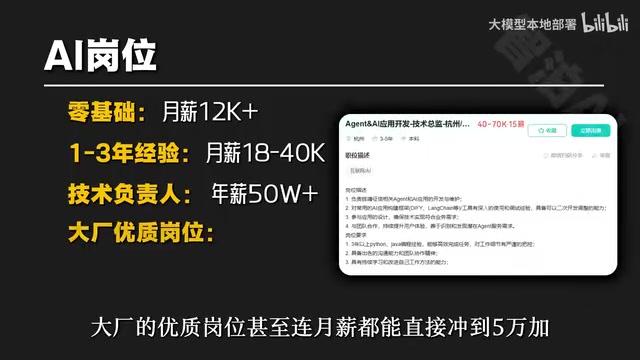
This salary structure reflects a trend: the AI industry is no longer dominated by pure algorithms and pure Python. What enterprises lack most when implementing AI is technical talent who can do engineering implementation and stable deployment. Agent development sits precisely at the application layer between algorithms and engineering, with engineering capability requirements higher than algorithm research requirements—this is the opportunity window for backend developers.
It should be noted that the above data comes from a single creator's sample analysis of job postings. Specific salaries will vary greatly by city, company size, and individual background, but the overall trend is consistent with industry observations.
Agent (AI Agent) refers to AI systems that can perceive their environment, make autonomous decisions, and call tools to complete multi-step tasks, typically using large language models as the reasoning core combined with planning, memory, and tool-use capabilities. Unlike traditional single-turn Q&A or API calls, Agents emphasize "autonomy" and "task closure"—for example, automatically booking tickets, generating code, or approving business workflows, requiring the model to dynamically choose the next action across multiple steps. This characteristic determines that the focus of Agent development is not on training models, but on orchestrating models, designing tool interfaces, managing context, and ensuring system stability. Therefore, engineering capability (rather than algorithm research) becomes the core requirement of the position—which is the fundamental reason backend developers can make a lateral move into this space.
What Skills Do Backend Developers Need to Transition to Agent Development?
The learning path given by the creator emphasizes "no need to learn Python from scratch, and no need to grind through low-level algorithms"—instead, based on the Java ecosystem, you only learn application-layer implementation development. The path is divided into three stages:
Month 1: Build foundations: Master core LLM principles, prompt engineering, and function calling; become proficient with Spring AI and Spring AI Alibaba to connect to major model APIs; and get basic intelligent development working.
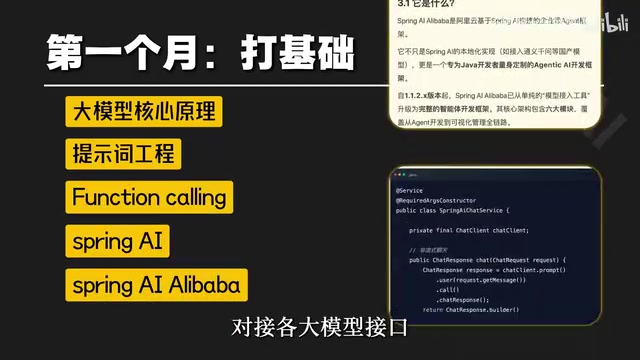
Month 2: Focus on core capabilities: Master ReAct chain-of-thought, tool calling, short- and long-term memory mechanisms, and RAG knowledge bases; independently develop commercial-grade projects such as intelligent customer service, enterprise knowledge bases, and business approval assistants to meet enterprise hiring standards.
Final stage: Advanced elevation: Learn multi-Agent collaboration, task decomposition, and workflow orchestration; complete advanced projects such as office automation and code generation, targeting mid-to-high-end AI development positions.
The entire path is designed around employment, using project-driven learning without empty theory. After completing it, you can directly write it into your resume, interview with it, and implement projects.

From a tech stack perspective, this path avoids model training and fine-tuning, focusing instead on engineering aspects like Agent orchestration, tool integration, and knowledge base construction. The learning curve is relatively friendly for backend developers. However, "reaching enterprise standards in two months" is an estimate under ideal conditions; actual mastery depends on the depth of project practice and individual foundations.
The Natural Advantages of Backend Engineers
The creator believes the core logic of backend transition to Agent development is "change direction, not stack"—leveraging existing engineering advantages. Specifically, there are three points:
Tech stack alignment. Existing backend engineering deployment experience can be directly reused; the Spring ecosystem and Java engineering capabilities remain effective in Agent application-layer development.
Better understanding of implementation than pure algorithm backgrounds. People who only know model calling often lack engineering experience with production-grade projects, while backend developers can independently develop production-grade projects—which is exactly what enterprises urgently need.
Programming fundamentals and logical thinking accelerate learning. When learning Agent logic, workflows, and tool calling, a solid programming foundation makes onboarding much faster than for those starting from zero.
Among these three advantages, the most practical is the reusability of engineering deployment experience. Agent applications ultimately need to go live, remain stable, and handle concurrency and exceptions—precisely the daily work of backend developers. In contrast, developers with pure algorithm backgrounds may need to catch up on engineering, while backend developers need to catch up on understanding model capabilities and limitations.
A Rational View of the Transition Hype
The high salaries in Agent development are indeed attractive, but several points require calm judgment. A sample of 2,500+ positions can reflect trends but doesn't mean every transitioner can reach the upper salary limit; the 18-40K range is wide, and experience, project quality, and interview performance all affect leveling. Additionally, the Agent tech stack iterates quickly—today's popular frameworks may not be tomorrow's standard. The real moat for backend developers remains engineering capability and learning ability, not proficiency in a specific framework.
For developers with existing Java backend experience who want to enter the AI application layer, this path offers a low-barrier starting point. But slogans like "from beginner to expert in seven days" should be taken with a grain of salt—two months of foundation-building plus project practice is a more realistic expectation.
Background Supplement
Function calling is a key mechanism for LLMs to interact with external systems: developers predefine a set of functions (such as checking weather, checking inventory, sending emails) and their parameter structures. During conversation, the model determines based on user intent whether to call a function, which function to call, and outputs structured parameters. The application layer receives the call request, executes the actual code, and returns the result to the model for continued reasoning. It transforms Agents from "only able to talk" to "able to do things" and is the foundation for advanced capabilities like tool calling and multi-Agent collaboration. For backend developers, understanding function calling is essentially understanding a new "interface protocol"—the model acts as the caller, and backend services act as the callee, except the caller changes from code to a natural-language-driven reasoning engine.
RAG (Retrieval-Augmented Generation) refers to retrieving relevant fragments from external knowledge bases (documents, databases, vector stores) before the model generates an answer, injecting them as context into the prompt so the model can answer based on enterprise private knowledge, mitigating hallucinations and outdated knowledge issues. The typical process includes document chunking, vectorization (embedding), similarity retrieval, and reranking. RAG is one of the most common implementation scenarios in Agent development (intelligent customer service, enterprise knowledge bases) and the area where backend developers can best leverage their advantages—it is essentially an engineering problem of data pipelines, storage and retrieval, and service orchestration, highly connected to the search, caching, and database design that backend developers are familiar with.
One-line Summary
Agent job demand is surging with salaries higher than traditional backend, and backend engineers can transition at low cost leveraging their engineering advantages.
Paragraph Summary
Based on a Bilibili creator's sample analysis of 2,500+ Agent development positions on BOSS Zhipin, this article outlines the market landscape and transition path for Agent development. Agent job demand is rising rapidly with a market CAGR of 107%; zero-background transitioners start at 12K monthly, 1-3 years of experience stabilizes at 18-40K, and tech leads typically earn 500K annually. The skill path emphasizes "change direction, not stack": based on the Java ecosystem and Spring AI, learn LLM principles, prompt engineering, and function calling in month one; tackle ReAct, tool calling, memory mechanisms, and RAG in month two; and finally advance to multi-Agent collaboration and workflow orchestration. Backend engineers' engineering deployment experience, production-grade implementation capability, and programming fundamentals are natural advantages. The article also cautions against taking quick-success hype at face value—real salaries are affected by experience, project quality, city, and other factors.
Related articles

Microsoft Fabric Database Agent in Action: From Reactive Firefighting to Intelligent Detective
A deep dive into the Microsoft Fabric Database Agent: how to enable it, supported monitoring scenarios, a blocking-issue demo, and the roadmap from reactive to autonomous operations.

Zendesk Uses ChatGPT Enterprise to Build a Sales Agent with 1,000 Daily Active Users
Zendesk opened ChatGPT Enterprise to all employees, who built about 600 apps themselves, including a sales expansion agent with about 1,000 daily active users. This article analyzes how it turns internal data into sales opportunities and its "don't wait" implementation strategy.

Google Releases Gemini 4 Carbon: Its Strongest Model Yet, Debuting with a Cybersecurity Focus
Google releases Gemini 4 Carbon, calling it its strongest model, with a cybersecurity focus. It tops the third-party composite ranking at 59 points but leads by only one or two. This article analyzes its security test results, staged rollout, token pricing, and the divergence between self-reported and third-party tests on hallucinations.