Baidu ERNIE 5.5 Flash Base Open-Sourced: 280B Parameters with Only 14B Active, Million-Token Context

Baidu open-sources ERNIE 5.5 Flash Base: impressive specs but Base positioning and absent channels lead to muted response.
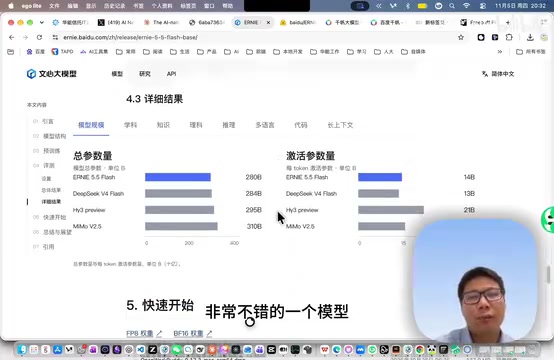
Baidu has officially open-sourced ERNIE 5.5 Flash Base, using a MoE architecture with 280B total parameters, 14B active parameters, and million-level context support, positioned at the sweet spot for enterprise private deployment. However, this release is a Base model that hasn't undergone preference alignment or reinforcement learning, and it's absent from Baidu's official website and Qianfan platform — a clear disconnect between open-sourcing and usability. Official comparisons target DeepSeek V4.1 Flash and previous-generation Base models, which Bilibili creator Kunpeng Talk sees as reflecting limited confidence. The model is text-only with no standout speed or capability highlights, and community discussion is far cooler than for other vendors. The creator also unexpectedly found that ERNIE Bot's official website offers a fully featured free AI workbench, usable as a backup for lightweight tasks.
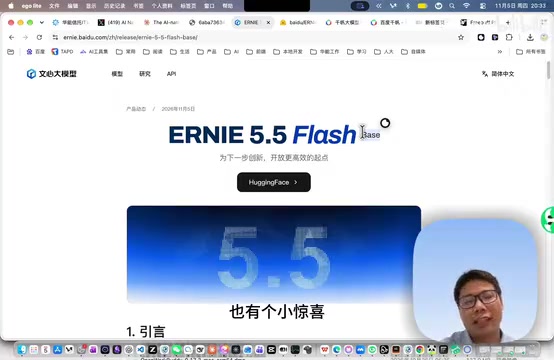
Baidu's ERNIE large model ERNIE 5.5 Flash Base has officially been open-sourced recently, featuring 280B total parameters, 14B active parameters, and support for million-level context — specifications that are quite rare in the 300B parameter tier. However, community reaction after the release has been lukewarm, with many bloggers not even bothering to cover it. According to hands-on testing by Bilibili creator Kunpeng Talk, the model has not yet been made available on Baidu's official channels — a clear disconnect between open-sourcing and usability.
Open-Source Specs: 280B Total Parameters, 14B Active, Positioned at the Enterprise Deployment Sweet Spot
According to Kunpeng Talk, ERNIE 5.5 Flash Base uses a 43-layer Transformer architecture with 64 attention heads, trained on 33.5T tokens. The model employs a hybrid MLA and HCA attention architecture, with the KV Cache portion optimized using MLA while most layers retain the HCA structure. Training most commonly used 128K data, but the model supports context lengths of up to one million tokens (originally described as "one trillion").
This parameter configuration is seen by the creator as the "sweet spot" for enterprise private deployment — around 280B total parameters with 14B active, inference costs drop significantly compared to larger-scale models. Few models are currently available at this tier; Ant Group also has products of similar parameter scale, but overall, excellent models under 300B remain scarce.
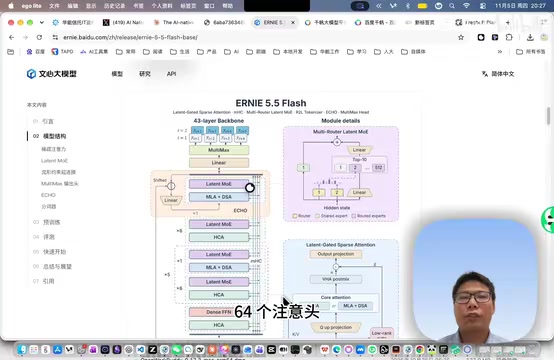
The model is open-sourced on Hugging Face, supports vLLM and SGLang inference deployment, and is available in FP8 and BF16 formats, though NVFP4 format is not yet provided. However, the creator states bluntly that "most likely no one will deploy it," citing questions about both the model's positioning and its availability.
Total Parameters vs. Active Parameters (MoE Architecture): Total parameters refer to the full number of weights in the model, while active parameters refer to the number of parameters actually involved in computation during a single forward inference pass. ERNIE 5.5 Flash Base's 280B total parameters with 14B active indicates it uses a Mixture of Experts (MoE) architecture: each token is routed to only a subset of expert networks, so actual computation is close to that of a 14B dense model, but model capacity is carried collectively by the 280B parameters. The advantage of this design is that inference FLOPs and memory bandwidth pressure are significantly lower than a dense model with the same total parameters, while retaining larger knowledge capacity — hence it is seen as a compromise balancing performance and cost in private deployment.
MLA and HCA Hybrid Attention: MLA (Multi-head Latent Attention) compresses the KV Cache through low-rank compression, greatly reducing memory usage during long-context inference; it is the structure popularized by the DeepSeekAd series. HCA typically refers to a hierarchical or block-wise efficient attention variant used to handle long sequences at lower cost in most layers. A hybrid of the two means the model uses MLA for KV Cache optimization in only some layers while keeping a lighter attention structure in the rest, aiming to control memory usage and latency under million-level context.
Base Model Positioning: Can Run Benchmarks but Not Ready for Direct Use
What's open-sourced this time is the Base model — a version that has only completed foundational training and has not yet undergone post-training such as preference alignment and reinforcement learning. This explains why Baidu has not made it available for direct user access on the ERNIE Bot official website or the Qianfan platform — it is not yet suitable for end users.
But the creator's criticism is about the reversed process: other vendors typically open access first, let the community use it for a while, and then open-source it, whereas Baidu simply released the Base model directly, with no entry point found on either the official website or the Qianfan platform. In the video, he complains that "a model Baidu open-sourced — even I don't use it myself," seeing this as a reflection of unfamiliarity with open-source community habits.
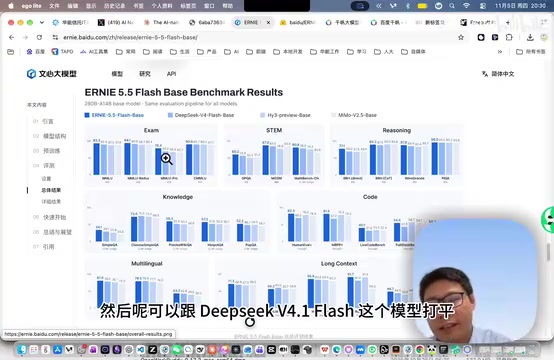
From the official comparison chart, ERNIE 5.5 Flash Base is benchmarked against DeepSeek V4.1 Flash, as well as "previous-generation" models such as its own ERNIE 3 Base version and MIMO 2.5 Base version. The creator believes this comparison approach indicates limited confidence from the team — theoretically a new model should be benchmarked against the current strongest models, though it could also be interpreted as pragmatism. At least on paper, a model with 280B total parameters and 14B active holding its own against DeepSeek V4.1 Flash is already reasonably respectable.
Base Models and Post-Training: Large model training typically consists of two stages: pre-training (Base) and post-training. A Base model has only undergone next-token prediction self-supervised training, acquiring language and knowledge distributions, but it does not follow instructions, does not refuse harmful requests, and its output style is unstable. Post-training includes supervised fine-tuning (SFT), preference alignment (such as RLHF/DPO), and reinforcement learning (such as RLVR) — these steps are what turn a Base model into a product capable of direct conversation. Therefore, Base models are suitable as research baselines or starting points for further fine-tuning; ordinary users calling them directly often have a poor experience, which is also a reasonable explanation for why Baidu did not put it on the official website or Qianfan platform.
Hugging Face and vLLM/SGLang: Hugging Face is the mainstream model weight hosting community; open-sourcing means weights can be publicly downloaded. vLLM and SGLang are two high-throughput inference frameworks — the former is known for PagedAttention, the latter excels at structured output and prefix caching. Supporting both means enterprises can deploy using standard toolchains, but the two precision formats FP8/BF16 also mean deployment requires at least tens of GB of GPU memory — the actual barrier is not low.
Capability Boundaries: Text-Only, No Multimodality, No Standout Highlights in Speed or Capability
ERNIE 5.5 Flash Base, like its benchmark DeepSeek V4.1 Flash, currently supports only plain text and does not yet support multimodal inputs such as images. The creator comments that the model "has no distinctive features": it should either be fast or highly capable — being neither makes it hard to compete.
He cites StepFun as an example — Step 3.5 could achieve inference speeds of 600-700 tokens per second, but by Step 5 the speed dropped below 100 while capability showed no significant improvement. This "neither fast nor strong" predicament is exactly what new models need to avoid.
Judging from community attention, the Matthew effect in the large model field is evident — Baidu's model promotional materials and discussion volume are far lower than those of other vendors. The creator expresses regret multiple times in the video, hoping Baidu can build better models to participate in open-source competition.
Surprising Find: Baidu's Free AI Workbench Is Fully Featured
Although he couldn't get hands-on with the model itself, the creator discovered a free AI workbench when logging into the ERNIE Bot official website. According to his description, the workbench offers scheduled tasks, skills, knowledge base, and other features, and also includes modules for image generation, PPT generation, application development, and document processing, as well as scenario-based capabilities such as travel planning, financial analysis, investment research, and browser operations.
In hands-on testing, he used browser operations to query 12306 information and found the overall capability usable. The workbench defaults to the 5.1 model, and model selection is limited after switching. For tasks that don't require particularly intelligent models, this free workbench is an option worth trying — after all, domestic products like Doubao and Yuanbao also offer similar capabilities, and an extra free choice does no harm to users.
Summary
ERNIE 5.5 Flash Base makes a meaningful attempt at parameter efficiency: 280B total parameters, 14B active, million-token context, targeting the enterprise deployment sweet spot. But the Base model positioning combined with the absence from official channels makes this open-sourcing feel more like a technical submission than a product launch. The model's capabilities are middling, lacking a memorable point in either speed or capability, so the muted community response is understandable. Whether Baidu can address the usability gaps in subsequent official versions is worth watching.
Related articles

Qwen 4.5 and Qwen 5 Roadmap Leaked: Parameter Sizes Keep Growing, Will the 27B Size Survive?
A Reddit leak reveals the Qwen 4.5 and Qwen 5 roadmap, with officials confirming parameter scales will keep growing. The community wonders whether the 27B size will survive and if mid-sized MoE models will become the new option.

Qwen 4 Launch Imminent? The Community Buzz Behind "Qsoon"
Qwen 4 release rumors spark heated Reddit discussion. Official "Qsoon" response and unconfirmed "next week" news intertwine as developers meme and hope for stronger, leaner models.

1.5-Centimeter Biohybrid Robot Jumps 5mm in a Single Contraction: ETH Zurich Unlocks It with Scaffold Design
ETH Zurich researchers used lab-grown muscle to drive a 1.5-cm robot that jumps 5 mm in one contraction. The key lies not in the muscle itself but in microgrooves on a 3D-printed scaffold that guide fiber alignment—offering a new interface-engineering approach for biohybrid robots.