Behind the $560 Million Crypto Theft: Re-examining Exchange Centralization Risks

Reddit's viral "largest theft ever" was actually a centralized exchange hack, not a failure of crypto technology itself.
The article examines a Reddit post claiming "the largest hack in crypto history," noting that the victim was a centralized exchange like Binance, not a decentralized wallet. The comments reveal widespread public confusion between "crypto" concepts and custody architectures: tech skeptics mistakenly think wallets are unsafe, political satirists mock authority endorsements, and AI conspiracy theorists link the incident to OpenAI. The author emphasizes that centralized custody and self-custody wallets have entirely different risk models — the former relies on platform governance, the latter on personal operational security. Crypto news on social media has a low signal-to-noise ratio, and exaggerated headlines undermine credibility. The takeaway for ordinary users: distinguish exchange accounts from self-custody wallets, be wary of exaggerated claims lacking on-chain data, and view centralized platform incidents and crypto technology itself rationally.
A Mocked "Largest Theft in History"
A Reddit post titled "Black October update: The largest hack in crypto history just happened. $5.6 billion stolen." drew attention. The post itself was just one sentence with a screenshot of typical crypto news, but the comments revealed a subtle split: some were shocked that "crypto wallets could be unsafe," some sarcastically said "waiting for Sam to say OpenAI's LLM did it," and others pointed straight at the core issue — what was stolen wasn't a decentralized wallet, but a centralized exchange like Binance.
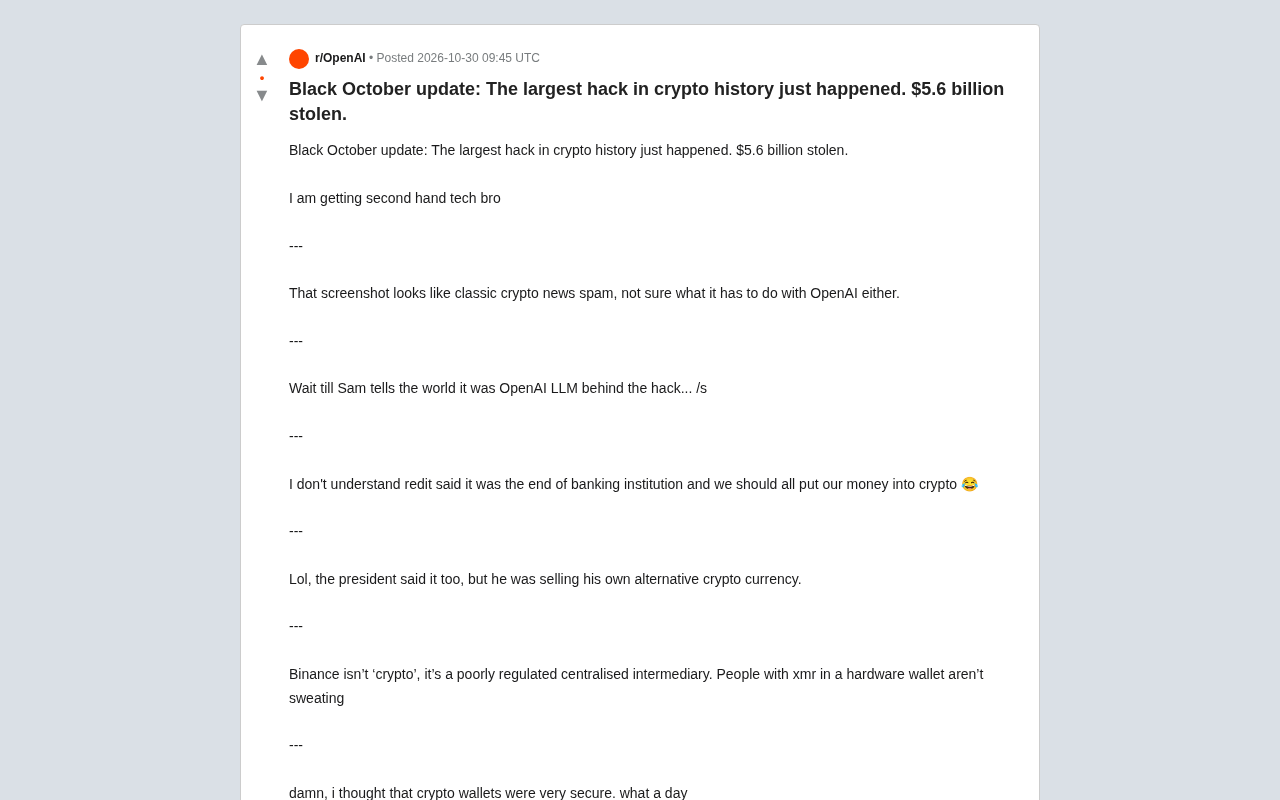
This split is telling in itself. When the word "crypto" is used to refer to Bitcoin, hardware wallets, centralized exchanges, and all kinds of meme coins at the same time, the public's understanding of risk is almost inevitably muddled.
Was It "Crypto" That Was Stolen, or "Intermediaries"?
A highly upvoted reply in the comments hit the nail on the head: "Binance isn't 'crypto', it's a poorly regulated centralised intermediary. People with xmr in a hardware wallet aren't sweating." This points to the most easily misunderstood aspect of this incident.
From a technical architecture standpoint, centralized exchanges and decentralized wallets are two completely different risk models. The former requires users to entrust assets to the platform, with private keys controlled by the platform — essentially closer to a traditional financial intermediary than to true "crypto asset self-custody." The latter keeps private keys on the user's device, and asset security depends on personal operating habits.
Therefore, when a large-scale theft occurs, blaming "crypto technology being unsafe" is a bait-and-switch. What's actually exposed is the governance and security shortcomings of centralized custody, not the cryptographic foundations of the blockchain itself.
Core Differences Between Centralized Exchanges (CEX) and Decentralized Wallets (DeFi Wallet)
Centralized exchanges (such as Binance, Coinbase) use order matching and asset custody models: after users register an account and deposit assets to an address controlled by the platform, private keys are managed centrally by the platform. Trading occurs on the platform's internal ledger, with on-chain settlement only happening at deposit and withdrawal. This model is efficient, with a user experience close to traditional brokerages, but users bear the platform's credit risk and hacking risk.
Decentralized wallets (such as MetaMask, Ledger hardware wallets) are non-custodial tools: private keys are generated and stored on the user's device, and transactions are signed locally by the user and broadcast directly to the blockchain. The platform never touches private keys and cannot freeze or transfer assets. Their risks mainly come from user operational errors (such as leaking seed phrases or signing malicious contracts) and device security.
The risk models of the two are entirely different: CEX risks are concentrated in platform governance and hot wallet security, while self-custody wallet risks are concentrated in personal operational security. Therefore, blaming CEX theft on "crypto technology being unsafe" is a category error.
Three Typical Mindsets in the Comments
Around this post, Reddit users' reactions can be roughly grouped into three categories, each corresponding to a long-standing cognitive bias in the crypto industry.
The first is the tech skeptic. One user said, "I thought crypto wallets were safe, today really opened my eyes." This reaction seems reasonable but actually conflates custodial and non-custodial wallets. Hardware wallet users don't lose sleep over an exchange hack — unless they mistakenly believe an exchange account is a "wallet."
The second is the political satirist. Someone joked, "The president says so too, but he's selling his own alternative cryptocurrency." This points to the increasingly complex relationship between the crypto industry and political figures, and reflects some investors' wariness of "authority endorsements."
The third is the AI conspiracy theorist. One comment said half-jokingly, "Waiting for Sam to tell the world that OpenAI's LLM was behind this hack." Behind this jest is the public's widespread anxiety about AI technology being misused, even though there is currently no evidence linking this incident to AI.
Security Boundaries of Hardware Wallets and Non-Custodial Wallets
A hardware wallet (such as Ledger, Trezor) is a physical device that stores private keys offline; transaction signing is done within the device, and private keys never touch a networked environment. It is a type of non-custodial wallet, but not absolutely secure: users still need to guard against phishing attacks, malicious firmware, and physical loss. The security premise of a hardware wallet is that the user properly safeguards the seed phrase and verifies transaction details.
Non-custodial wallets also include software wallets (such as MetaMask), whose private keys are encrypted and stored on the local device, with security depending on the device environment. Compared to custodial wallets, non-custodial wallets eliminate the risk of platform misappropriation or theft, but transfer security responsibility entirely to the user.
The reason hardware wallet users don't "lose sleep" over exchange hacks is that their assets are outside the platform's custody — unless they mistakenly treat an exchange account as a wallet. This distinction is key to understanding the controversy in this incident.
Why "Crypto News" Is Always Treated as Noise
At the beginning of the post there was a thought-provoking comment: "That screenshot looks like classic crypto news spam, not sure what it has to do with OpenAI either." This user pointed out that the screenshot looked like typical crypto news spam and had nothing to do with OpenAI.
This reveals a deeper problem: on social media, the credibility of crypto news has been severely overdrawn. Exaggerated headlines, vague sources, and reports lacking technical details make it hard for ordinary readers to distinguish which are real security incidents and which are just attention-grabbing traffic fodder. When a post claiming "the largest theft in history" can't even specify the stolen address, timeline, or platform name, it becomes a sample of information pollution in itself.
For readers interested in AI and technology, the value of this post may not lie in the "$560 million" figure itself, but in the two long-term issues it reflects: the risk boundaries of centralized custody, and the signal-to-noise problem of technical news on social media.
Verifiability of On-Chain Data and Security Incidents
Real crypto security incidents are usually accompanied by verifiable on-chain evidence: the stolen address, transaction hashes, fund flows, official platform announcements, and third-party audit reports. On-chain data is public and transparent; anyone can track fund transfers through a blockchain explorer. Reports of "the largest theft in history" lacking these elements are often hard to verify and may even be rumors or marketing material.
Crypto news on social media often spreads via screenshots, anonymous sources, and exaggerated headlines, exploiting the public's unfamiliarity with technical details to create panic or traffic. This information environment lowers the overall signal-to-noise ratio, making it hard for ordinary readers to distinguish real incidents from noise. For AI and technology readers, identifying whether on-chain data exists is the basic method for judging the credibility of crypto news.
Practical Takeaways for Ordinary Users
Setting aside the emotional comments, this discussion leaves at least a few actionable reminders.
First, distinguish between "exchange accounts" and "self-custody wallets." If you don't control the private keys, your asset security depends on the platform's risk control capabilities, not on the blockchain's immutability.
Second, be wary of phrases like "largest in history" and "epic" on social media. Real security incidents are usually accompanied by on-chain data, official announcements, and third-party audits — not a screenshot of unknown origin.
Third, don't reject crypto technology wholesale because of a single centralized platform incident, and don't ignore operational risks just because the technology itself is decentralized. Risk never lies in the word "crypto" — it lies in specific architectural choices and governance practices.
The line from the Reddit comments — "People with xmr in a hardware wallet aren't sweating" — may be the most concise footnote to this incident.
Related articles

A New Paradigm for Text Editing in Compose: TextFieldState Replaces the Old API
Jetpack Compose introduces the TextFieldState API to fix dropped characters and cursor jumps from async input. The old value/onValueChange callbacks will be deprecated in 1.13. This article covers InputTransformation, OutputTransformation, four state hoisting patterns, and new formatted text editing capabilities.

Remote Compose: A New Document-Driven Paradigm for Cross-Platform UI on Android
Remote Compose transmits compact binary documents instead of screen pixels, enabling efficient UI rendering on remote surfaces like Wear OS and widgets. This article covers its document creation API, expression animations, size optimization techniques, and Wear OS progress.

How Crashlytics Eliminates Android Memory and Responsiveness Issues
Through the Chroma Clip case study, this article explains how Firebase Crashlytics uses Application Exit Info, Profiling Manager, GWP ASAN, and ARM MTE to pinpoint ANRs, OOMs, memory limit terminations, and native memory corruption—solving the challenge of stack traces that don't point to the real culprit.