Can Edited Knowledge Be Recovered Without Changing Weights? A New Prompt-Space Auditing Method

Memento recovers 80% of facts in edited models via prompt space, showing knowledge may just be suppressed.
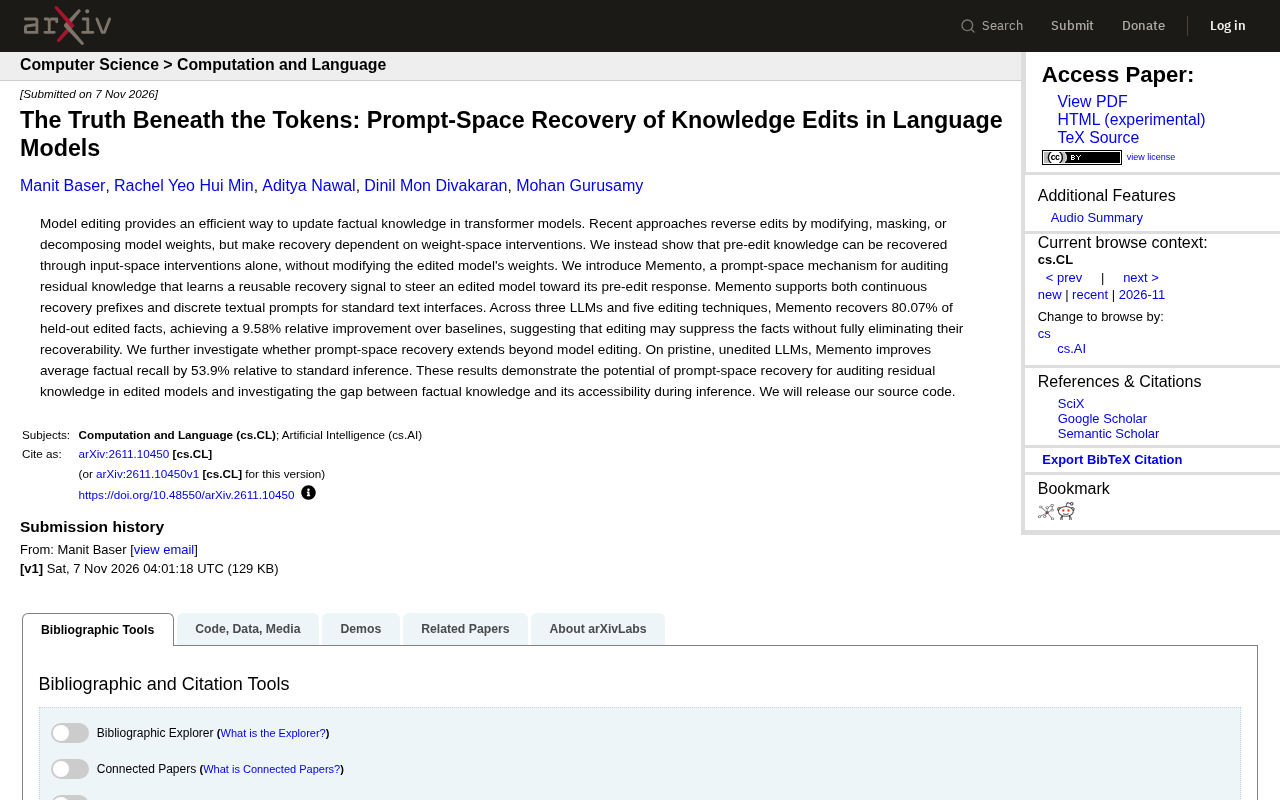
The paper proposes Memento, a prompt-space mechanism that recovers facts suppressed by knowledge editing without modifying model weights. It learns a reusable recovery signal supporting both continuous prefixes and discrete text prompts, recovering 80.07% of held-out facts across three models and five editing techniques (9.58% over baselines). On unedited models, it improves average fact recall by 53.9% over standard inference, revealing a general gap between factual knowledge and inference accessibility. This offers a black-box-friendly auditing dimension complementary to weight-space methods, though out-of-distribution generalization and unrecovered knowledge remain open questions.
Large language model knowledge editing techniques can efficiently update factual knowledge, but a key question remains unresolved: does the edited-out knowledge truly disappear from the model, or is it merely suppressed? A recent paper proposes a prompt-space mechanism called Memento that recovers most of the edited facts without modifying model weights. This research not only provides a new tool for model auditing but also reveals the gap between large models' factual knowledge and its accessibility.
The Hidden Concern of Knowledge Editing: Changing Weights Is Not Deleting Knowledge
The goal of model editing is to enable Transformer models to quickly update specific facts without retraining. Mainstream methods include directly modifying weights, masking, or decomposing weights, all of which intervene in weight space. When edits need to be undone or a model's residual knowledge audited, existing methods rely heavily on further weight interventions, which are often infeasible in real-world deployment—weight modifications may introduce side effects and are not applicable to black-box models.
The authors raise a fundamental counter-question: can pre-edit knowledge be recovered solely through input-space interventions? If possible, it suggests that editing operations may only suppress facts rather than completely eliminating their recoverability. This approach shifts knowledge editing auditing from weight space to prompt space, lowering the barrier to auditing.
Knowledge Editing is a technical direction that enables pretrained language models to quickly correct or update specific facts without retraining. Mainstream methods fall roughly into three categories: first, parameter-modifying approaches, such as directly locating and rewriting key-value memories in feed-forward layers (ROME and similar methods); second, meta-learning approaches, which train a hypernetwork to predict weight updates (e.g., MEND); and third, external memory approaches, which retain original weights and attach retrievable external modules. What these methods share is that interventions occur at the weight or model-structure level, so evaluating whether an edit succeeded typically only checks whether the post-edit output is correct. What Memento questions is precisely this evaluation paradigm: correct output does not equal deleted original knowledge—the model may simply have learned to suppress old answers under specific trigger conditions. This distinction is crucial for model auditing, because "suppression" means old knowledge may still be reactivated through other input paths.
Memento: Learning a Reusable Recovery Signal
At the core of Memento is a prompt-space mechanism that learns a reusable recovery signal to guide the edited model back to its pre-edit answers. The mechanism supports two forms: continuous recovery prefixes and discrete text prompts. The former suits scenarios requiring fine-grained control, while the latter can be used directly with standard text interfaces without access to model internal states.
The elegance of this design lies in the recovery signal being learned rather than manually crafted for each fact. This means the same mechanism can generalize across different facts and editing techniques. The authors validated Memento on three large language models and five editing techniques, showing it recovered 80.07% of held-out edited facts, a 9.58% improvement over baselines. This data indicates that a substantial proportion of edited facts remain latent in the model, merely unreachable by conventional inference.
Prompt Space refers to intervention methods that influence model behavior solely by constructing inputs without changing model parameters, typically represented by soft prompts, prefix tuning, and discrete prompt engineering. Compared with weight-space interventions, prompt space has the advantage of not requiring access to or modification of model internal parameters, making it equally applicable to black-box models and closed-source APIs. Continuous recovery prefixes are learnable vector sequences prepended to input embeddings, providing finer control signals than natural language; discrete text prompts are directly readable and reusable natural language strings, trading some effectiveness for interface compatibility. Memento learns recovery signals on a large number of "pre-edit—post-edit" fact pairs, yielding a general trigger independent of specific facts—which is exactly why it can generalize across facts and editing techniques.
Beyond Model Editing: The Universality of Prompt-Space Recovery
The research further asks: is prompt-space recovery only effective on edited models? The authors tested Memento on unedited original models and found an average fact recall improvement of 53.9% over standard inference. This result points to a more general conclusion: there is a significant gap between large models' factual knowledge and its accessibility during inference, and prompt-space interventions can narrow this gap.
In other words, models "know" more than they "say." Memento provides a means to probe this latent knowledge, which is methodologically significant for understanding the relationship between internal representations and output behavior.
Fact Recall here refers to the proportion of correct answers a model gives to a set of factual questions, a common metric for measuring a model's knowledge coverage. Standard inference typically uses direct questioning or few-shot prompting, requiring the model to retrieve answers from parametric memory in a single forward pass. When a model "knows but cannot answer," it is often because retrieval paths are not activated rather than knowledge being absent. This phenomenon echoes findings in probing research: the amount of information encoded in internal representations is usually greater than what generation outputs reveal. The recall improvement Memento brings to unedited models suggests prompt-space interventions can serve as "retrieval cues," guiding facts latent in parameters to the output side—providing an operational experimental means to distinguish "knowledge absence" from "knowledge inaccessibility."
Implications for Model Auditing and Trustworthy Deployment
The impact of this research may extend beyond academia. For scenarios requiring auditing of a model's knowledge state—such as confirming whether sensitive information has truly been removed or assessing the persistence of edits—Memento offers a black-box-friendly solution that requires no weight modification. It reminds practitioners that weight-space editing effects need cross-validation from input space; concluding that knowledge has been deleted merely because post-edit outputs look correct may be overly optimistic.
The authors state they will open-source the code, lowering the barrier to reproduction and follow-up research. As a new auditing dimension, prompt-space recovery is expected to complement weight-space methods and drive more reliable knowledge editing evaluation standards.
Limitations and Open Questions
The paper does not discuss in detail the generalization ability of recovery signals on out-of-distribution facts, nor whether it is equally effective in adversarial scenarios involving malicious edits. Moreover, the 80.07% recovery rate means some facts remain unrecovered—whether this knowledge is truly eliminated or requires stronger recovery strategies remains to be explored. The computational overhead and practical deployment costs of prompt-space recovery also need further evaluation.
One-line Summary
Memento uses a prompt-space mechanism to recover 80% of facts in edited models, revealing that knowledge may merely be suppressed.
Paragraph Summary
The paper proposes a prompt-space mechanism called Memento that recovers facts suppressed by knowledge editing without modifying model weights. It learns a reusable recovery signal supporting both continuous prefixes and discrete text prompts, recovering 80.07% of held-out facts across three models and five editing techniques—a 9.58% improvement over baselines. On unedited models, the mechanism also improves average fact recall by 53.9% over standard inference, indicating a general gap between large models' factual knowledge and inference accessibility. The research provides a black-box-friendly new dimension for model auditing that can complement weight-space methods, though out-of-distribution generalization of recovery signals and the status of unrecovered knowledge remain to be explored.
Related articles
97KB Single-File HTML Underwater World: A WebGPU Experiment in AI Programming
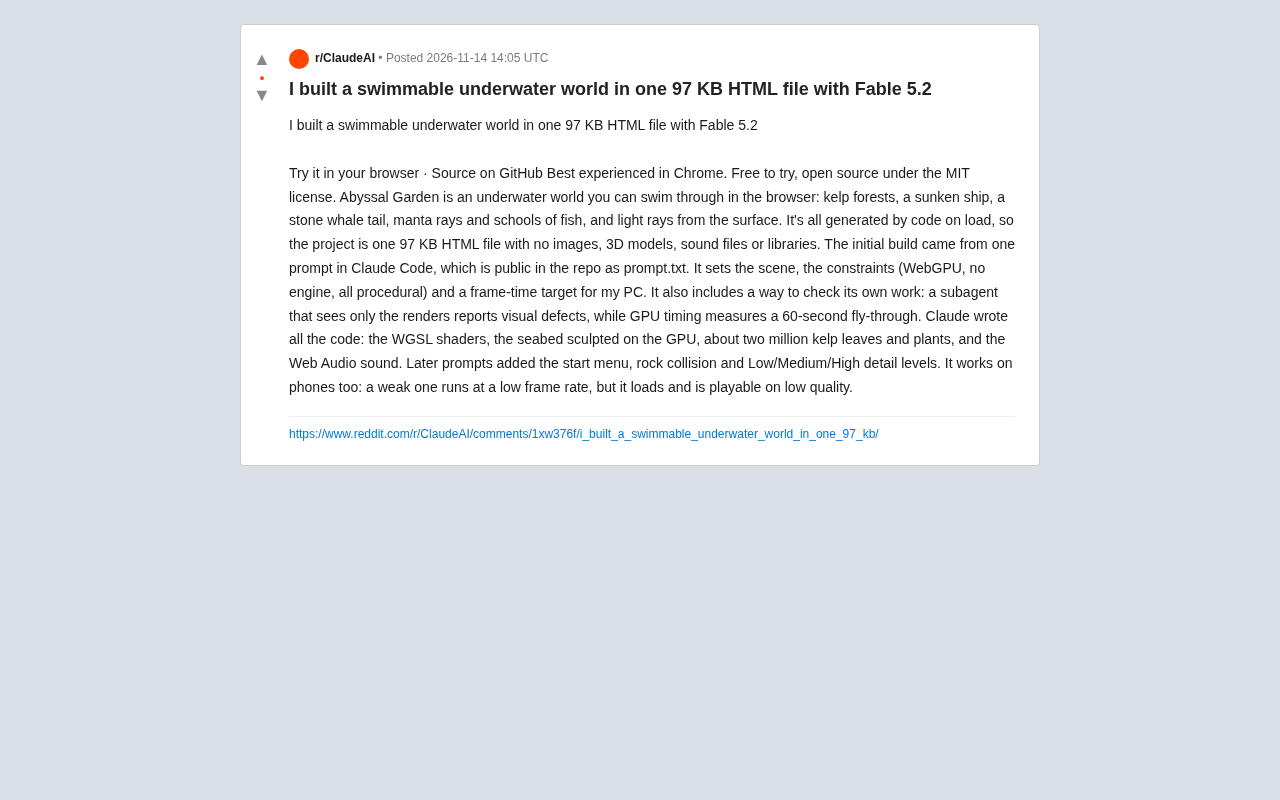
A developer used a single prompt in Claude Code to generate a 97 KB single-file HTML underwater world, fully procedurally generated with WebGPU—kelp forests, a shipwreck, and fish, no images or model libraries, MIT-licensed, playable on mobile.
Should Vercel Fork and Maintain Deno? Developer Community Debates
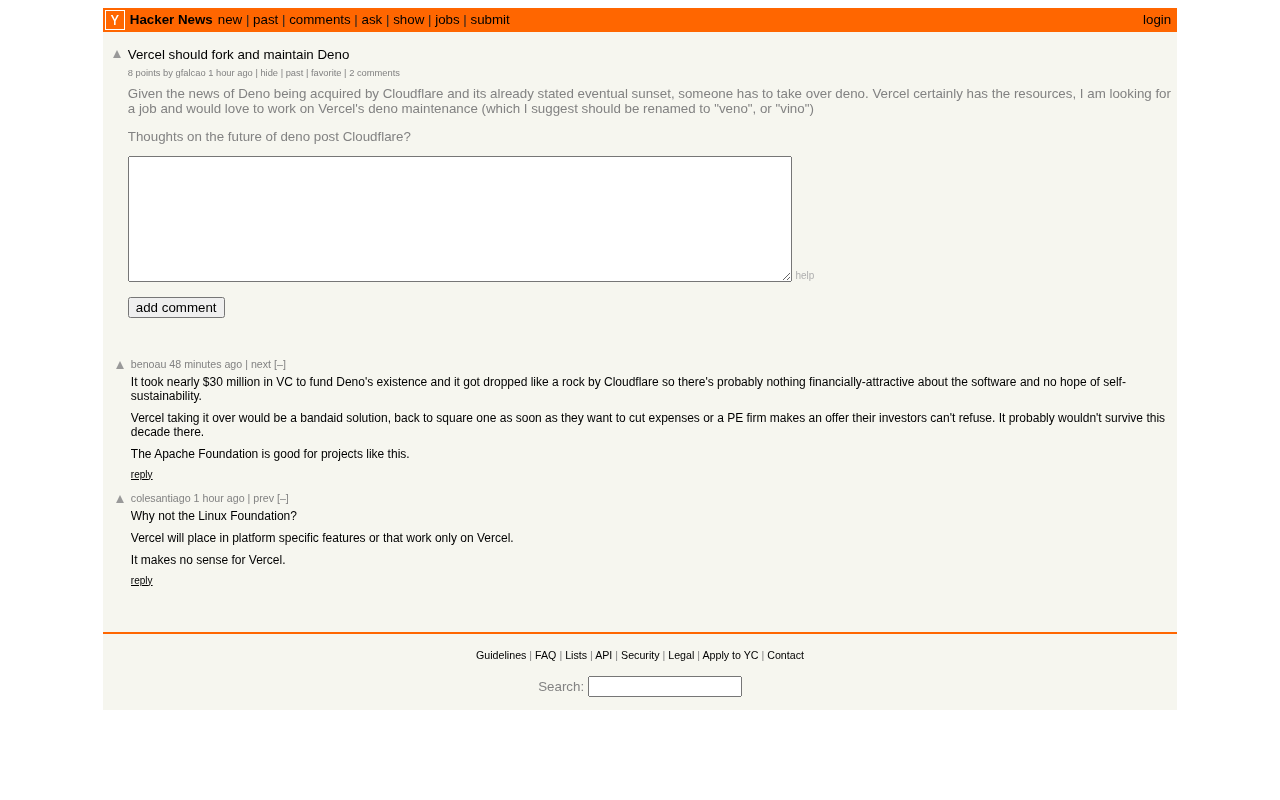
Hacker News debates whether Vercel should fork and maintain Deno. This article analyzes the runtime ecosystem competition behind the claim, the commercialization dilemma of open-source projects, and the practical impact of forking on developers.
Visually Deconstructing Reinforcement Learning: An Intuitive Guide to Core Concepts
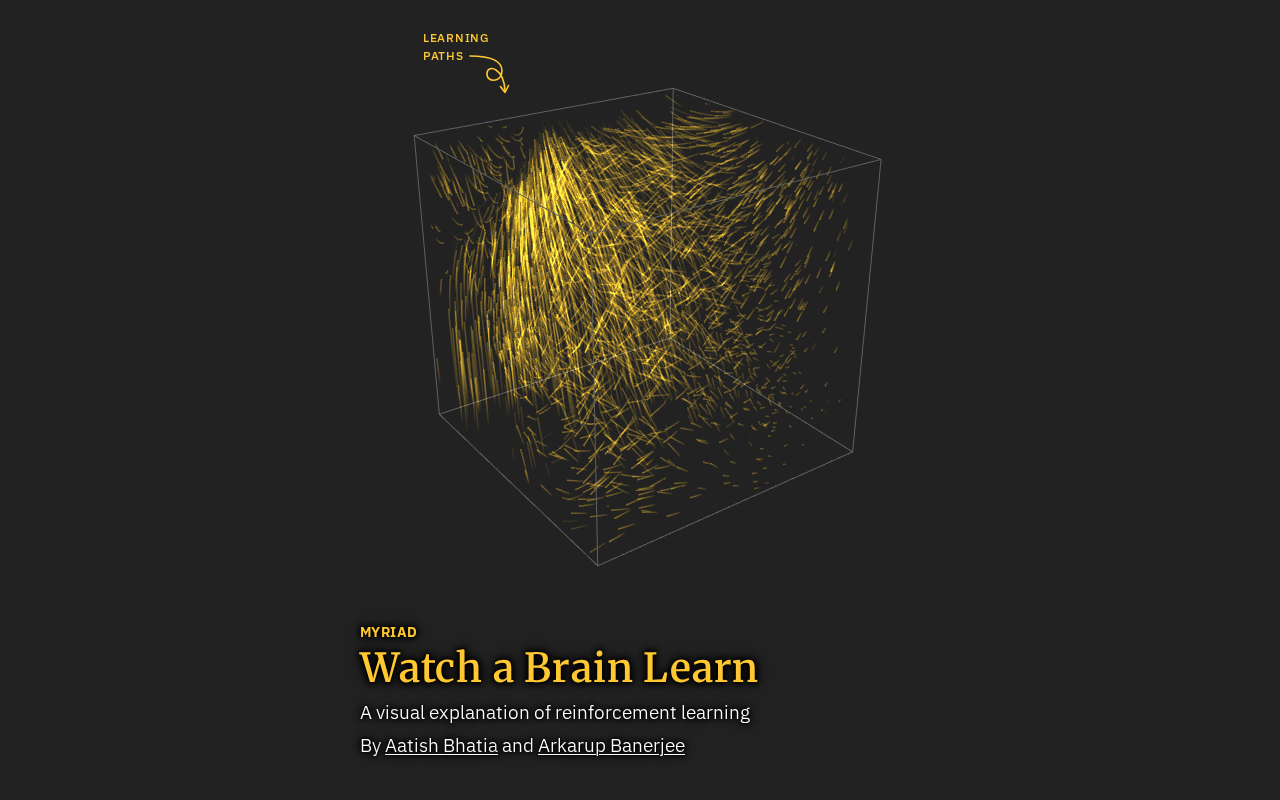
A visual guide to reinforcement learning's core concepts: the agent-environment loop, policies and value functions, and the exploration-exploitation trade-off. Ideal for beginners building intuition and lowering the barrier to RL.