Can Pure Functional Programming Approach C's Performance? An In-Depth Analysis
Pure functional programming narrows the performance gap with C through optimizations, but applicability depends on the scenario.
The article examines how close pure functional programming can get to C in performance, centering on the discussion sparked by Richard Feldman on Hacker News. Pure FP incurs overhead from immutable data and garbage collection, but optimizations like lazy evaluation, persistent data structures, and escape analysis can significantly narrow the gap. Benchmarks show Haskell and OCaml can approach C in numerical computation after optimization, while C retains advantages in memory layout control and bit manipulation; Erlang's lightweight processes also excel in high-concurrency throughput. The community disagrees on whether FP can fully replace C; the consensus is that the choice should be based on the problem domain, weighing performance, safety, and development efficiency.
Introduction: Rethinking the Performance Debate
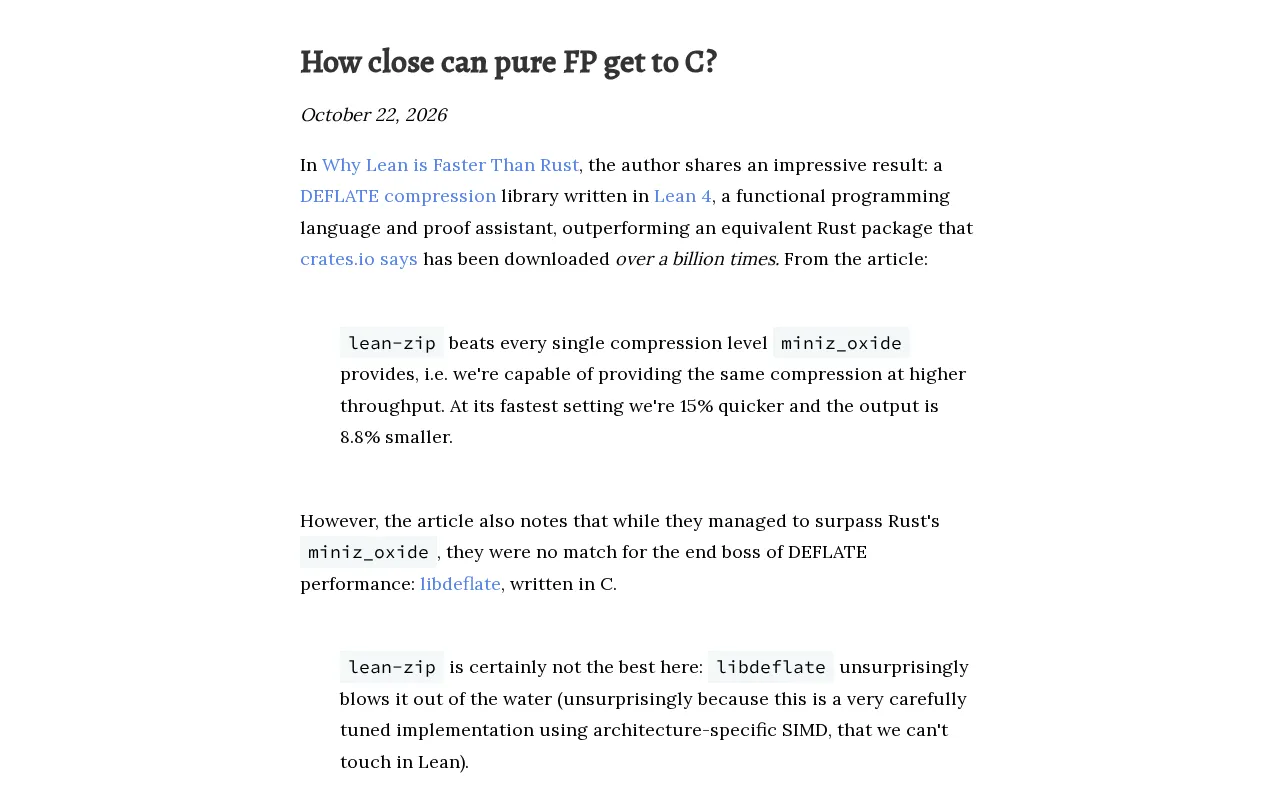
In the field of systems programming, C has long been regarded as the gold standard for performance. Pure functional programming (FP), with its immutability and high-level abstractions, is often questioned for its ability to match C in performance. Recently, developer Richard Feldman's article "How close can pure functional programming get to C?" sparked heated discussion on Hacker News, earning 208 points and 59 comments. Based on that discussion, this article delves into how close pure FP can get to C in performance and analyzes the technical trade-offs behind it.
The Root of the Performance Gap: Immutability and Memory Management
Pure functional programming emphasizes immutable data structures and referential transparency, which simplifies concurrent programming but also incurs performance overhead. Every modification requires creating new data, leading to frequent memory allocation and garbage collection (GC), whereas C allows manual memory management and in-place modification, making it more efficient.
However, modern FP languages narrow the gap through optimization techniques. For example, they use compiler optimizations (such as lazy evaluation and fusion) and persistent data structures to reduce unnecessary copying. According to discussions in HN comments, FP performance can approach C in certain scenarios, but it depends on the specific implementation and workload type.
Key Optimization Techniques
- Lazy evaluation: Avoids computing unused values, but may introduce overhead.
- Persistent data structures: Reduce copying costs through structural sharing.
- Escape analysis: The compiler converts heap allocations to stack allocations, reducing GC pressure.
Referential transparency is one of the core properties of pure functional programming, meaning that an expression can be replaced by its evaluated result without changing program behavior. This means function calls have no side effects, and the same input always produces the same output. The greatest benefit of referential transparency is equational reasoning: developers can derive and refactor code as if solving mathematical equations, and the compiler can more freely reorder, cache, or parallelize computations. However, this property is tightly bound to immutability—once state changes, a new value must be produced, and in-place updates are impossible, so the cost of allocation and copying is amplified for frequently updated data structures. Understanding referential transparency helps determine which performance overheads are inherent costs of pure FP and which can be eliminated through compiler optimization.
Structural sharing is the key mechanism by which persistent data structures achieve low copying costs. When an immutable data structure is modified, the system does not copy the entire content but reuses the unaffected parts, creating only a new path from the modification point to the root node. For example, inserting an element into a persistent balanced tree only requires copying O(log n) nodes, with the remaining subtrees shared through pointers. This keeps the overhead of a single update on the same order of magnitude as mutable structures while keeping old versions available. The cost of structural sharing lies in extra pointer indirection and poorer cache locality, which is one reason pure FP lags behind C on certain memory-intensive workloads.
Real-World Cases: Performance Comparison Between FP Languages and C
In the HN discussion, developers shared benchmark results. For example, numerical computation programs written in Haskell or OCaml, after optimization, perform on par with C but with more concise code. However, C still has the advantage when fine-grained control over memory layout or low-level bit manipulation is required.
You may not have noticed that pure FP languages such as Haskell provide a rich set of tuning options through their runtime system (RTS), but the learning curve is steep. Commenters pointed out that for highly concurrent network services, the lightweight process model of FP languages (such as Erlang) may surpass C in throughput, but latency behavior varies.
The Haskell Runtime System (RTS) is the execution engine behind GHC-compiled programs, responsible for scheduling green threads, managing generational garbage collection, and performing lazy evaluation. The RTS provides numerous runtime parameters, such as specifying the number of capabilities via -N to enable multicore parallelism, adjusting the allocation area size via -A to balance GC frequency and memory usage, and setting heap growth hints via -H. These options significantly affect performance, but the defaults may not suit all workloads, and tuning requires understanding the interaction between generational GC and parallel scheduling. OCaml's runtime, by contrast, uses a simpler two-generation GC with less tuning space but more predictable behavior. In comparison, C has no runtime overhead at all, but it also loses automatic memory management and lightweight concurrency primitives—a typical trade-off in which FP languages exchange runtime complexity for development efficiency and safety.
Community Perspectives: Divergence and Consensus
HN comments present two voices. One side believes that FP performance is already close enough to C, especially with clear advantages in development efficiency and safety; the other side emphasizes that C remains irreplaceable in domains with extremely high determinism requirements, such as embedded and real-time systems. The consensus is that FP's applicability depends on the problem domain, not on absolute performance.
Conclusion: The Choice Depends on the Scenario
Pure functional programming has made great strides in performance, but fully approaching C remains unrealistic. For most applications, FP performance is acceptable and can reduce the risk of concurrency errors. In systems-level programming, C or Rust remains the safer choice. Developers should weigh performance, safety, and development efficiency based on project requirements.
One-line Summary
Pure functional programming narrows the performance gap with C through optimization techniques, but its applicability depends on the specific scenario.
Paragraph Summary
The article examines how close pure functional programming can get to C in performance, centering on the discussion sparked by Richard Feldman on Hacker News. Pure FP incurs extra overhead due to immutable data and garbage collection, but optimizations such as lazy evaluation, persistent data structures, and escape analysis can significantly narrow the gap. Real benchmarks show that Haskell and OCaml, after optimization, can approach C in scenarios such as numerical computation, while C still holds advantages in memory layout control and bit manipulation; Erlang's lightweight processes also shine in high-concurrency throughput. The community disagrees on whether FP can fully replace C; the consensus is that the choice should be based on the problem domain, weighing performance, safety, and development efficiency.
Related articles

GitHub Daily · October 30: Skills Ecosystem Explodes, Agents Start Provisioning Their Own Computers
GitHub Daily Oct 30: Skills ecosystem hits three layers (official, personal, vertical), agents get their own computers, and cross-session memory becomes essential.
AWS AgentCore Gateway: Connecting AI A…
AWS AgentCore Gateway: Connecting AI Agents to Enterprise Backends with MCP
How AWS AgentCore Gateway acts as a primary MCP server to aggregate REST APIs, Lambda, and existing MCP services? Analyzing its AST real-time mapping, zero cold start, semantic search for tool overload, session isolation, and key injection security design, plus the architectural approach to decoupling enterprise AI agents from backends.

One Link Gives Figma AI a New Skill: Hands-On with MCP Connectors
Paste one MCP server link and the AI Agent in Figma gains new tool capabilities. We break down the setup flow, 20+ one-click apps, read/write permissions and execution policies, and the public HTTPS requirement.