Chit: Print Your Day in Claude Code as a Receipt

Chit turns your local Claude Code session logs into a daily standup-ready work receipt.
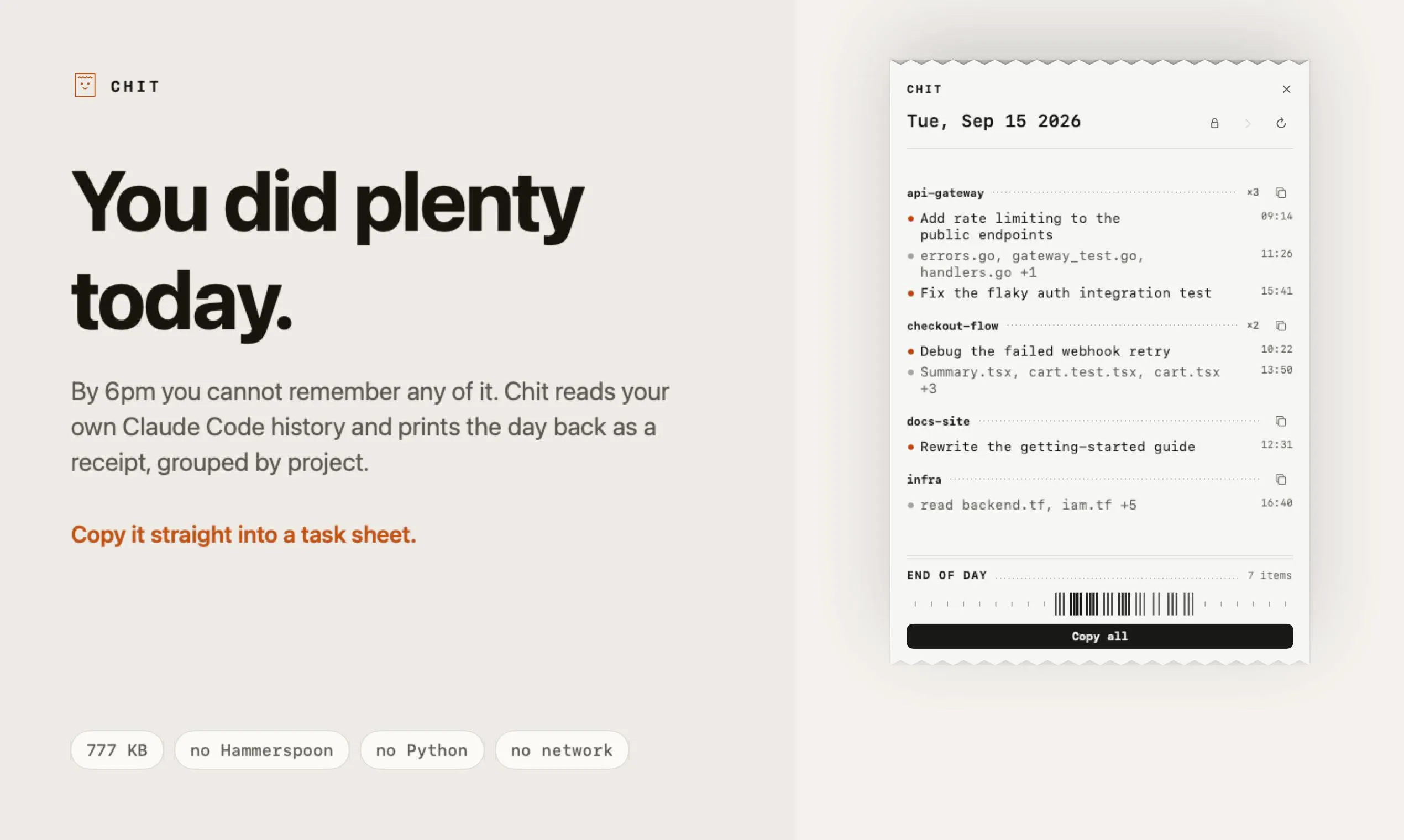
Chit is a lightweight Mac app (just 777KB) ranking third on Product Hunt, designed for heavy Claude Code users. It reads locally stored session transcripts, groups the day's work by project, and produces a structured "receipt" you can paste directly into standups. Its standout differentiator is privacy-first, zero-config design: no Hammerspoon, no Python, no account, and no network code in the binary — your data never leaves your machine.
A Mac Tool That's Only 777KB
As AI coding assistants become increasingly mainstream, developers are generating more and more interaction records with Claude Code — yet this data often sits scattered across disk, rarely put to any real use. Chit, a newcomer ranking third on Product Hunt, targets exactly this gap: it reads your locally stored Claude Code session transcripts and prints your entire day's work as a "receipt," grouped by project and ready to paste directly into your daily standup.
What immediately stands out is its size — the entire Mac app is just 777KB. In a modern app ecosystem where most tools weigh hundreds of megabytes, that number is a statement in itself.
Product Design Through a Minimalist Lens
Chit's core value proposition can be distilled into a single sentence: no Hammerspoon, no Python, no account, and zero network code in the binary.
Each of those "no's" reflects a deliberate product decision. No dependency on automation frameworks like Hammerspoon means install-and-run with zero configuration overhead. No Python runtime eliminates the dependency hell developers dread most. No account registration lowers the barrier to entry. And "no network code in the binary" is a fairly radical privacy commitment — your development records never leave your local disk, and data upload is architecturally impossible.
For developers working with sensitive code and commercial projects, this "purely local" design is far more convincing than any privacy policy statement. What the tool physically cannot do is excluded at the infrastructure level.
From Session Transcripts to Standup Updates
Chit's logic is straightforward: Claude Code generates transcripts on disk during use, and Chit reads that existing data — no additional instrumentation or monitoring required — then reorganizes the day's activity into a highly readable "receipt."
The project-grouped design is especially well-suited to real-world workflows. Developers routinely context-switch across multiple projects throughout the day, and recalling "what did I actually accomplish today" is a common pre-standup pain point. Chit effectively auto-generates a work log, transforming granular interaction records into a structured summary of outcomes.
Claude Code is Anthropic's command-line AI coding assistant, where developers converse directly in the terminal to write, debug, and refactor code. After each session, Claude Code saves a complete conversation transcript in JSON format to a local directory (typically under ~/.claude/), capturing user instructions, AI responses, executed commands, and code changes. These files are rarely reviewed by developers, yet they contain remarkably complete work context. Chit leverages this existing data infrastructure without inserting any hooks or monitoring into the Claude Code workflow — a classic "read, don't intrude" design philosophy.
Hammerspoon is a popular macOS automation tool that lets users control system behavior via Lua scripts, commonly used by developers to build keyboard shortcuts, window management, or workflow automation. Many similar productivity tools depend on Hammerspoon to leverage its system-level permissions for data collection or UI injection — but that requires users to install and configure a Hammerspoon environment first. Chit explicitly states it doesn't depend on Hammerspoon, meaning it retrieves data purely by reading disk files with no system-level hooks. This also explains how it can offer the hard privacy guarantee of "no network code in the binary" — the only data-access path is local file reading.
Who Needs Chit
The target user profile is quite clear: developers who use Claude Code heavily, need to report progress to their team, and care about keeping data local.
It solves a real but easily overlooked productivity problem — tracking and recalling your work output. As AI-assisted coding becomes routine, the human-AI collaboration process itself becomes a valuable record. Chit transforms process data that would otherwise be forgotten into ready-to-use reporting content.
With 122 upvotes and a third-place ranking on Product Hunt, this "small but beautiful" positioning has resonated with the community. It's listed across three categories — Mac, Productivity, and Developer Tools — and was built by indie developer Ravindra Sisodia.
The Indie Developer's Precision Strike
Chit is also a textbook example of how indie developers are building tools today: not chasing breadth, but zeroing in on a specific, high-frequency scenario and polishing the experience to a razor's edge with the lightest possible technical footprint. The 777KB size, purely local operation, and zero configuration together form a genuinely differentiated competitive position.
Against the backdrop of explosive growth in AI coding tools, the surrounding "companion ecosystem" — cost tracking, session analysis, output summaries — is emerging as a notable niche market. Chit offers an interesting perspective: the process data generated by AI is itself an untapped resource worth mining.
Wrap-Up
Chit uses a clever metaphor — "a receipt for your day" — to turn Claude Code session transcripts into a practical daily reporting tool. Its value lies not in technical complexity, but in its precise identification of a real developer pain point and its unwavering commitment to privacy and lightweight design. For developers who work with Claude Code every day, this might just be worth adding to your toolbox.
Related articles

Will GitHub Die? Open Source Maintainer Burnout and the Collaboration Crisis in the AI Era
Lex Fridman podcast discussion on open source maintainer burnout and GitHub's predicament: massive pull requests overwhelm core maintainers, and AI worsens code bloat. Using math journal peer review and Poincaré conjecture verification as analogies, the article analyzes why verification in knowledge production must be deliberately slow, and how open source communities can avoid the failure mode of maintainers exiting.

Stop Building Cookie-Cutter AI Websites: 3 Tools That Transform Your Coding Agent
Three tools that boost AI coding agents: FFmpeg skill for local video editing in Claude Code and Cursor, Hallmark's 50 design themes to fix cookie-cutter AI sites, and Jailbreaks' 25+ model prompts.

How America's Gerontocracy Squeezes the Younger Generation
Americans over 55 hold nearly three-quarters of national wealth, alongside an 80-year-old president and elderly congressional leaders. The Atlantic's Idrees Kahloon explains how gerontocracy drives up housing costs, squeezes opportunities for the young, and explores zoning reform and child poverty reduction as practical fixes.