Claude Adds Personal Finance Analysis: Connects to Bank Accounts, AI Reviews Your Statements Directly

Claude launches a Personal Finance tool that connects bank accounts via Plaid and analyzes personal finances in natural language.
Anthropic has launched a Personal Finance tool for Claude. Users can connect bank and credit card accounts through Plaid and directly ask about spending and financial status in natural language, with Plaid handling compliant data connectivity and Claude providing analysis. The article notes this marks LLM assistants moving toward personal decision support, but key details on privacy, pricing, and accuracy safeguards remain undisclosed, so users should verify authorization scope and data terms before connecting.
From Conversational Assistant to Financial Butler: Claude's New Personal Finance Skill
Anthropic's Claude is expanding its boundaries. According to the latest news, Claude has now launched a Personal Finance tool that lets users connect their bank accounts and credit card accounts to Claude via Plaid, and then directly ask the AI questions about their financial situation.
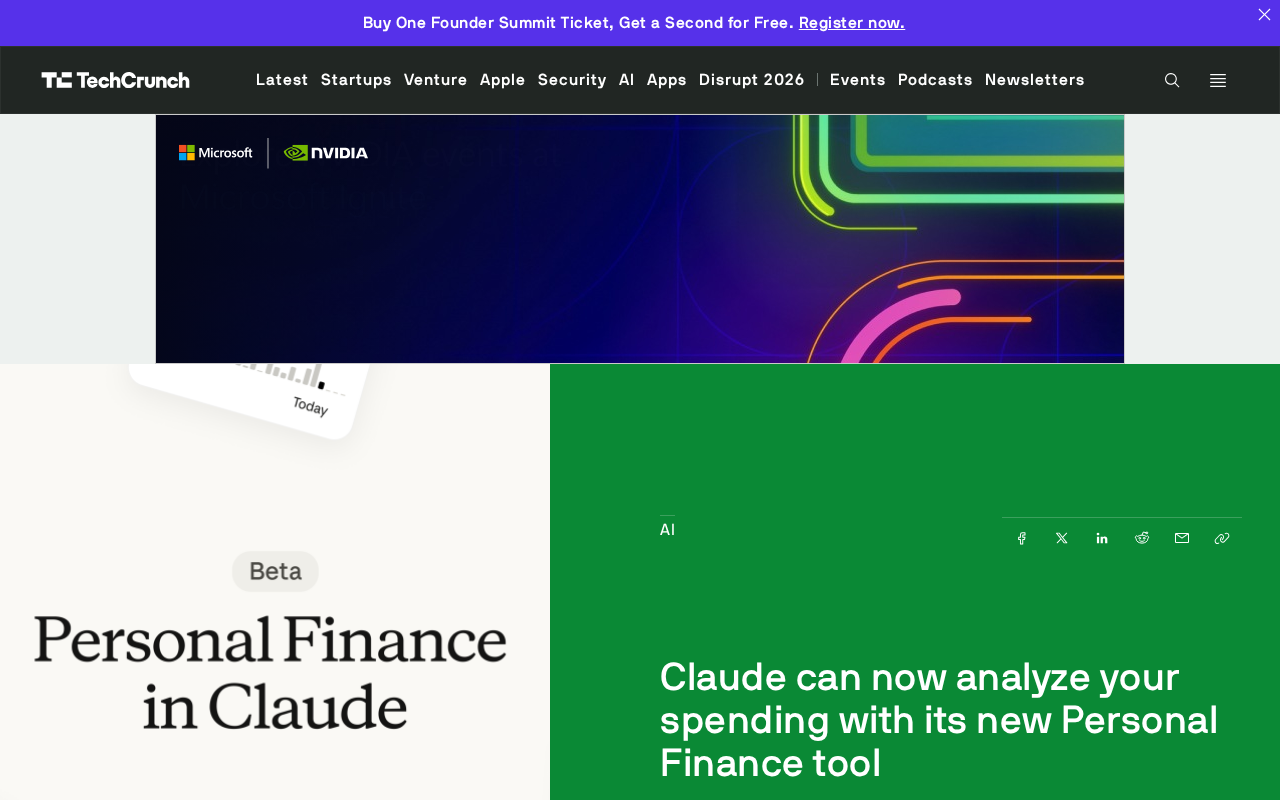
The core logic of this feature isn't complicated: Plaid, as a financial data aggregation service, is responsible for connecting bank and card account data with the user's authorization, while Claude plays the role of analyst. Users no longer need to export transactions and build spreadsheets themselves—they can simply ask about their spending in natural language and let Claude handle the interpretation.
Why This Matters
Connecting an AI assistant to real financial data means the LLM use case is moving beyond "information processing" toward "personal decision support." In the past, when users asked Claude about financial planning, they mostly got generic advice; after connecting accounts, answers can be based on real spending records. This shift from generic to personalized is an important step in the productization of AI assistants.
How the Feature Works: Plaid Connects, Claude Analyzes
According to the original information, users complete account connection through Plaid and can then ask Claude finance-related questions. Plaid is widely used account-connection infrastructure in the fintech space, and many personal finance apps rely on it for bank data integration. Using it as the underlying connection layer suggests that Claude's feature follows a relatively mature, compliance-oriented technical path.
Data Authorization and Privacy Boundaries
It should be noted that the original material does not disclose the specific design of this feature regarding data storage, access permissions, or privacy protection. For a product involving bank accounts, these details are crucial. Before trying it out, users should verify the scope of authorization and data processing terms themselves—how much data the AI can see, how long data is retained, and whether it is used for model training all require clear answers from the official side.
Plaid is a fintech company headquartered in San Francisco, founded in 2013, that mainly provides bank account data connection and verification services for third-party applications. Its core product is a set of APIs: after user authorization, Plaid can read bank account balances, transaction histories, account types, and other information on behalf of an app, without the app needing direct access to the user's bank login credentials. This model is widely adopted in personal finance, payment, and lending products in Europe and the United States, because it avoids the risk of users submitting account passwords to each app one by one and also relieves developers of the engineering burden of integrating separately with thousands of financial institutions. Plaid itself is not a bank; its data access permissions derive from agreements with institutions and explicit user authorization, so at the compliance level it is typically constrained by open banking regulations and financial regulatory frameworks.
Open Banking is the key regulatory backdrop for understanding such features. Represented by the EU's PSD2, the UK's Open Banking standard, and Section 1033 of the U.S. Dodd-Frank Act, regulators are gradually requiring banks to open account data to third parties with user authorization, while also specifying the scope, duration, and revocation mechanisms of authorization. This means products like Claude that access financial data are not operating without rules, but specific requirements vary greatly across jurisdictions: whether data can be used for model training, whether authorization needs periodic renewal, and how users can revoke access with one click—answers differ by location. When assessing risk, users can focus on whether the product clearly explains the granularity of authorization (e.g., balance only or transaction-level), whether it supports disconnecting at any time, and whether it states that data will not be used to train models.
Potential Impact on Personal Finance Scenarios
Several practical application directions can be derived from this feature: spending structure analysis, abnormal expense identification, monthly budget reviews, and more. Compared with traditional budgeting apps that require manual categorization, Claude's natural language interaction lowers the barrier to use—users don't need to learn complex report interfaces and can simply ask questions in everyday language.
Differences from Existing Financial Tools
Traditional personal financial management (PFM) tools emphasize data visualization, while Claude's advantage lies in "explanation" and "conversation." It doesn't just display charts; it can also provide context-relevant analysis in response to follow-up questions. This interaction style is friendlier to ordinary users who are not good at data analysis, but it also places higher demands on the accuracy of the AI's answers—mistakes in financial advice are far more costly than in ordinary Q&A.
Issues That Still Need Observation
The information disclosed so far is quite limited. The feature's specific coverage, supported countries and banks, whether it charges fees, and the mechanisms safeguarding the accuracy of AI analysis have not been explained. For a product involving financial data, these gaps mean users should remain cautious. It is advisable to follow the official privacy policy and terms of use released later before deciding whether to connect your own accounts.
Overall, Claude's Personal Finance feature represents the trend of LLM products penetrating personal data scenarios. The technical path is clear, but trust-building takes time and transparency.
One-line Summary
Claude launches a Personal Finance tool that connects bank accounts via Plaid and analyzes personal finances in natural language.
Paragraph Summary
Anthropic has launched a Personal Finance tool for Claude. Users can connect bank and credit card accounts through financial data aggregator Plaid, and then directly ask about spending and financial status in natural language. The core division of labor is that Plaid handles compliant account data connectivity while Claude takes on the role of analysis and interpretation, shifting answers from generic financial advice to personalized analysis based on real transactions and reducing reliance on traditional report interfaces. The article argues that this marks LLM assistants moving from information processing toward personal decision support, but also notes that the original information does not disclose key details such as data storage, privacy protection, pricing, supported scope, and accuracy safeguards. Users should confirm authorization scope and data processing terms before connecting, and trust-building still requires time and transparency.
Related articles

Anthropic Fable 5.2 Hands-On: 3A Games and Excel Clones from One Prompt
Anthropic Fable 5.2 hands-on: three-line prompts generate a playable Gears of War clone, a full Excel clone, and a DaVinci Resolve clone. Benchmarks, Ultra Code mode, token costs, and pricing analyzed — is it worth replacing Opus 5.5?

RL Racing Agent Stuck Against the Wall? Try These Recovery Strategies
RL racing agent stuck against walls? We analyze recovery data, observation limits, and action space, comparing DAgger, behavior cloning, and SAC with diagnostic experiments.

Giving AI Agents Long-Term Memory: A New Approach to Supply Chain Disruption Decisions
A developer uses Hindsight to build persistent memory for a supply chain AI agent, enabling retrieval of past disruptions and decision outcomes. The article analyzes its architecture, memory retention and recall design, and engineering challenges such as what to remember and how to evaluate memory effectiveness.