Claude Code Source Leak Breakdown: Hands-On with the Harness Agent Architecture
The Claude Code source leak reveals key engineering points of enterprise agent Harness architecture and sandbox isolation.
Based on a Bilibili live stream, this article traces the Claude Code source leak (an NPM release included a MAP file pointing to an R2 bucket with unobfuscated TypeScript source, about 510,000 lines across 1,902 files), and highlights Harness Engine as a new enterprise agent architecture. It also covers sandbox isolation as the biggest challenge in building an Open Claude, and offers three developer takeaways.
Introduction: An Agent Architecture Lesson Sparked by a Leak
A live stream on Bilibili used "Claude Code source leak-level breakdown" as its entry point to introduce a key concept in current enterprise AI development—Harness Engine. The presenter, Xiao Bin (who says he has worked in AI since 2019 and teaches AI large model courses on Bilibili and at the Mashi Education Group), started from the late-March source leak news and ultimately landed on the agent software architecture that is "a must-learn for programmers transitioning into AI."
This article, based on the live stream content, sorts out the ins and outs of the leak, the positioning of the Harness architecture, and the practical thread from sandbox isolation to enterprise-level project implementation.
Event Recap: How the Claude Code Source Code Leaked
According to the live stream, at the end of March, a programmer inside Anthropic included a MAP mapping file when publishing a package to NPM. This mapping file pointed to an Anthropic R2 storage bucket containing unobfuscated TypeScript source code, exposing the source code directly to the public internet.
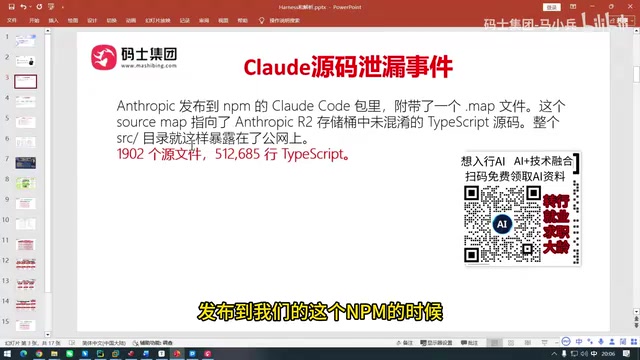
As for the scale of the leak, the number given in the live stream was 1,902 source files in total, about 510,000 lines of code. The presenter emphasized that this was not the complete Claude Code codebase, but the core portion of it. After the incident, the community quickly followed up, and a GitHub project read through nearly all of the leaked source code and produced a systematic summary, organizing the core mechanisms and software architecture highlights by directory.

This detail is worth pondering: a slip-up in the release process laid the engineering implementation of a closed-source product bare before the public. For developers, it amounts to getting an "architecture reference book for a big-tech agent product"; for the vendor, it is a costly lesson in supply chain security.
Source Map (MAP mapping file) is a common artifact of front-end engineering builds, usually generated by TypeScript/JavaScript bundlers to map minified and obfuscated code back to the original source, making it easier to locate error line numbers during online debugging. The problem is that Source Map files contain a sourcesContent field or paths pointing to the original files; once they enter the public NPM registry along with a published package, anyone who downloads the package can restore source code close to its original form. The correct practice is to exclude .map files in the production release process, or upload Source Maps to a private error monitoring platform rather than a public repository. This is precisely the technical root of this leak: a build configuration oversight, combined with a release process lacking artifact auditing, exposed unobfuscated TypeScript source code in full through a public link to an R2 storage bucket.
Harness Engine: A New Software Architecture for Enterprise Agents
The core takeaway of the live stream was Harness Engine. The presenter's judgment was that in the future, enterprise environments will most likely adopt a Harness-style Engine software architecture, describing it as "the newest and most cutting-edge large model technology at present."
From the context of the live stream, it can be inferred that Harness is not a specific model, but a layer of agent runtime framework wrapped around the model—an overall software architecture responsible for scheduling, isolation, tool invocation, and engineering encapsulation. The reason Claude Code's source code was broken down layer by layer is precisely that it is a highly complete sample of this kind of architecture: from the source structure, you can see how a production-grade agent product organizes its core mechanisms and handles boundary issues.
This is also where the "programmers transitioning into AI" narrative lands: knowing how to call APIs is only the starting point; being able to understand and build the engineering skeleton of the Harness layer is the AI engineering capability enterprises truly need.
Harness borrows the metaphor of horse tack: the model is the "horse" providing power, and the Harness is the complete set of tack that transmits that power to specific tasks. In the context of agent engineering, it usually refers to a runtime framework outside the model, covering prompt and context organization, registration and execution of tool/function calls, multi-turn loops and stopping conditions, permissions and sandbox boundaries, logging and observability, error retries, and more. Similar concepts include Agent Runtime, Agent Scaffold, or Orchestration Layer. The industry emphasizes this layer because the same model can differ significantly in task completion rates under different Harnesses—the framework determines what context the model can see, which tools it can call, and how it recovers from errors, so it often affects final product performance more than simply swapping models.
Sandbox Isolation: The Biggest Difficulty in Building an Open Claude
One particularly realistic segment of the live stream was the presenter sharing his experience developing "Open Claude" for the first time. He admitted that he had publicly said he would do this, and that after actually getting started, the biggest difficulty he encountered was the sandbox problem, which he said was finally fully resolved the day before the live stream.
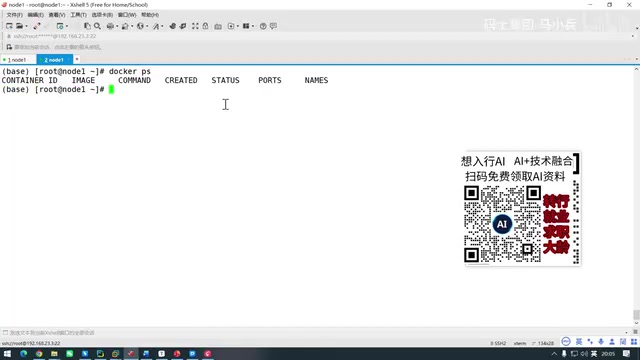
For the demo, he prepared an experimental environment simulating a real enterprise environment: on Windows, he created a new CentOS Linux operating system in VMware to simulate a sandbox container in an enterprise environment. At the time of the demo, the Docker container was still empty, indicating that the environment had been set up from scratch that day.
The engineering significance of this segment is that for an agent to execute code and call tools, it must be constrained within an isolated environment. A sandbox is not optional; it is a prerequisite for enterprise deployment—it determines the blast radius when the Agent makes a mistake. The core mechanisms covered in the source code breakdown ultimately all come down to the concrete question of "how to run safely within isolation boundaries."
Sandbox in agent scenarios usually refers to an isolated execution environment implemented based on containers or lightweight virtual machines, with typical technologies including Docker containers, gVisor, Firecracker microVM, and others. Its core goal is to limit the execution scope of Agent-generated code: file system reads and writes are confined to mounted directories, network access can be disabled or routed through a whitelist proxy, CPU/memory/runtime quotas are set, and process privileges are reduced to a regular user. The difficulty lies in balancing isolation strength and usability—if isolation is too strict, the Agent cannot install dependencies or access necessary services; if it is too loose, a single incorrect command could affect the host machine or the corporate intranet. Therefore, enterprise-level solutions usually also need snapshot rollback, operation auditing, and human approval processes to form defense in depth.
Takeaways for Developers
Several judgments valuable for AI engineering practice can be drawn from this live stream:
- When reading source code, look at the architecture layer: reading 510,000 lines line by line is unrealistic; the community summary version, organized by core mechanisms and architecture highlights, is a more efficient entry point;
- Harness is a capability watershed: as model capabilities converge, differences in engineering frameworks will become the main source of product differentiation;
- Sandbox first: enterprise-level agent projects should treat the isolated environment as a first-priority design item, not an after-the-fact patch.
The live stream focused mainly on conceptual explanation and demonstration, with limited expansion of source-level technical details; the specific module division and interface design of Harness still need to be further completed with the help of community-organized materials.
One-line Summary
Claude Code's source leak reveals key engineering points of enterprise agent Harness architecture and sandbox isolation.
Paragraph Summary
Based on a Bilibili live stream, this article traces the Claude Code source leak: an Anthropic programmer included a MAP mapping file in an NPM release that pointed to an R2 storage bucket holding unobfuscated TypeScript source code, involving 1,902 files and about 510,000 lines of code, which a community GitHub project has already systematically broken down. The core takeaway of the live stream was Harness Engine—an agent runtime framework wrapped around the model, responsible for scheduling, isolation, and tool invocation, regarded as a new software architecture for enterprise AI. The presenter also shared that sandbox isolation was the biggest difficulty in building his own Open Claude, and demonstrated it using a VMware + CentOS + Docker environment simulating enterprise infrastructure. The article concludes with three developer takeaways: look at the architecture layer when reading source code, Harness is a capability watershed, and sandbox first.
Related articles
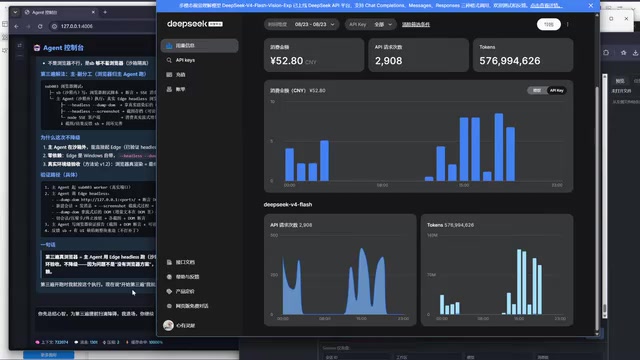
The Harness Is the Core of an Agent: Three Keys to Industrial-Grade Multi-Agent Deployment
From a Bilibili hands-on demo, we analyze why the Harness is the core of an Agent: Master-Worker dual-Agent architecture, mindset consistency constraints, three autonomous iterations, and reusable framework essentials for industrial multi-Agent deployment.
Zero-Cost Claude Code: A Guide to Configuring ModelScope's Free API
A Bilibili creator shares how to use ModelScope's free API quota with VS Code and the SystemService protocol conversion tool to call domestic models like DeepSeek in Claude Code at zero cost. Includes a five-step setup, model selection tips, and three common pitfalls to avoid.
Pi Agent: A Practical Guide to a Minimalist Open-Source Coding Agent
Pi Agent is a minimalist open-source coding agent benchmarked against Codex and Claude Code, with growing GitHub Stars. Learn its rise, design philosophy, and a practical path from principles to extensions.